
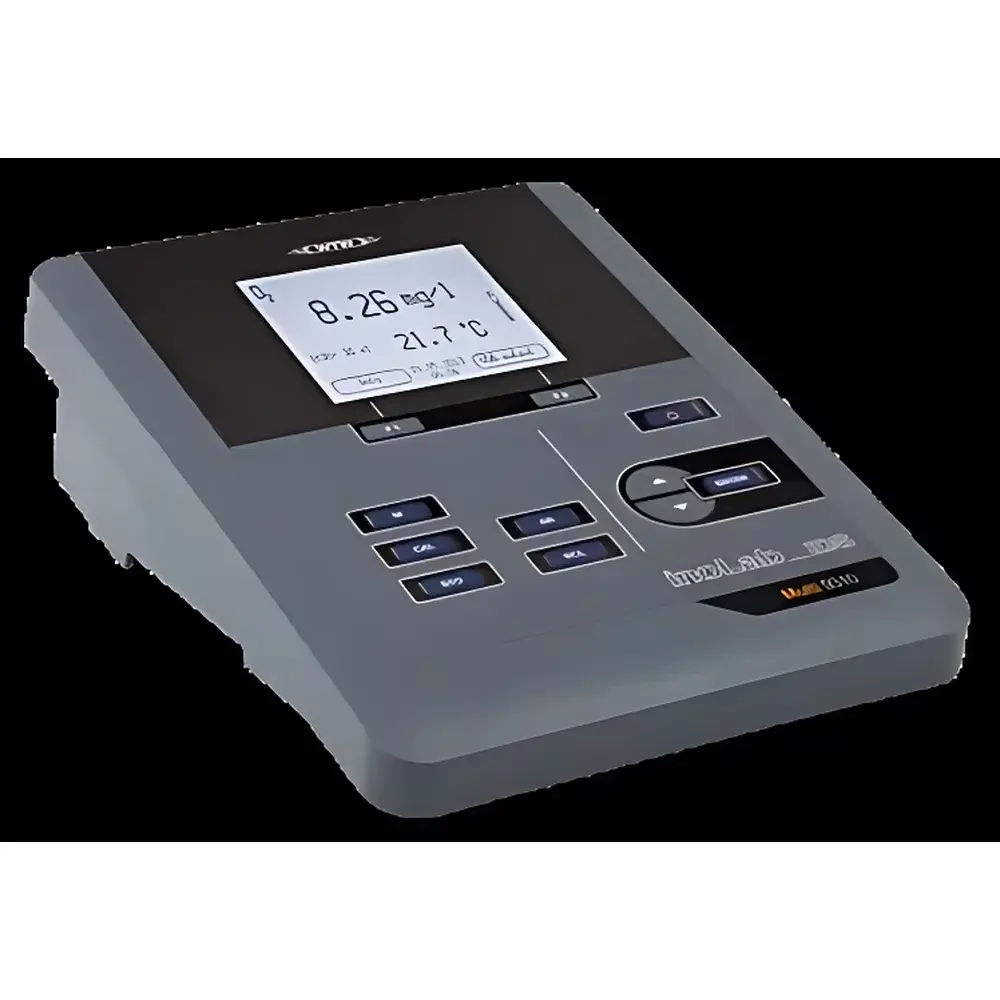
WTW Multi9310 Multiparameter Meter
| Brand | WTW |
|---|---|
| Origin | Germany |
| Model | Multi9310 |
| Instrument Type | Laboratory Benchtop Meter |
| Temperature Range | 0–80 °C |
| pH Range | 0.000–14.000, Accuracy: ±0.002 |
| Dissolved Oxygen (DO) | 0.00–20.00 mg/L, Accuracy: ±0.5% |
| Conductivity | 10 μS/cm–2000 mS/cm, Accuracy: ±0.5% |
| Turbidity | 0–4000 FNU, Accuracy: ±2% |
Overview
The WTW Multi9310 Multiparameter Meter is a high-precision, laboratory-grade benchtop instrument engineered for simultaneous, traceable measurement of five conventional water quality parameters: pH, redox potential (ORP), dissolved oxygen (DO), electrical conductivity (EC), and turbidity. Designed in accordance with ISO 5667 (water sampling), ISO 7027 (turbidity), ISO 5814 (electrochemical DO), and EN ISO 11885 (pH and conductivity), the Multi9310 integrates digital sensor architecture with embedded metrological traceability to support compliance-driven workflows in environmental laboratories, municipal water testing facilities, and academic research settings. Its core measurement principles include potentiometric pH/ORP detection using temperature-compensated glass or solid-state electrodes, polarographic or optical DO sensing (depending on probe configuration), four-electrode conductivity measurement for extended range and reduced polarization error, and infrared 90° scattered-light detection for FNU-compliant turbidity assessment. The instrument operates as a centralized data acquisition hub—accepting interchangeable digital sensors via standardized M12 connectors—and eliminates manual calibration entry through automatic probe recognition and onboard EEPROM-stored calibration history.
Key Features
- Digital Smart Probe Interface: Automatically detects connected ISM (Intelligent Sensor Management) probes; reads and applies stored calibration coefficients, serial numbers, and service history without user input.
- QSC (Quality Sensor Control) Function: Continuously monitors electrode impedance, membrane integrity (for DO probes), and reference junction stability—displaying real-time diagnostic status and recommending maintenance or recalibration when thresholds are exceeded.
- CMC (Continuous Measurement Control): Validates each measurement against internal plausibility algorithms (e.g., temperature-pH correlation, saturation-based DO limits) and flags outliers before data logging, ensuring analytical integrity per GLP requirements.
- Backlit Graphic LCD Display (128 × 64 pixels): Supports multilingual UI (English, German, French, Spanish), dual-parameter simultaneous view, and intuitive icon-based navigation—even with gloves.
- Antimicrobial Keypad: Surface-treated with silver-ion technology to inhibit microbial growth in high-humidity lab environments, supporting ISO 14644 cleanroom-adjacent handling protocols.
- Expandable Probe Architecture: Accepts any combination of WTW’s digital pH, ORP, DO, EC, and turbidity probes—including optional analog adapter modules for legacy glass pH electrodes—enabling method-specific configuration without hardware replacement.
Sample Compatibility & Compliance
The Multi9310 accommodates aqueous samples across a broad physicochemical spectrum: from ultrapure water (18.2 MΩ·cm) to hypersaline brines (>100 g/L NaCl), activated sludge supernatants, surface runoff, and drinking water distribution systems. Its turbidity module meets ISO 7027 Class 1 performance criteria for formazin-based calibration traceability, while DO measurements comply with ISO 5814:2012 for electrochemical sensors and ASTM D888 for membrane-covered amperometric cells. All calibration and measurement data adhere to ALCOA+ principles (Attributable, Legible, Contemporaneous, Original, Accurate, Complete, Consistent, Enduring, Available) and support audit-ready reporting under FDA 21 CFR Part 11 when paired with WTW LabX software (optional). The device carries CE marking per Directive 2014/30/EU (EMC) and 2014/35/EU (LVD), and conforms to IEC 61000-4-2/3/4/6 immunity standards for laboratory electromagnetic environments.
Software & Data Management
Data storage capacity: 10,000 timestamped measurement records with full metadata (probe ID, calibration date, operator ID, temperature, ambient pressure for DO correction). Internal memory supports CSV export via USB-A port to flash drives; no proprietary drivers required. Optional LabX Direct software enables automated report generation (PDF/Excel), electronic signature integration, and secure network synchronization with LIMS via TCP/IP or OPC UA. Audit trails record all user actions—including calibration edits, parameter changes, and data deletions—with immutable timestamps and operator authentication. Raw sensor output (e.g., mV, µA, frequency) is retained alongside processed values, facilitating retrospective uncertainty budgeting per GUM (Guide to the Expression of Uncertainty in Measurement).
Applications
- Regulatory compliance testing for EU Drinking Water Directive (2020/2184) and US EPA Method 180.1 (turbidity), 365.1 (conductivity), and 360.1 (pH).
- Benchmarking of wastewater treatment plant influent/effluent streams against ISO 10523 (pH), ISO 15839 (DO sensors), and ISO 7888 (conductivity).
- Method validation and instrument qualification (IQ/OQ/PQ) per ISO/IEC 17025:2017 Annex A.3.
- Long-term stability studies of sensor drift under controlled temperature/humidity chambers.
- Educational use in environmental chemistry labs requiring NIST-traceable calibration verification and student-accessible diagnostics.
FAQ
Does the Multi9310 support automatic temperature compensation for all parameters?
Yes—each digital probe performs on-sensor temperature measurement; the meter applies parameter-specific algorithms (e.g., Nernst equation for pH, Stokes-Einstein for viscosity-corrected conductivity) without manual input.
Can I use non-WTW analog pH electrodes with this meter?
Yes—via the optional Analog Adapter Module (Art. No. 200000), which provides BNC input, adjustable mV offset, and automatic temperature compensation using an external Pt1000 sensor.
Is firmware upgrade possible in the field?
Yes—upgrades are delivered as signed .bin files via USB stick and require administrator password authentication to preserve regulatory compliance integrity.
What is the maximum allowable sample temperature for turbidity measurement?
40 °C—exceeding this may cause condensation on the optical window or alter particle settling kinetics, violating ISO 7027 preconditioning requirements.
How does QSC differ from traditional calibration due dates?
QSC evaluates real-time electrochemical health—not elapsed time—so calibration intervals adapt dynamically to actual probe usage, reducing unnecessary recalibrations while maintaining measurement confidence.
Related Products







