
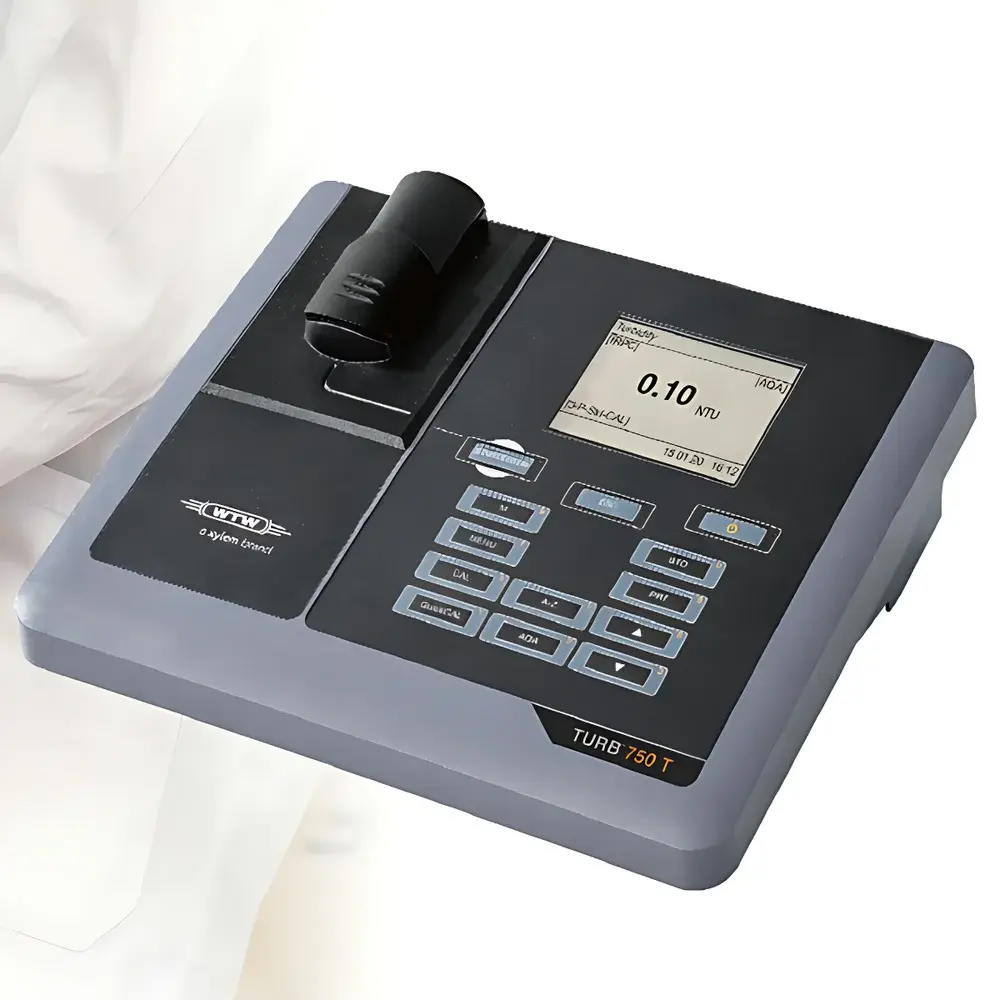
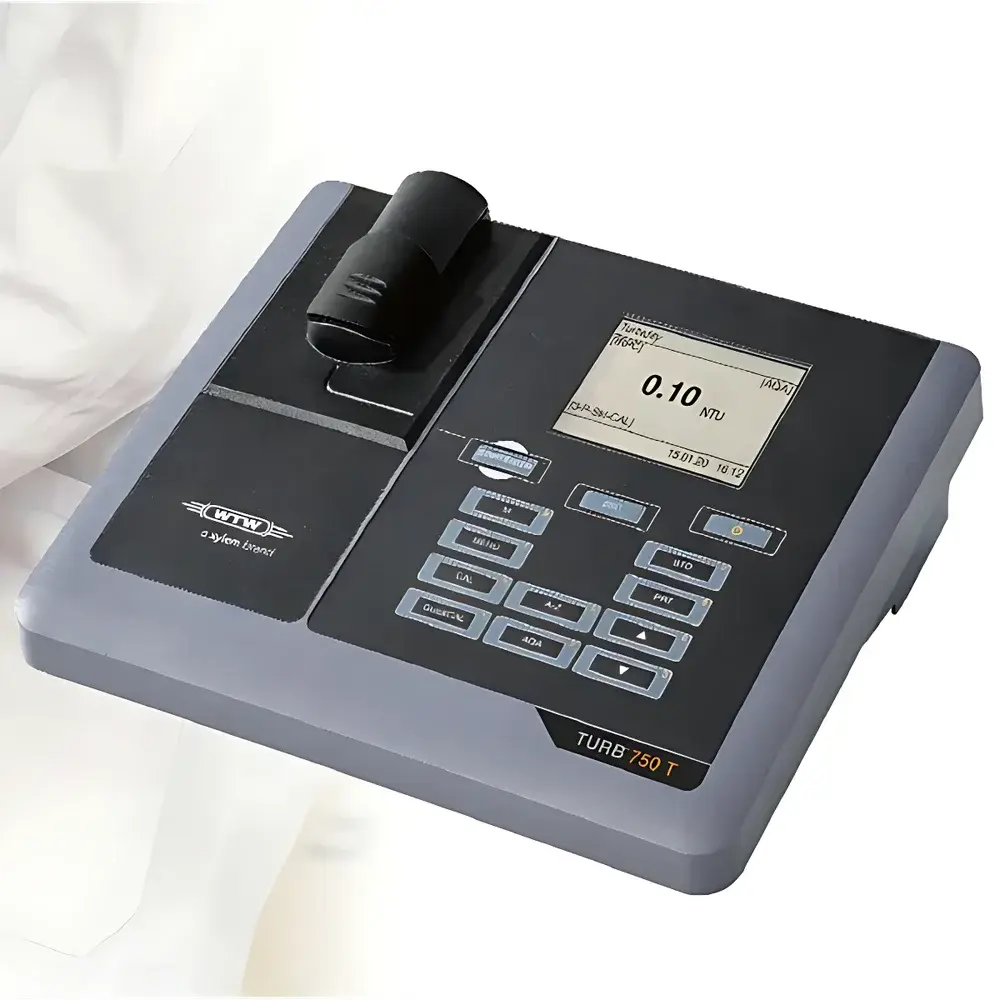
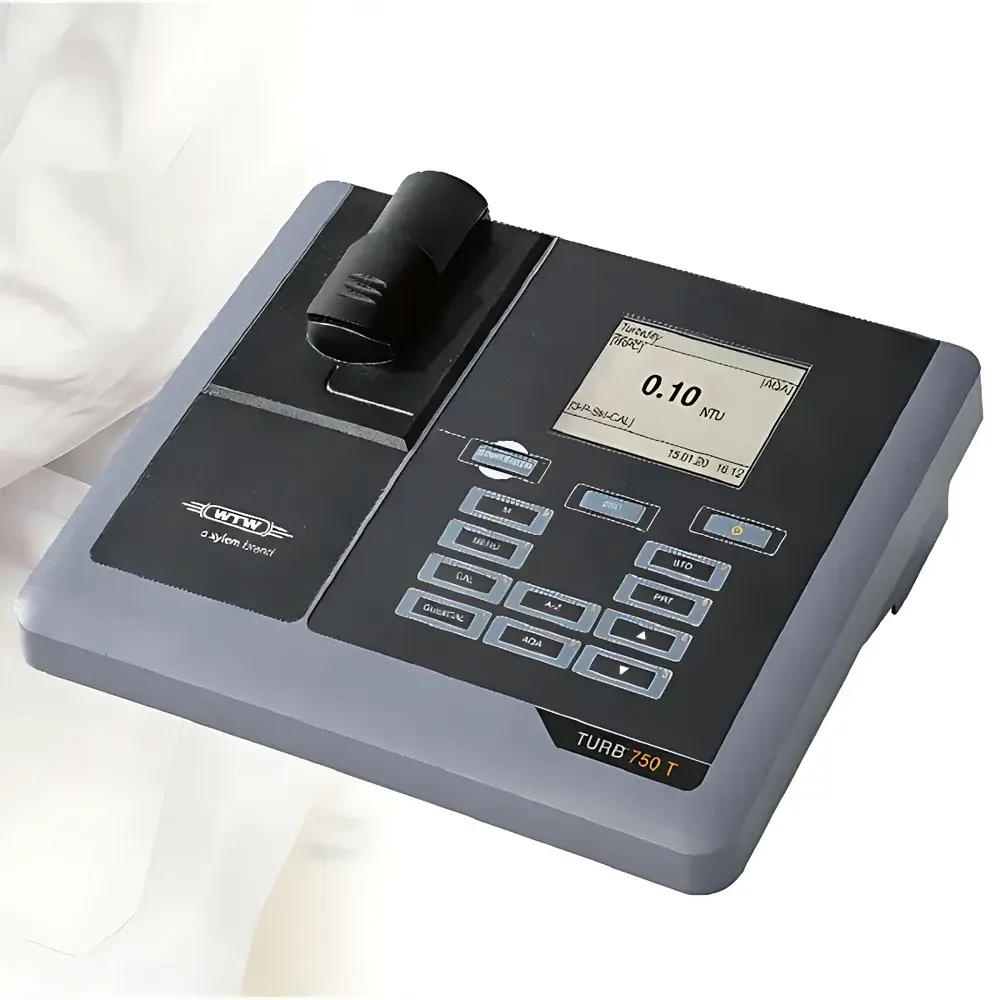
WTW Turb 750IR Infrared Turbidimeter (Model 600120)
| Brand | WTW |
|---|---|
| Origin | Germany |
| Model | 600120 |
| Instrument Type | Benchtop Laboratory Turbidimeter |
| Measurement Range | 0–1100 FNU/NTU |
| Resolution | 0.01 FNU/NTU (0.00–9.99), 0.1 FNU/NTU (10–99.99), 1 FNU/NTU (100–1100) |
| Operating Temperature | +5 to +55 °C (41–131 °F) |
| Accuracy | ±0.01 FNU/NTU or ±2% of reading (±3% at 500–1100 FNU/NTU) |
| Compliance Standard | DIN EN ISO 7027-1 |
| Light Source | Infrared LED |
| Detection Angle | 90° Nephelometric Scattering |
| Display | Backlit Graphic LCD (160 × 104 pixels) |
| Data Storage | 2500 datasets with calibration protocols and AQA flags |
| Interface | USB, RS-232, optional printer |
| GLP Support | Full audit trail, user ID, sample ID, calibration interval tracking, electronic signatures via Turb Data software |
Overview
The WTW Turb 750IR Infrared Turbidimeter (Model 600120) is a precision benchtop instrument engineered for high-reproducibility turbidity measurement in compliance with DIN EN ISO 7027-1. It employs infrared nephelometry at a fixed 90° detection angle, eliminating spectral interference from sample coloration—critical for applications in potable water, wastewater, pharmaceutical process streams, beverage production (e.g., wine and beer), food processing, aquaculture, and industrial effluent monitoring. Unlike white-light turbidimeters, the 850 nm infrared LED source minimizes absorption artifacts in yellow- or brown-tinted samples, ensuring traceable, matrix-robust quantification across the full 0–1100 FNU/NTU range. The instrument’s optical architecture is factory-aligned and thermally stabilized to maintain signal integrity over extended operation within its specified ambient range (+5 to +55 °C).
Key Features
- Infrared 850 nm LED light source compliant with DIN EN ISO 7027-1 for color-independent turbidity assessment
- Three-tier resolution switching: 0.01 FNU/NTU (0–9.99), 0.1 FNU/NTU (10–99.99), and 1 FNU/NTU (100–1100) — automatically applied per measurement range
- Integrated Advanced Quality Assurance (AQA) framework: configurable calibration intervals, tolerance thresholds, automatic flagging of out-of-spec measurements, and real-time AQA status indicators on display
- AMCO Clear polymer microsphere calibration standards (0.02, 10.0, and 1000 FNU/NTU) included—NIST-traceable, non-toxic, chemically inert, and stable for >5 years without drift
- IRPC (Intelligent Response and Precision Control) algorithm enabling rapid stabilization (<4 s response time) and adaptive compensation for settling or flocculating suspensions
- Full GLP-compliant data management: timestamped datasets include sample ID, operator ID, calibration protocol ID, AQA pass/fail status, and environmental metadata (ambient temperature, instrument serial number)
- Robust mechanical design: borosilicate glass cuvettes (28 mm diameter, 15 mL minimum volume), PTFE-coated rubber seals, phenolic caps — no silicone oil required for scratch mitigation
Sample Compatibility & Compliance
The Turb 750IR accommodates liquid samples up to 70 °C and is validated for use with clarified drinking water, filtered wastewater, fermentation broths, pharmaceutical suspensions, and low-viscosity food emulsions. Its infrared detection geometry meets statutory requirements under EU Drinking Water Directive (2020/2184), US EPA Method 180.1 (via cross-calibration traceability), and WHO Guidelines for Drinking-water Quality. All firmware and calibration routines are designed to support 21 CFR Part 11 readiness when used with Turb Data PC software—including electronic signature capture, role-based access control, and immutable audit logs. Instrument certification includes CE marking, RoHS compliance, and conformity to IEC 61010-1 for laboratory electrical safety.
Software & Data Management
Turb Data PC software (supplied on CD-ROM and compatible with Windows 10/11) serves as the central hub for GLP-aligned data governance. It enables bidirectional communication via USB or RS-232, supports instrument identification by serial number, enforces user authentication, and exports datasets in CSV format for direct import into LIMS or statistical analysis platforms (e.g., JMP, Minitab, Excel). Each exported record contains raw turbidity value, measurement uncertainty estimate, calibration certificate reference, AQA compliance status, and full chain-of-custody metadata. Software updates are delivered via signed firmware packages; version history and change logs are retained in the local database. Data filtering options allow extraction by date range, operator, sample group, or AQA flag—essential for internal audits and regulatory inspections.
Applications
- Drinking water quality control per national regulatory frameworks (e.g., German TrinkwV, UK DWI, US EPA SDWA)
- Wastewater treatment plant effluent verification prior to discharge permitting
- Yeast viability and suspension stability monitoring in brewing and winemaking QC labs
- Clarification endpoint detection in biopharmaceutical downstream processing (e.g., centrifugation, depth filtration)
- Raw material screening for colloidal consistency in dairy, juice, and plant-based beverage manufacturing
- Research-grade turbidity profiling in environmental microbiology and sediment transport studies
FAQ
What calibration standards are supplied with the Turb 750IR?
A three-point AMCO Clear polymer standard set (0.02, 10.0, and 1000 FNU/NTU) is included, certified for long-term stability and traceable to formazin via PTB (Physikalisch-Technische Bundesanstalt).
Can the instrument store calibration protocols internally?
Yes — up to 2500 complete datasets, each embedding the active calibration curve ID, date/time stamp, operator input, and deviation metrics against AMCO Clear reference values.
Is the Turb 750IR suitable for field deployment?
It is optimized for controlled laboratory environments (benchtop use only); battery operation is not supported, and ambient operating temperature is restricted to +5 to +55 °C.
How does IRPC improve measurement reliability for unstable samples?
IRPC dynamically adjusts integration time and applies real-time scatter signal smoothing to minimize noise from particle settling or Brownian motion—particularly beneficial for low-turbidity drinking water or rapidly aggregating colloids.
Does Turb Data software meet FDA 21 CFR Part 11 requirements?
When configured with password-protected user roles, electronic signatures, and audit-trail-enforced data immutability, Turb Data satisfies core technical controls for Part 11 compliance in regulated GMP/GLP environments.




