
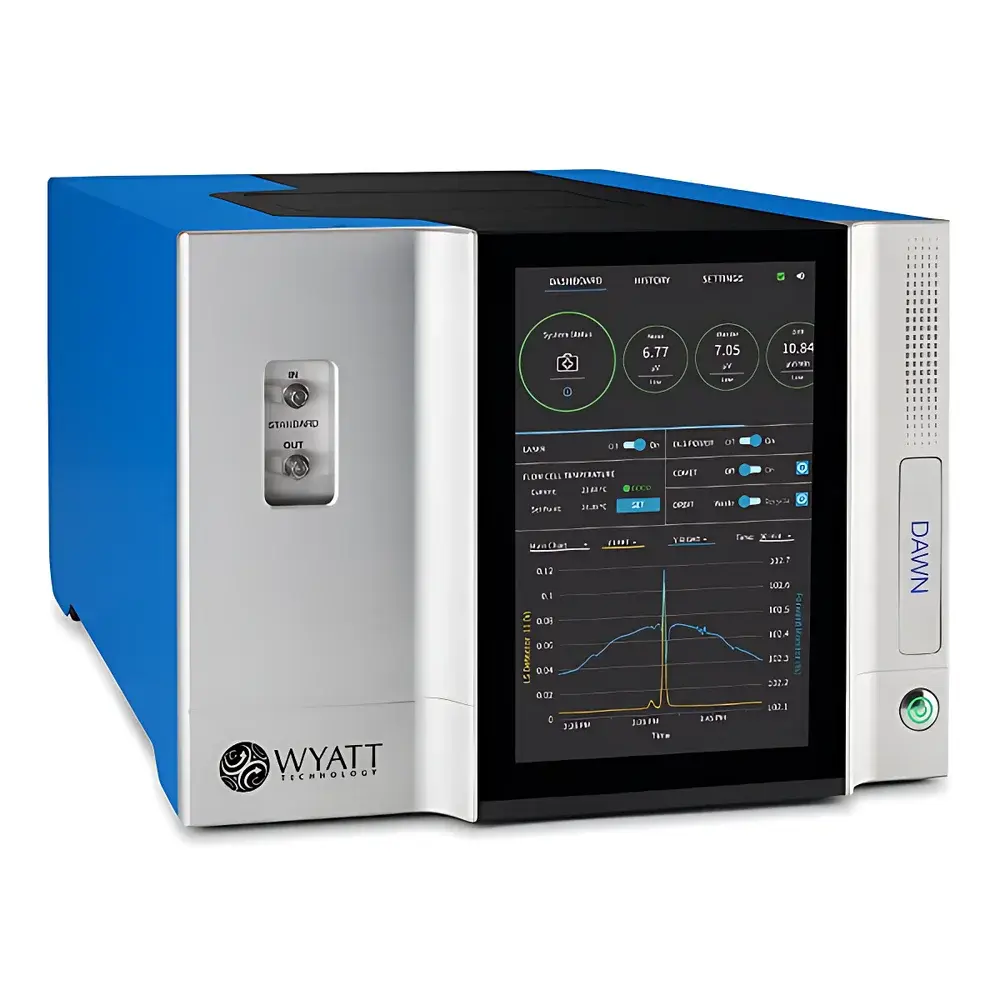
Wyatt DAWN 18-Angle Multi-Angle Light Scattering (MALS) Instrument
| Brand | Wyatt |
|---|---|
| Origin | USA |
| Manufacturer | Wyatt Technology Corporation |
| Product Type | Imported Instrument |
| Model | DAWN |
| Price | Upon Request |
| Molecular Weight Range | 200–10⁹ Da |
| Size Range | 10–500 nm |
| Laser Source | 100 mW GaAs linearly polarized laser |
| Wavelength | 658 nm |
| Detector Configuration | 18 angular detectors |
| Power Consumption | 400 W |
| Solvent Compatibility | Aqueous and organic solvents |
| Dimensions (L×W×H) | 58 × 36 × 25 cm |
| Shipping Weight | 23 kg |
Overview
The Wyatt DAWN 18-Angle Multi-Angle Light Scattering (MALS) instrument is a precision optical detector engineered for absolute, calibration-free characterization of macromolecules and nanoparticles in solution. Based on the fundamental principles of static light scattering (SLS) and angular-dependent intensity analysis, the DAWN measures scattered light intensity simultaneously at 18 discrete angles—ranging from 25° to 165°—enabling rigorous determination of root-mean-square radius (Rg), intrinsic viscosity ([η]), conformational parameters (e.g., ρ = Rg/Rh), and, most critically, absolute molar mass without reliance on column calibration or reference standards. Unlike single-angle or low-angle instruments, the 18-angle configuration provides high-fidelity angular distribution data essential for resolving non-ideal scattering behavior—including aggregation, branching, and polydispersity—in complex samples such as synthetic polymers, biologics, and viral vectors. The system operates with a stable 658 nm linearly polarized GaAs laser (100 mW output), optimized for minimal thermal drift and high signal-to-noise ratio across diverse solvent environments.
Key Features
- 18 independently calibrated photodiode detectors positioned at fixed scattering angles (25°–165°) for robust angular resolution and reliable Rg extraction
- Calibration-free absolute molar mass determination from 200 Da to 10⁹ Da, validated against NIST-traceable standards
- Simultaneous measurement of molar mass, size (Rg), and conformation—enabling direct discrimination between linear, branched, and aggregated species
- Full solvent compatibility: supports aqueous buffers (including high-salt and denaturing conditions), chlorinated organics, THF, DMF, and high-temperature polymer solvents (e.g., o-dichlorobenzene at 160 °C)
- Integrated temperature-controlled flow cell (±0.1 °C stability) and low-volume optical path (≤ 15 µL) to minimize band broadening during SEC/GPC coupling
- 400 W universal power supply with active cooling and EMI-shielded enclosure compliant with IEC 61000-6-3 and UL 61010-1 safety standards
Sample Compatibility & Compliance
The DAWN accommodates a broad spectrum of analytes—from synthetic homopolymers (PP, PE, PS) and ultra-high-MW polyelectrolytes to sensitive biomolecules including monoclonal antibodies, AAV capsids, plasmid DNA, and glycosylated polysaccharides. Its optical design eliminates assumptions about refractive index increment (dn/dc) by supporting real-time, in-line dn/dc measurement when coupled with a differential refractometer (e.g., Optilab T-rEX). The instrument meets critical regulatory requirements for quality control and characterization in GMP environments: raw data files include full audit trails, timestamped detector gain settings, and laser power logs; software export formats comply with FDA 21 CFR Part 11 (electronic signatures, user access controls, and immutable records); and analytical workflows align with ISO 13877 (light scattering for polymers) and USP (chromatographic system suitability).
Software & Data Management
Data acquisition and analysis are performed using ASTRA software—a validated, modular platform designed specifically for multi-detector SEC/MALS systems. ASTRA implements Zimm, Debye, and Berry fitting models with automated outlier rejection, batch processing for method transfer, and GLP-compliant report generation. All raw intensity vs. angle datasets are stored in vendor-neutral HDF5 format, enabling third-party integration with Python-based analysis pipelines (e.g., SciPy, lmfit). Instrument control, calibration validation, and security administration occur within a role-based access framework supporting password policies, session timeouts, and encrypted local database storage. Raw data integrity is preserved via write-once filesystem logging and SHA-256 checksum verification per acquisition cycle.
Applications
- Determination of absolute molecular weight distributions for synthetic polymers without column calibration artifacts
- Quantification of aggregation state and higher-order structure in therapeutic proteins under stress conditions (pH, temperature, excipients)
- Branching ratio analysis of dendrimers and comb polymers via simultaneous Rg and Mw correlation
- In-line monitoring of polymerization kinetics and reaction intermediates during controlled radical polymerization
- Characterization of lipid nanoparticles (LNPs) and extracellular vesicles—including size heterogeneity, density, and payload association efficiency
- Validation of biosimilarity through orthogonal assessment of higher-order structure beyond primary sequence
FAQ
Can the DAWN be used without coupling to SEC/GPC?
Yes—the DAWN supports batch-mode (static) analysis for homogeneous samples, enabling rapid absolute molar mass and Rg determination in cuvette-based measurements.
Is the 658 nm laser suitable for fluorescent or absorbing samples?
The 658 nm wavelength minimizes interference from common UV-absorbing chromophores and native fluorescence; for highly absorbing systems, optional 785 nm or 1064 nm laser modules are available.
How is detector alignment maintained over time?
Each detector is factory-aligned using interferometric metrology and secured with redundant mechanical locking; annual verification kits and alignment diagnostics are included in the service contract.
Does the system support temperature-controlled batch analysis?
Yes—optional Peltier-controlled sample holders maintain temperatures from 4 °C to 60 °C with ±0.2 °C accuracy for thermal stability studies.
What validation documentation is provided for regulated environments?
Wyatt supplies IQ/OQ protocols, traceable calibration certificates (NIST-traceable power meter and angle verification fixtures), and a complete 21 CFR Part 11 compliance package upon request.



