
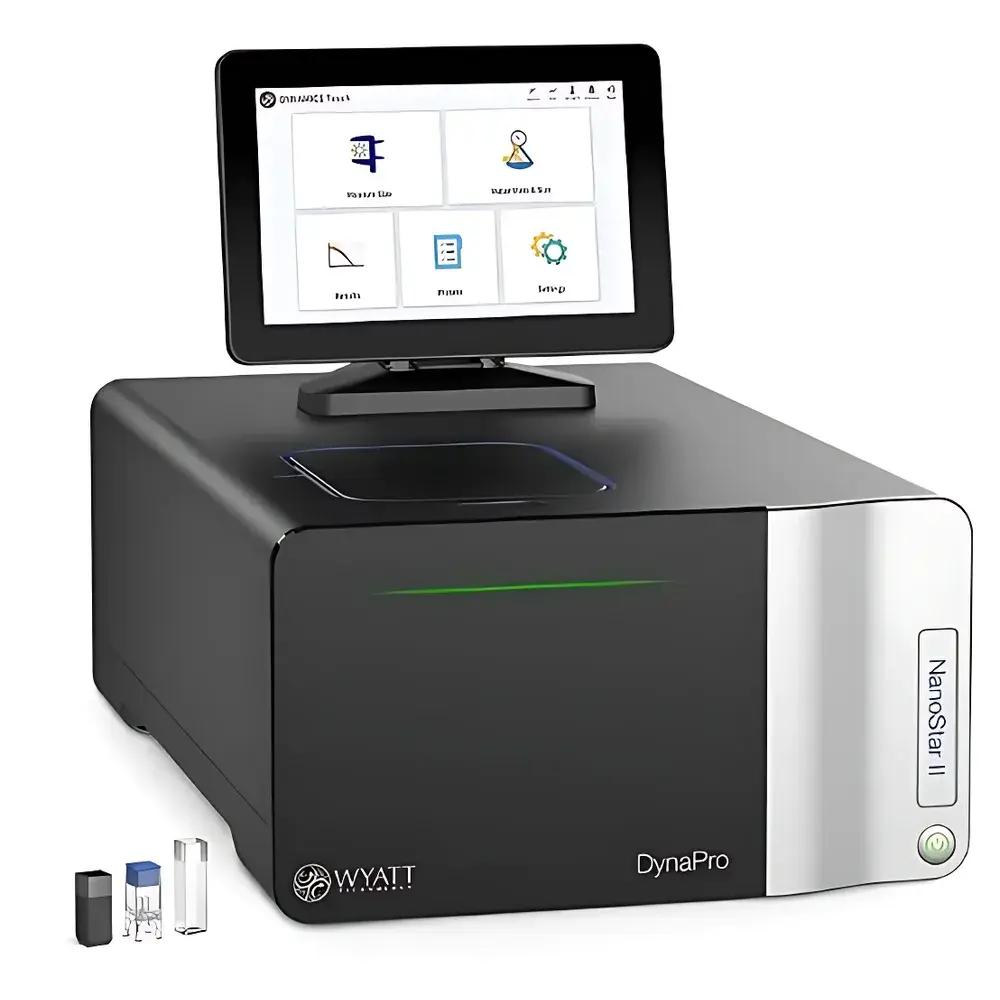
Wyatt DynaPro NanoStar II Dynamic Light Scattering Instrument
| Brand | Wyatt |
|---|---|
| Origin | USA |
| Manufacturer Type | Original Equipment Manufacturer (OEM) |
| Origin Category | Imported |
| Model | DynaPro NanoStar II |
| Price Range | USD 55,000 – 68,000 |
| Dispersion Method | Dry & Wet Dispersion |
| Measurement Range | 0.2–1000 nm |
| Measurement Duration | User-Configurable |
Overview
The Wyatt DynaPro NanoStar II is a high-sensitivity, benchtop dynamic light scattering (DLS) instrument engineered for precise hydrodynamic size distribution analysis of macromolecules and nanoparticles in solution. Based on the principles of Brownian motion-induced intensity fluctuation autocorrelation, the NanoStar II measures the diffusion coefficient of particles in suspension and converts it to hydrodynamic radius (Rh) via the Stokes–Einstein equation. Its integrated 658 nm diode laser (0–100 mW programmable output), fixed 90° scattering geometry, and thermally stabilized optical path ensure exceptional signal-to-noise ratio and measurement reproducibility across a broad size range (0.2–1000 nm). Designed specifically for biopharmaceutical characterization, the system operates with minimal sample volume requirements (as low as 12 µL), supports temperature-controlled measurements from 4 °C to 150 °C, and incorporates an internal dehumidifier to maintain optical integrity during extended thermal ramping or high-humidity environments.
Key Features
- Patented DLS optics with real-time autocorrelation processing and adaptive noise filtering for robust data acquisition under low-concentration conditions (down to 0.1 mg/mL for proteins)
- Benchtop form factor with fully automated alignment and self-diagnostic routines—no routine optical recalibration required
- Programmable laser power control (0–100 mW) to optimize signal intensity while minimizing photodegradation of sensitive biomolecules
- Dual-sample-volume compatibility: accommodates both microcuvettes (12 µL) and standard quartz cells (45 µL) without hardware modification
- Integrated Peltier-based temperature control with ±0.1 °C stability and linear ramping capability for thermal denaturation studies
- Optical chamber humidity management via built-in desiccant module, eliminating condensation-related artifacts during sub-ambient or elevated-temperature runs
Sample Compatibility & Compliance
The NanoStar II is validated for use with aqueous and organic solvent systems, including buffers, surfactants, glycerol/water mixtures, and low-viscosity oils. It supports both offline batch analysis and inline coupling with Wyatt’s multi-angle light scattering (MALS) systems—enabling simultaneous determination of absolute molar mass (via MALS) and hydrodynamic size (via DLS) within a single chromatographic or dilution run. The instrument complies with Good Laboratory Practice (GLP) and Good Manufacturing Practice (GMP) documentation requirements through audit-trail-enabled software logging (21 CFR Part 11 compliant when used with DYNAMICS v8+), and supports ASTM E2490-21 and ISO 22412:2017 methodologies for nanoparticle size distribution reporting.
Software & Data Management
Controlled by Wyatt’s DYNAMICS software suite (v8.x or later), the NanoStar II provides comprehensive data acquisition, real-time correlation curve fitting, and polydispersity index (PdI) calculation using cumulant, CONTIN, and NNLS algorithms. All raw intensity autocorrelation functions are archived with full metadata (temperature, laser power, acquisition time, cell ID, operator, timestamp). Export formats include CSV, PDF reports, and XML-compliant datasets compatible with LIMS integration. Batch processing workflows support automated quality control flagging based on user-defined thresholds for Rh, PdI, and baseline stability—facilitating high-throughput stability screening in formulation development labs.
Applications
- Assessment of protein monodispersity, aggregation onset temperature (Tagg), and conformational stability under varying pH, ionic strength, or excipient conditions
- Kinetic monitoring of self-assembly processes (e.g., virus-like particles, micelle formation, peptide fibrillation) with sub-minute temporal resolution
- Stability profiling of lipid nanoparticles (LNPs), polymer-drug conjugates, antibody-drug conjugates (ADCs), and PEGylated therapeutics
- Detection and quantification of subvisible aggregates that may compromise assay fidelity or elicit immunogenic responses
- Method development and transfer support for regulatory submissions requiring ICH Q5C, Q5A(R2), and USP / alignment
- Complementary use with SEC-MALS or FFF-MALS platforms to resolve heterogeneity arising from co-eluting species or column-induced artifacts
FAQ
What is the minimum required sample concentration for reliable DLS measurements on the NanoStar II?
For globular proteins, reliable size distributions can be obtained at concentrations as low as 0.1 mg/mL; for larger or less-scattering particles (e.g., liposomes >100 nm), concentrations ≥0.25 mg/mL are recommended.
Can the NanoStar II be used for temperature-ramp experiments over 100 °C?
Yes—the instrument supports continuous operation from 4 °C to 150 °C with active humidity control, enabling kinetic thermal unfolding studies and accelerated stability testing protocols.
Is the system compatible with non-aqueous solvents such as THF or chloroform?
Yes, provided the cuvette material is chemically compatible (e.g., quartz or specialized polymer cells) and refractive index matching is considered during data interpretation.
Does the NanoStar II support 21 CFR Part 11 compliance out of the box?
Full electronic signature, audit trail, and role-based access control are enabled when DYNAMICS software v8.3+ is deployed on a validated Windows OS environment with appropriate IT infrastructure.
How does the NanoStar II differ from the earlier DynaPro NanoStar model?
The NanoStar II features upgraded laser power control electronics, enhanced thermal stability of the detection module, improved humidity management, and native support for modern TLS 1.2+ network security protocols in software communications.



