
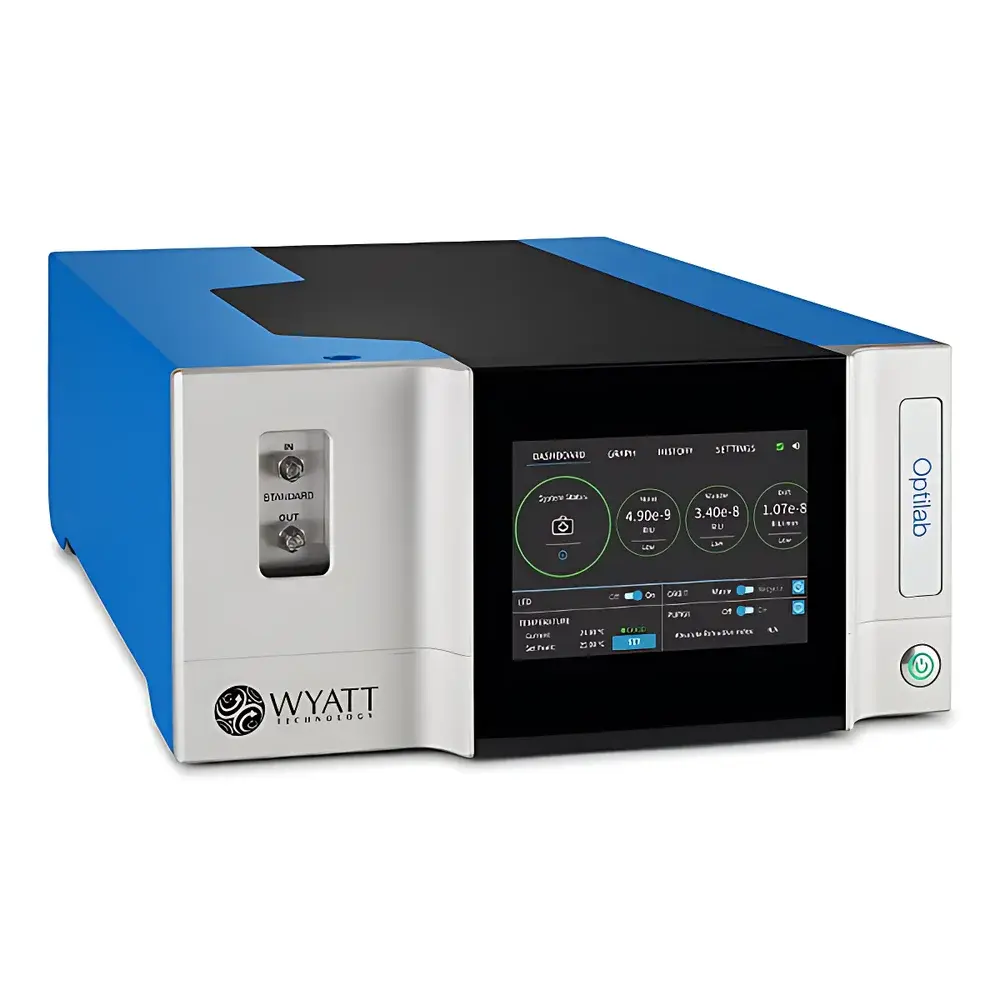
Wyatt Optilab Differential Refractometer (dRI Detector)
| Brand | Wyatt |
|---|---|
| Origin | USA |
| Manufacturer | Wyatt Technology Corporation |
| Instrument Type | Differential Refractometer (dRI) |
| Wavelength | 658 nm (LED source) |
| Detection Method | Photodiode Array |
| Cell Volume | 7.4 µL |
| RI Range (Δn) | ±0.0047 RIU |
| Noise Level | <2.0 × 10⁻⁹ RIU |
| Response Time | 0.1–5 s |
| Absolute RI Range | 1.2–1.8 RIU |
| Temperature Stability | <±0.005 °C |
| Max System Pressure | 30 psi |
| Max Flow Cell Pressure | 100 psi |
| Interface | High-Resolution LCD Display |
Overview
The Wyatt Optilab is a high-precision, temperature-stabilized differential refractometer engineered for integration with liquid chromatography (LC), size-exclusion chromatography (SEC), and field-flow fractionation (FFF) systems. It operates on the principle of measuring minute changes in the refractive index (RI) of a flowing solution relative to a reference solvent—enabling label-free, universal detection of analytes regardless of chromophore presence or UV absorbance. Unlike conventional single-point RI detectors, the Optilab employs a 256-element photodiode array to capture spatially resolved RI gradients across the optical path, delivering enhanced sensitivity, dynamic range (256× wider than legacy dRI instruments), and robust baseline stability. Its compact 7.4 µL flow cell minimizes band broadening and solvent diffusion effects—critical for high-resolution SEC-MALS and multi-angle light scattering (MALS) coupling. The integrated Peltier-based thermal control system maintains temperature uniformity within ±0.005 °C without external water baths, ensuring long-term drift-free operation under GLP-compliant analytical conditions.
Key Features
- 256-channel photodiode array detection for superior signal-to-noise ratio and extended linear dynamic range (±0.0047 RIU)
- Ultra-low-noise electronics yielding baseline noise <2.0 × 10⁻⁹ RIU—enabling accurate quantification of dilute macromolecular samples
- Compact 7.4 µL fused-silica flow cell with optimized optical geometry, reducing dispersion and improving chromatographic resolution
- Integrated solid-state Peltier temperature controller (no recirculating chiller required) with real-time monitoring and digital feedback regulation
- Stable LED light source at 658 nm (with optional multi-wavelength configurations: 630/660/690 nm) offering >10,000-hour lifetime and minimal thermal drift
- Front-panel high-resolution LCD interface with intuitive menu navigation, real-time signal display, and diagnostic status indicators
- Pressure-rated flow cell (up to 100 psi) compatible with UHPLC-compatible SEC columns and high-flow FFF channels
Sample Compatibility & Compliance
The Optilab supports aqueous and organic mobile phases—including THF, DMF, chloroform, and DMSO—across an absolute refractive index range of 1.2–1.8 RIU. It is routinely deployed in regulated environments for characterization of biologics (mAbs, AAVs, mRNA-LNPs), synthetic polymers, nanoparticles, and natural macromolecules. The instrument complies with key regulatory expectations for analytical instrumentation: its firmware supports audit-trail-enabled data logging, user-access controls, and electronic signature capability in alignment with FDA 21 CFR Part 11 requirements when operated within compliant LIMS or Chromatography Data Systems (CDS). All mechanical and optical components meet ISO 9001 manufacturing standards; calibration traceability is maintained per NIST-traceable refractive index standards.
Software & Data Management
The Optilab interfaces seamlessly with Wyatt’s ASTRA software suite via USB or Ethernet, enabling synchronized acquisition with MALS, viscometry, and UV/VIS detectors in multi-detector SEC workflows. Raw RI signals are acquired at up to 100 Hz sampling rate and processed using real-time baseline correction, zero-offset compensation, and solvent subtraction algorithms. ASTRA provides automated dn/dc calculation from co-injected standards and supports batch processing of hundreds of SEC runs with customizable reporting templates compliant with ICH Q5E and USP . Export formats include ASCII, CSV, and .ASTRA binary files—fully compatible with third-party platforms such as Empower, Chromeleon, and OpenLab CDS. Instrument configuration, calibration history, and maintenance logs are stored internally and exportable for internal audit or regulatory submission.
Applications
- Determination of absolute dn/dc values for proteins, polysaccharides, nucleic acids, and synthetic polymers—essential for accurate molar mass determination by SEC-MALS
- Quantitative analysis of non-UV-absorbing species including lipids, carbohydrates, and excipients in formulation development
- Monitoring aggregation kinetics and conformational changes during forced degradation studies (thermal, pH, oxidative stress)
- Characterization of complex formulations such as lipid nanoparticles (LNPs), virus-like particles (VLPs), and polymeric micelles
- Calibration of concentration-sensitive detectors in multi-angle light scattering (MALS) and differential viscometry systems
- Real-time process analytical technology (PAT) applications in downstream purification and fill-finish operations
FAQ
Can the Optilab be used with UHPLC systems?
Yes—the flow cell is rated to 100 psi and features low-volume, low-dead-volume connections compatible with sub-2-µm particle SEC columns and UHPLC-compatible solvents.
Does it require external temperature control or water circulation?
No—its integrated Peltier module delivers precise, self-contained temperature regulation with stability better than ±0.005 °C, eliminating dependency on external chillers or baths.
How is dn/dc measured using the Optilab?
By injecting a series of analyte solutions at known concentrations into matched solvent and sample channels, followed by linear regression of ΔRI versus concentration in ASTRA software.
Is the Optilab compliant with 21 CFR Part 11?
When operated with validated ASTRA software and appropriate procedural controls (e.g., role-based access, electronic signatures, audit trails), it meets technical requirements for Part 11 compliance in GxP environments.
What is the typical response time for transient peak detection?
Configurable between 0.1 s and 5 s, allowing optimization for narrow SEC peaks (<5 s wide) or high-sensitivity steady-state measurements.
Related Products




