Xarion LEAsys Non-Contact Laser-Ultrasound NDT Scanning System
| Brand | Xarion |
|---|---|
| Origin | Austria |
| Model | LEAsys |
| Excitation Source | Pulsed Laser (100 / 400 / 10,000 Hz PRF or thermoacoustic) |
| Detection Sensor | Eta450 Ultra Optical Microphone (2 MHz bandwidth) |
| Minimum Step Size | 10 µm |
| Scan Area | 530 × 500 mm or 530 × 1000 mm |
| Data Acquisition | 14-bit resolution, 50 MHz sampling rate |
| Measurement Modes | Through-transmission and single-sided (pitch-catch) |
| Software | Real-time A-, B-, C-scan visualization |
Overview
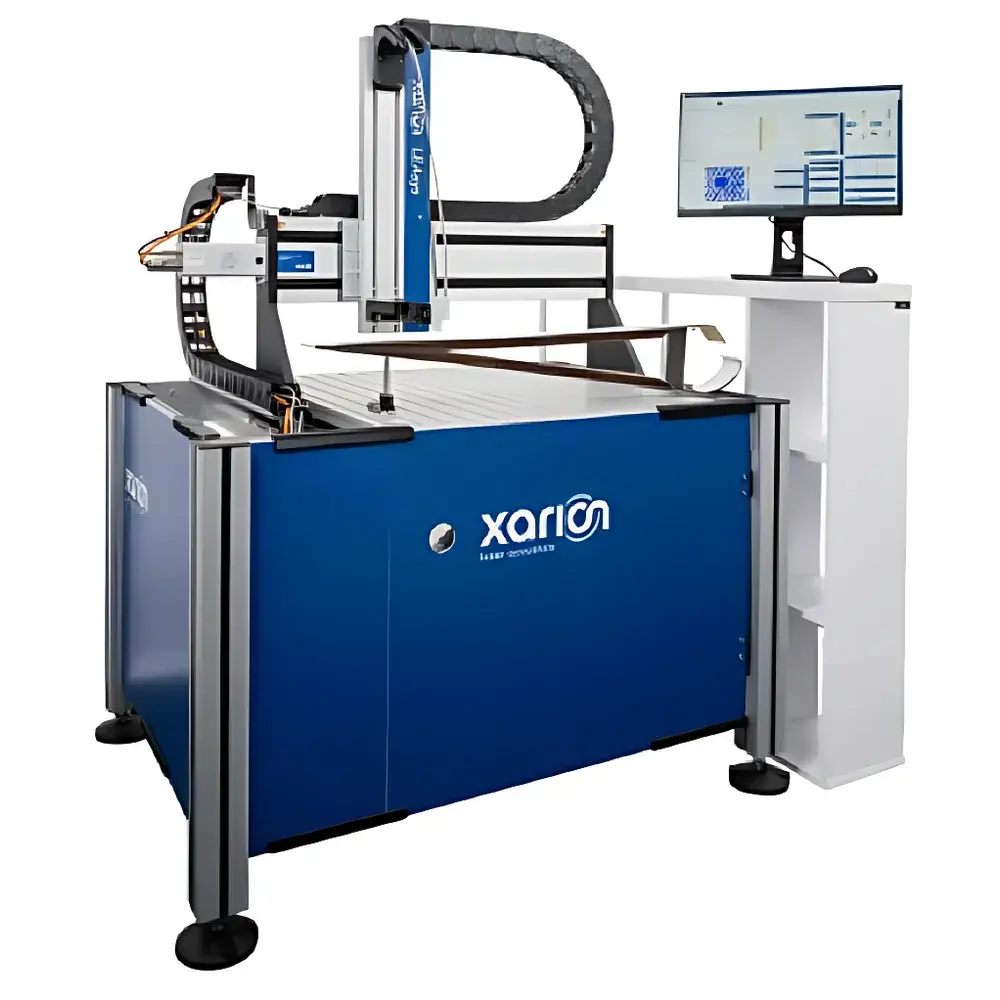
The Xarion LEAsys Non-Contact Laser-Ultrasound NDT Scanning System is an advanced, fully integrated platform for quantitative, non-contact ultrasonic inspection of structural materials. It operates on the principle of laser-induced ultrasound: a pulsed or thermoacoustic laser excites broadband acoustic waves in the sample surface, while a proprietary high-bandwidth optical microphone—specifically the Eta450 Ultra—detects transient acoustic responses without physical coupling. This eliminates the need for water baths, couplant gels, or mechanical transducers, thereby removing variability associated with contact-based methods and enabling reliable measurements on temperature-sensitive, rough, curved, or coated surfaces. Engineered for precision and repeatability, the LEAsys system delivers micron-level spatial resolution and sub-microsecond temporal fidelity, making it suitable for detecting subsurface flaws—including delaminations, disbonds, porosity, and micro-cracks—in multi-layered composites, metallic alloys, adhesive joints, and hybrid assemblies.
Key Features
- Laser-based ultrasound generation with selectable pulse repetition frequencies (100 Hz, 400 Hz, or 10 kHz) or continuous-wave thermoacoustic excitation for optimized signal-to-noise ratio across material classes.
- Eta450 Ultra optical microphone featuring 2 MHz analog bandwidth and sub-nanometer displacement sensitivity, enabling detection of both bulk and guided surface acoustic waves.
- High-precision XY scanning stage with configurable scan areas (530 × 500 mm or 530 × 1000 mm) and minimum step resolution of 10 µm for fine-grained defect mapping.
- Real-time digital acquisition at 50 MHz sampling rate with 14-bit vertical resolution, supporting time-domain waveform capture and post-processing flexibility.
- Eight-channel optical microphone array option available for parallel acquisition, significantly reducing inspection time in production environments or large-area screening applications.
- Robust mechanical architecture designed for laboratory and controlled industrial settings, with vibration-isolated baseplate and environmental shielding for stable long-term operation.
Sample Compatibility & Compliance
The LEAsys system demonstrates broad compatibility across industrially relevant materials—including carbon-fiber-reinforced polymers (CFRP), aluminum and titanium alloys, steel weldments, ceramic matrix composites, and bonded polymer-metal interfaces. Its non-contact nature ensures no surface damage or contamination during inspection, preserving part integrity for subsequent processing or service. The system supports compliance with established NDT standards frameworks: data acquisition protocols align with ASTM E1158 (Standard Guide for Material Characterization Using Ultrasonic Testing Methods), ISO 16810 (Ultrasonic Testing — General Principles), and EN 1330-4 (Non-destructive testing — Vocabulary — Part 4: Terms used in ultrasonic testing). While not inherently certified for regulated GMP or aerospace production lines, its traceable calibration procedures, audit-ready data logs, and timestamped metadata export support integration into GLP-compliant workflows and internal quality assurance documentation.
Software & Data Management
The LEAsys control and analysis software provides a unified graphical user interface (GUI) for instrument orchestration, real-time visualization, and quantitative evaluation. Core functionalities include synchronized A-scan waveform display, depth-resolved B-scan cross-sections, and amplitude-coded C-scan plan-view imaging—all rendered in real time during scanning. Advanced signal processing modules support Fast Fourier Transform (FFT)-based spectral analysis (F-scan), enabling frequency-selective defect characterization and material property inference (e.g., elastic modulus gradients, layer thickness via resonance spectroscopy). All generated images are exportable in lossless BMP format; raw time-series data can be saved in CSV for external analysis in MATLAB, Python, or statistical process control (SPC) platforms. The software maintains full metadata logging—including laser energy, scan coordinates, acquisition parameters, and system status—ensuring data integrity and facilitating FDA 21 CFR Part 11–compatible audit trails when deployed with appropriate IT infrastructure.
Applications
- Aerospace composite inspection: Detection of impact damage, resin-rich zones, and interply delaminations in CFRP fuselage panels and wing skins without disassembly or surface preparation.
- Automotive joining validation: Characterization of spot-weld integrity in multi-material body-in-white structures, including steel-aluminum hybrid joints, using single-sided pitch-catch configurations.
- Thin-film and coating adhesion assessment: Quantitative evaluation of bond strength and interfacial defects in thermal barrier coatings and functional thin films via surface wave dispersion analysis.
- Precision thickness metrology: Local ultrasonic resonance spectroscopy for non-contact thickness measurement of CFRP laminates with sub-10 µm uncertainty, validated against reference standards per ISO 2409.
- Research-grade material characterization: Mapping of elastic anisotropy, viscoelastic relaxation, and microstructural heterogeneity in additively manufactured metals and bio-inspired composites.
FAQ
What types of materials can be inspected using the LEAsys system?
The system is validated for use on composites (CFRP, GFRP), metals (Al, Ti, steel), ceramics, polymers, and adhesive-bonded assemblies. Surface finish, reflectivity, and thermal diffusivity influence signal strength but do not preclude inspection.
Is the system suitable for in-line industrial deployment?
While primarily designed for lab-based R&D and QA/QC labs, the optional 8-channel array and programmable API enable integration into semi-automated inspection stations. Full in-line integration requires custom mechanical interfacing and safety enclosure design.
Does the LEAsys system require calibration against reference standards?
Yes—periodic verification using NIST-traceable ultrasonic reference blocks (e.g., ASTM E127) or material-specific phantoms is recommended to maintain measurement consistency across time and operators.
Can the system detect subsurface defects deeper than 5 mm?
Detection depth depends on material attenuation and excitation energy. In low-loss CFRP or aluminum, features up to 10–15 mm deep have been resolved in published studies; in highly attenuative materials (e.g., thick rubber or foams), effective depth may be limited to 2–3 mm.
Is training and technical support provided with the system?
Xarion-certified application engineers deliver on-site installation, operational training, and method development support. Remote diagnostics and firmware updates are available under extended service agreements.