
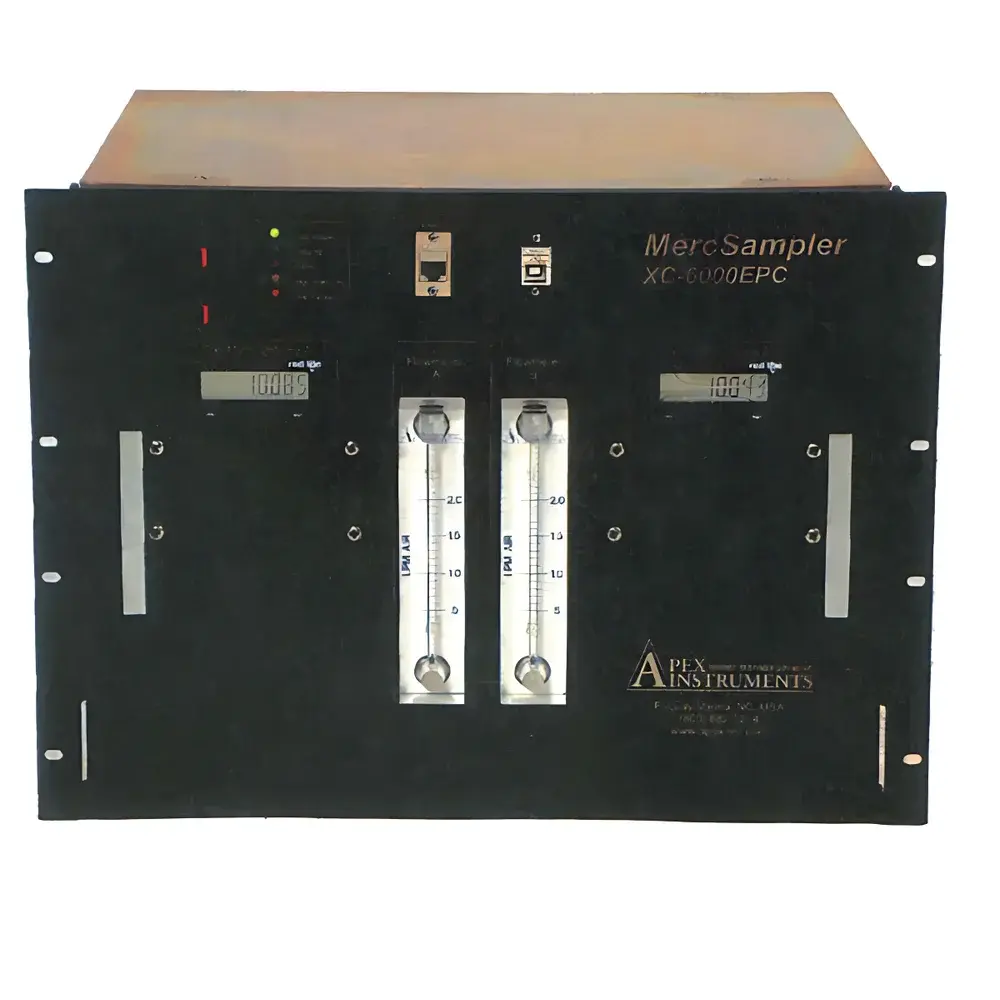
XC-6000EPC Automated Mercury Sampling System
| Origin | USA |
|---|---|
| Manufacturer Type | Authorized Distributor |
| Origin Category | Imported |
| Model | XC-6000EPC |
| Price Range | USD 13,500 – 40,500 |
| Dry Gas Meter | Positive Displacement, 0.7 L/rev, Optical Encoder, 8-digit LCD, Resolution: 1 cm³ |
| Flow Control Accuracy | ±2% of full scale (vacuum range: 0–101 kPa) |
| Sampling Flow Mode | Isokinetic or Constant Flow |
| Mass Flow Control Range | 100–2000 cm³/min |
| Proportional Valve | 12 V DC |
| Data Storage | 1 GB onboard memory, up to 99 sampling events (~30 days of typical field data) |
| Barometric Pressure Sensor | 600–1100 mbar |
| Communication Interfaces | Ethernet, USB, Optional Wi-Fi Router |
| Dimensions | 35.56 × 48.26 × 39.37 cm |
| Weight | 15.5 kg |
| Power Supply | 220 V AC, 50 Hz |
Overview
The XC-6000EPC Automated Mercury Sampling System is a field-deployable, EPA-compliant instrument engineered for the precise, trace-level collection and quantification of elemental mercury (Hg⁰) vapor emissions from stationary combustion sources—including coal-fired power plants, waste incinerators, cement kilns, and industrial boilers. Designed in strict accordance with U.S. Environmental Protection Agency (EPA) Method 30B and Appendix K to 40 CFR Part 60, the system implements dual-sorbent trap sampling using gold-coated quartz or iodated carbon cartridges, enabling robust, high-fidelity capture across variable stack conditions. Its core architecture integrates real-time flow regulation, thermally stabilized sampling lines, automated leak integrity verification, and on-board environmental correction—ensuring that raw volumetric data are automatically converted to standardized conditions (20 °C, 101.325 kPa, dry basis) per EPA requirements. Unlike manual or semi-automated alternatives, the XC-6000EPC executes full Method 30B workflows without operator intervention during sampling, reducing human error and supporting defensible regulatory reporting under NSPS and MACT standards.
Key Features
- Dual-channel fully automated sampling architecture with independent flow control and real-time synchronization for paired sorbent traps
- Positive displacement dry gas meter with optical encoder feedback (0.7 L/revolution), providing traceable volumetric measurement with 1 cm³ resolution and integrated temperature/pressure compensation
- Brushless DC diaphragm pump rated for continuous operation at elevated backpressures (up to 101 kPa vacuum), delivering stable flow across wide dynamic ranges (100–2000 cm³/min)
- Isokinetic flow controller with proportional solenoid valve (12 V DC) and closed-loop PID algorithm, maintaining velocity-matched sampling during fluctuating stack velocities
- Onboard barometric pressure sensor (600–1100 mbar, ±1 mbar accuracy) and ambient temperature monitoring for automatic standard-volume correction per EPA Equation 3–1
- Self-diagnostic leak-check sequence prior to and during sampling, compliant with Method 30B Section 8.2.2
- Intuitive 8-digit LCD interface with multilingual menu navigation, real-time status indicators, and configurable alarm thresholds
- Integrated data acquisition module featuring 1 GB non-volatile memory, storing complete metadata (flow profiles, temperatures, pressures, timestamps, calibration logs) for ≥99 discrete sampling events
Sample Compatibility & Compliance
The XC-6000EPC is validated for use with EPA-recognized sorbent media including gold-coated quartz tubes (EPA Method 30B Option 1) and iodated carbon cartridges (Option 2). It supports both single-point and multi-point isokinetic traverses per EPA Method 1 and Method 2. All firmware and data handling protocols align with EPA’s Quality Assurance Handbook for Air Pollution Measurement Systems (QA Handbook Vol. III) and support audit-ready documentation for regulatory submissions. The system meets electromagnetic compatibility (EMC) requirements per FCC Part 15 Class B and operates within IEC 61000-4-2 (ESD) and IEC 61000-4-3 (radiated immunity) specifications. For GLP/GMP environments, optional audit-trail logging and user-access controls can be enabled to satisfy 21 CFR Part 11 requirements when paired with validated laboratory information management systems (LIMS).
Software & Data Management
Field data are stored locally in a structured binary format with embedded CRC-32 checksums for integrity validation. Export options include CSV (comma-separated values) and XML formats compatible with EPA’s Electronic Reporting Tool (ERT) and third-party QA/QC platforms. USB and Ethernet interfaces enable direct transfer to secure network servers or portable workstations; optional Wi-Fi connectivity supports remote status polling and firmware updates via TLS 1.2–secured connections. The embedded firmware includes timestamped calibration event logging, flow deviation alerts, and automatic generation of Method 30B-compliant field forms (e.g., Form 30B-1, 30B-2). No proprietary software installation is required—data files conform to ASTM D6784-22 Annex A1 structure for seamless integration into accredited laboratory workflows.
Applications
- Regulatory compliance monitoring of Hg emissions under EPA MATS (Mercury and Air Toxics Standards) and state-level air toxics rules
- Performance testing of activated carbon injection (ACI) systems and fabric filter retrofits
- Source testing for Title V permit renewal and NSPS applicability determinations
- Method validation and inter-laboratory comparison studies under ISO/IEC 17025-accredited programs
- Long-term trend analysis of mercury speciation (Hg⁰ vs. Hg²⁺) when coupled with post-sampling thermal desorption–CVAFS analysis
- Stack testing support for international projects aligned with EU IED (Industrial Emissions Directive) Annex VI monitoring requirements
FAQ
Does the XC-6000EPC meet EPA Method 30B certification requirements for field use?
Yes—the instrument is pre-configured with Method 30B logic, including automatic isokinetic calculation, leak-check sequencing, and standard-volume conversion algorithms verified against EPA’s 30B Reference Software v2.1.
Can the system operate unattended for extended periods (e.g., 24–72 hours)?
Yes—designed for continuous operation with battery-backup-ready power input options; internal memory retains full datasets even during unexpected power loss, and auto-resume functionality restores sampling upon power restoration.
Is external analog signal input supported for synchronizing with stack velocity or O₂ analyzers?
Yes—the rear-panel 4–20 mA analog input port accepts real-time velocity or oxygen concentration signals for dynamic isokinetic ratio adjustment.
What maintenance intervals are recommended for the dry gas meter and pump?
The positive displacement meter requires biannual verification using NIST-traceable calibrators; the brushless diaphragm pump has a rated service life exceeding 15,000 operating hours with no scheduled lubrication.
How is data security and traceability ensured during regulatory audits?
All sampling sessions generate immutable records with digital signatures, time-stamped calibration entries, and revision-controlled firmware logs—fully exportable for inclusion in EPA Form 30B reports and third-party audit packages.







