
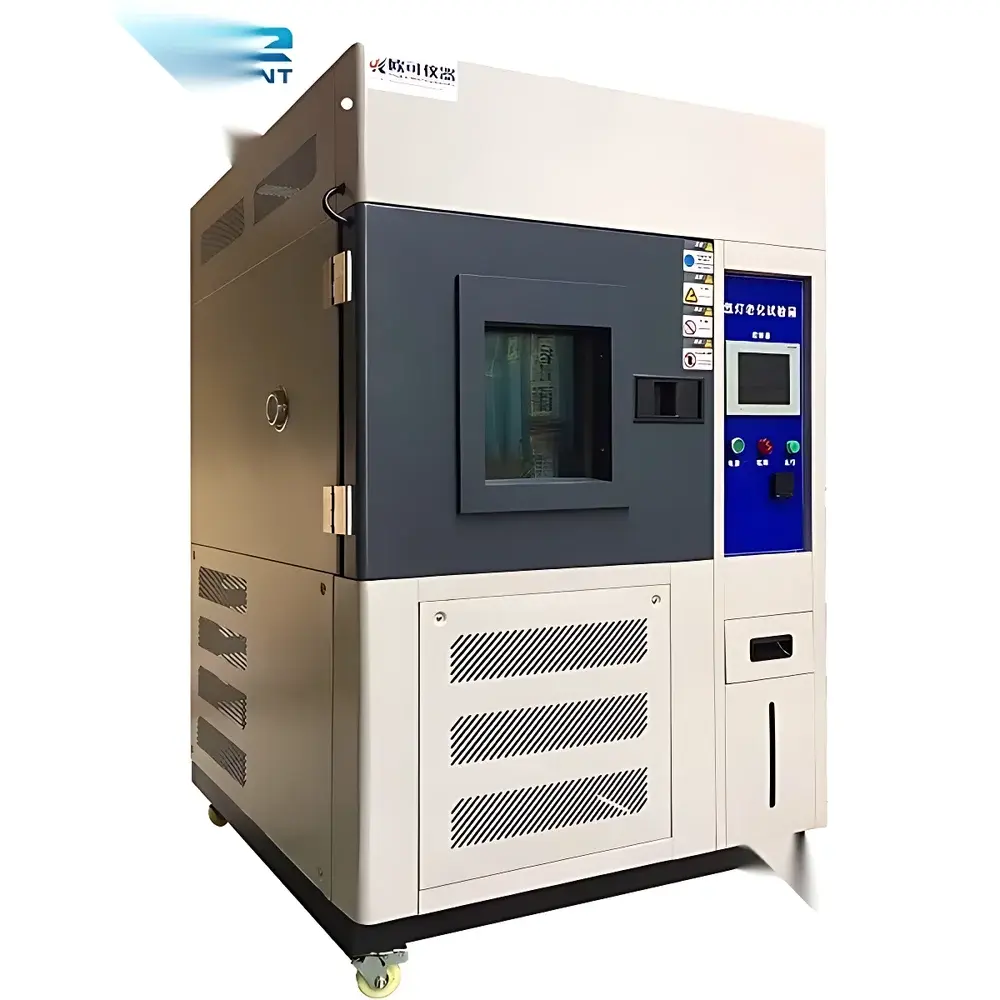
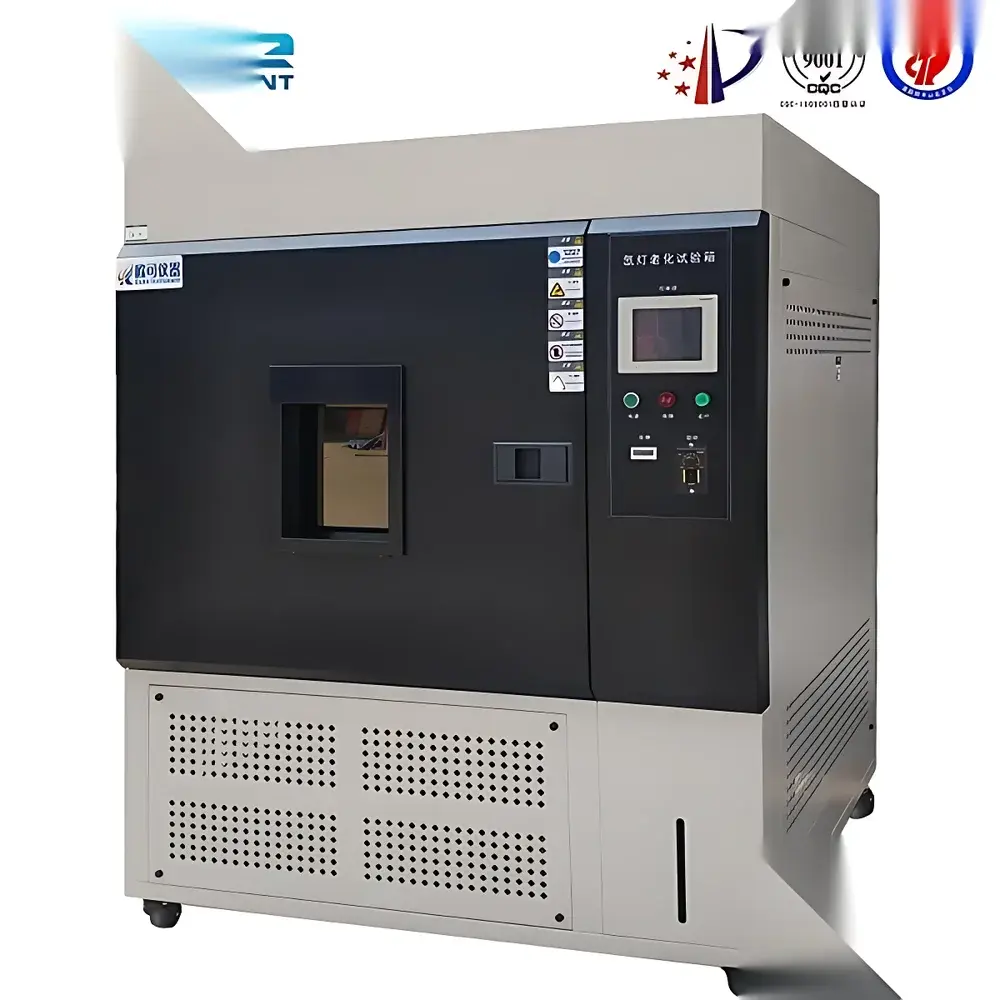
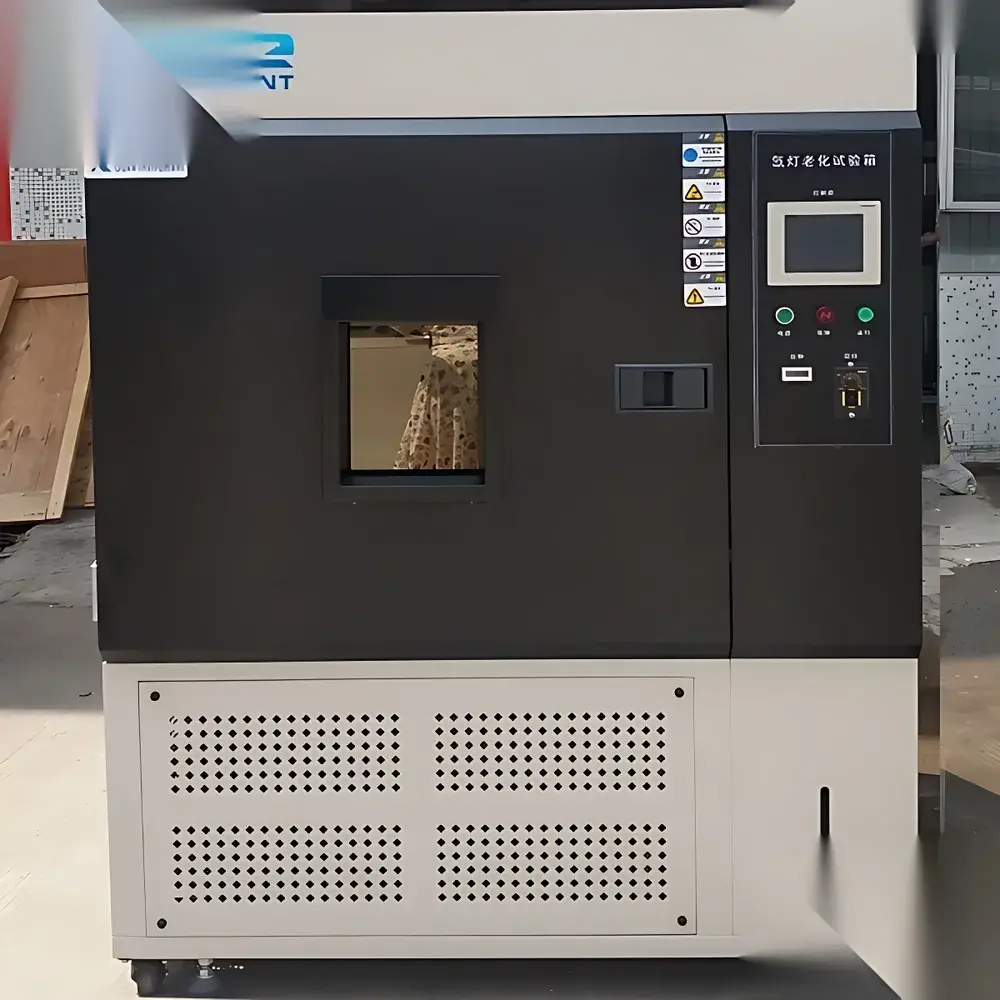
OK-XD Series Programmable Xenon Arc Weathering Test Chamber
| Brand | OK Instruments |
|---|---|
| Origin | Imported |
| Manufacturer Type | Authorized Distributor |
| Temperature Range | 0–150°C (chamber), 40–85°C (black panel) |
| Humidity Range | 20–75% RH (light cycle), 20–98% RH (dark cycle) |
| Temperature Control Accuracy | ±0.5°C |
| Humidity Control Accuracy | ±2.0% RH |
| Temperature Uniformity | ±2.0°C |
| Humidity Uniformity | ±3.0% RH |
| Irradiance | 550 W/m² ±10% (300–800 nm), 1000 W/m² ±10% (300–1200 nm) |
| Xenon Lamp Power | 1.8 kW / 2.5 kW / 6 kW |
| Lamp Lifetime | ~1500 h |
| Spray Duration | 1–999 min (intermittent or continuous) |
| Spray Pressure | 70–127 kPa |
| Sample Holder | Dual-layer mesh tray or 500-mm-diameter rotating turntable (0–3 rpm) |
| Internal Chamber Material | SUS304 stainless steel |
| External Cabinet | SUS304 stainless steel or powder-coated steel |
| Power Supply | AC 380 V ±5%, 50 Hz ±0.5 Hz |
Overview
The OK-XD Series Programmable Xenon Arc Weathering Test Chamber is an engineered environmental simulation system designed to replicate the full solar spectrum—including UV, visible, and near-infrared radiation—to accelerate material degradation under controlled climatic conditions. Based on xenon arc lamp technology compliant with ISO 4892-2 and ASTM G155, it delivers spectrally stabilized irradiance across 300–1200 nm, enabling quantitative assessment of photostability, colorfastness, gloss retention, cracking, chalking, and embrittlement in polymeric, textile, coating, and automotive components. Unlike narrow-band UV chambers, the OK-XD series employs long-arc, air-cooled xenon lamps with precision optical filters to maintain spectral match to CIE Standard Illuminant D65—critical for correlating laboratory exposure to real-world outdoor weathering. Its integrated temperature, humidity, and water spray control modules support multi-phase test cycles (e.g., light/dark, dry/wet), satisfying requirements for GB/T 16422-2, ISO 11341, and AATCC TM16.
Key Features
- Full-spectrum xenon arc source with calibrated irradiance output (550 W/m² ±10% at 300–800 nm; 1000 W/m² ±10% at 300–1200 nm), traceable to NIST-traceable reference cells
- Independent black panel thermometer (BPT) and chamber air temperature control, both regulated to ±0.5°C accuracy with PID feedback loops
- Dual-mode humidity control: precise RH regulation during light cycles (20–75% RH) and extended saturation capability during dark phases (20–98% RH)
- Programmable water spray system with adjustable duration (1–999 min), pressure (70–127 kPa), and intermittent/continuous modes—simulating dew, rain, and thermal shock
- Flexible sample mounting: dual-layer stainless steel mesh trays for flat specimens or a 500-mm-diameter rotating turntable (0–3 rpm) to ensure uniform irradiance exposure per ASTM D7869
- Robust construction using interior SUS304 stainless steel and exterior options of either stainless steel or powder-coated carbon steel for corrosion resistance and long-term stability
- Modular lamp assembly with quick-release mechanism; standard 1500-hour lamp life with field-replaceable design and integrated spectral filter maintenance schedule
Sample Compatibility & Compliance
The OK-XD chamber accommodates diverse geometries—from rigid panels and fabric swatches to molded plastic parts and coated metal substrates—via its configurable sample holders. Its internal dimensions (ranging from 50 × 50 × 40 cm to 100 × 100 × 100 cm across models) allow testing of full-size automotive trim, architectural cladding, or multi-specimen arrays. All models comply with international standards governing accelerated weathering protocols, including ISO 4892-2 (xenon arc exposure), ASTM D2565 (plastics), ASTM D4329 (plastics—fluorescent UV), ISO 105-B02 (textile colorfastness to light), and GB/T 8427 (textiles—xenon arc). The system supports GLP-compliant operation when paired with validated software: audit trails, user access levels, and electronic signatures align with FDA 21 CFR Part 11 requirements for regulated industries.
Software & Data Management
The OK-XD series integrates with OK-WeaControl™ v3.2, a Windows-based programmable controller offering intuitive drag-and-drop test sequence building, real-time parameter monitoring (irradiance, BPT, chamber RH, spray status), and automated data logging at user-defined intervals. All operational parameters—including lamp voltage, filter age, and calibration history—are stored with timestamped metadata. Export formats include CSV and PDF reports compatible with LIMS integration. Optional Ethernet/IP or Modbus TCP interfaces enable remote supervision and centralized fleet management across multi-chamber laboratories. Firmware updates are delivered via secure HTTPS, and system diagnostics include lamp spectral drift alerts and humidity sensor validation prompts.
Applications
This chamber serves as a core tool in R&D, quality assurance, and regulatory submission workflows for materials exposed to outdoor environments. Key use cases include: evaluating UV stabilizer efficacy in polyolefins and PVC compounds; validating fade resistance of automotive interior trims per SAE J2412; assessing colorfastness of dyed textiles per ISO 105-B02; screening anti-corrosion coatings on aerospace alloys; qualifying LED housing materials for street lighting durability; and conducting comparative aging studies for biodegradable packaging films under simulated subtropical or desert climates. Its reproducible irradiance profile and multi-stress capability make it suitable for ASTM G151–based reference material calibration and inter-laboratory round-robin studies.
FAQ
What spectral range does the xenon lamp cover, and how is spectral stability maintained?
The lamp emits continuously from 290 nm to >2500 nm. Optical filters limit output to 300–800 nm or 300–1200 nm bands, with spectral match to CIE D65 verified annually using a calibrated spectroradiometer.
Can the chamber perform cyclic tests combining light, heat, moisture, and spray?
Yes—up to 99 programmable steps per cycle, each defining irradiance level, temperature setpoint, RH target, spray activation, and duration.
Is black panel temperature (BPT) measured and controlled independently from chamber air temperature?
Yes—dual PID controllers regulate BPT (40–85°C) and air temperature (0–150°C) separately, ensuring surface-specific thermal stress fidelity.
How is humidity controlled during dark cycles without condensation interference?
A dedicated steam humidification system with dehumidification bypass maintains RH up to 98% while preventing uncontrolled condensation on samples or sensors.
What documentation is provided for IQ/OQ qualification?
Factory-issued IQ/OQ protocols, calibration certificates for all sensors (NIST-traceable), and a full compliance matrix mapping hardware/software functions to ISO/IEC 17025 and ASTM E2500 requirements are included.



