
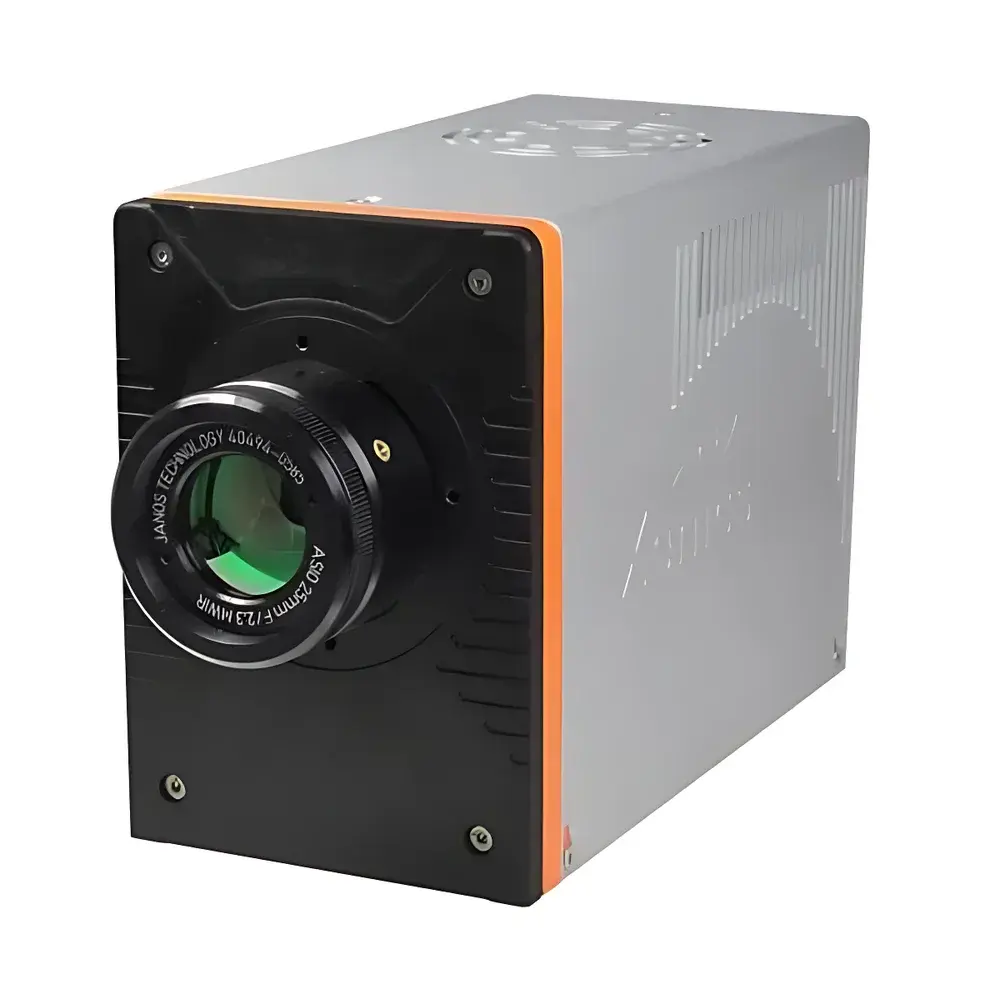
XenICs Tigris-640-MCT Stirling-Cooled MWIR Imaging Camera
| Brand | XenICs |
|---|---|
| Origin | Belgium |
| Model | Tigris-640-MCT |
| Detector Type | Mercury Cadmium Telluride (MCT) |
| Spectral Range | 3.7–4.8 µm (standard), optional 1.5–6.0 µm broadband |
| Resolution | 640 × 512 |
| Pixel Pitch | 15 µm |
| Effective Pixels | 99.5 % |
| Cooling Method | Integrated Stirling cooler (operating at ~80 K) |
| NETD | < 25 mK |
| Frame Rate | up to 117 Hz at full resolution |
| ROI Mode | configurable down to 144 × 64 |
| Bit Depth | 14-bit ADC |
| NUC | Two-point non-uniformity correction |
| Onboard Processing | Bad pixel replacement, auto gain & offset control, Xenics Image Enhancement (XIE) |
| Interface Options | CameraLink, GigE Vision, HD-SDI, analog (PAL/NTSC) |
| Trigger | Configurable in/out |
| Power Supply | 24 V DC, 25 W |
| Operating Temperature | −40 °C to +60 °C |
| Dimensions (W×H×L) | 100 × 149 × 200 mm |
| Weight | 3.5 kg |
| Filter Wheel | Motorized, 5-position, 25.4 mm diameter, 1.0 mm thickness |
| Lens Mount | Bayonet |
Overview
The XenICs Tigris-640-MCT is a high-performance, Stirling-cooled mid-wave infrared (MWIR) imaging camera engineered for scientific, industrial, and defense applications requiring precise thermal contrast, low-noise radiometric stability, and real-time image acquisition. Based on a monolithic mercury cadmium telluride (MCT) focal plane array (FPA), the camera operates in the 3.7–4.8 µm spectral band—optimized for high quantum efficiency in ambient-temperature target detection and high-temperature process monitoring. Optional broadband variants extend sensitivity from 1.5 to 6.0 µm, enabling cross-band comparative analysis in spectroscopic or multispectral configurations. The integrated Stirling cryocooler maintains detector temperature at approximately 80 K, ensuring sub-25 mK noise-equivalent temperature difference (NETD) and long-term thermal stability without liquid nitrogen dependency. Its 640 × 512 format, 15 µm pixel pitch, and >99.5% active pixel yield support high-fidelity spatial sampling of fine thermal gradients, making it suitable for quantitative thermography, dynamic thermal profiling, and time-resolved IR emission studies.
Key Features
- Stirling-cooled MCT detector with stable 80 K operating temperature and < 25 mK NETD
- Full-frame rate of 117 Hz at 640 × 512 resolution; ROI mode enables frame rates exceeding 500 Hz (e.g., 144 × 64 window)
- 14-bit digitization with hardware-level two-point non-uniformity correction (NUC), bad pixel replacement, and real-time Xenics Image Enhancement (XIE)
- Dual interface architecture: CameraLink (base configuration) and GigE Vision (for long-cable, Ethernet-based integration); also supports HD-SDI and analog PAL/NTSC outputs
- Motorized 5-slot filter wheel (25.4 mm diameter, 1.0 mm thickness) with start-stop actuation and TTL-triggered positioning
- Built-in auto gain and auto offset control for adaptive exposure management under varying scene radiance
- Ruggedized aluminum housing (100 × 149 × 200 mm, 3.5 kg) rated for operation between −40 °C and +60 °C ambient
- Bayonet lens mount compatible with standard MWIR optics (F/3 minimum)
Sample Compatibility & Compliance
The Tigris-640-MCT is designed for direct integration into optical benches, microscope add-ons, vacuum chambers (with appropriate feedthroughs), and industrial inspection stations. Its compact form factor and low power draw (25 W @ 24 V DC) facilitate deployment in space-constrained or mobile platforms. The camera complies with CE, RoHS, and REACH directives. While not certified as medical-grade per IEC 62304 or FDA 510(k), its radiometric linearity, temporal stability, and calibrated output format support GLP-aligned experimental workflows. Data timestamps, trigger synchronization, and metadata embedding (exposure time, gain, cooler status) enable traceability required for ISO/IEC 17025-compliant calibration labs and ASTM E1933-19 thermal measurement protocols.
Software & Data Management
XenICs provides the Xeneth SDK—a comprehensive, cross-platform (Windows/Linux) software development kit supporting C/C++, Python, MATLAB, and LabVIEW APIs. Xeneth GUI enables live streaming, parameter scripting, multi-camera synchronization, and export of raw 14-bit frames in TIFF, HDF5, or proprietary .xen formats. All acquired images retain embedded EXIF-like metadata, including detector temperature, integration time, gain state, and NUC timestamp—critical for post-hoc radiometric recalibration. For regulated environments, optional audit-trail logging and user-access controls align with 21 CFR Part 11 requirements when deployed with validated third-party LIMS or data acquisition systems.
Applications
- Materials science: Defect detection in composites, thermal mapping of microcracks in ceramics, and emissivity-dependent phase transition analysis
- Semiconductor metrology: Junction temperature profiling during wafer-level burn-in, solder joint integrity verification, and laser-induced thermal transient imaging
- Biomedical research: Non-contact thermoregulation studies in small-animal models, inflammation response tracking, and cryoablation monitoring
- Industrial process control: Real-time furnace uniformity assessment, weld pool dynamics observation, and polymer extrusion thermal homogeneity validation
- Defense & security: Long-range target identification under adverse visibility, counter-UAS thermal signature characterization, and laser spot tracking
- Spectroscopy & microscopy: Coupling with FTIR or tunable laser sources for hyperspectral MWIR imaging and confocal IR microscopy
FAQ
What cooling method does the Tigris-640-MCT use, and what is its typical operational lifetime?
It employs an integrated Stirling cryocooler with an MTTF of >15,000 hours under continuous operation at nominal load.
Is radiometric calibration provided with the camera?
Yes—each unit ships with factory-calibrated non-uniformity correction tables and optional NIST-traceable radiometric calibration certificates (upon request).
Can the camera operate in vacuum environments?
The standard housing is not vacuum-rated; however, custom vacuum-compatible variants with feedthrough connectors and outgassing-controlled materials are available under OEM agreement.
Does the GigE Vision interface support Precision Time Protocol (PTP) for multi-sensor synchronization?
Yes—GigE Vision implementation includes IEEE 1588 PTP v2 support for sub-millisecond inter-camera timing alignment.
How is bad pixel correction handled during acquisition?
Bad pixel replacement occurs in real time using a factory-generated map updated via NUC cycles; users may also upload custom maps through Xeneth SDK.





