
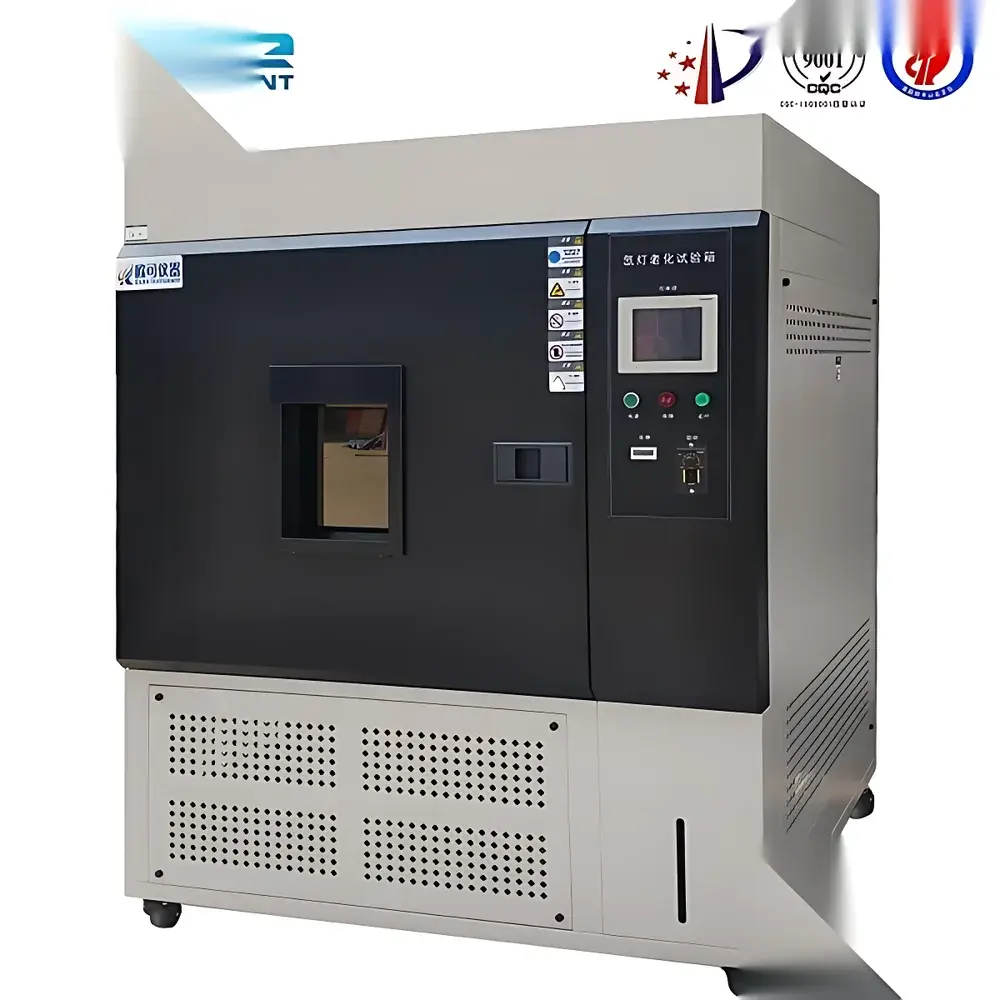
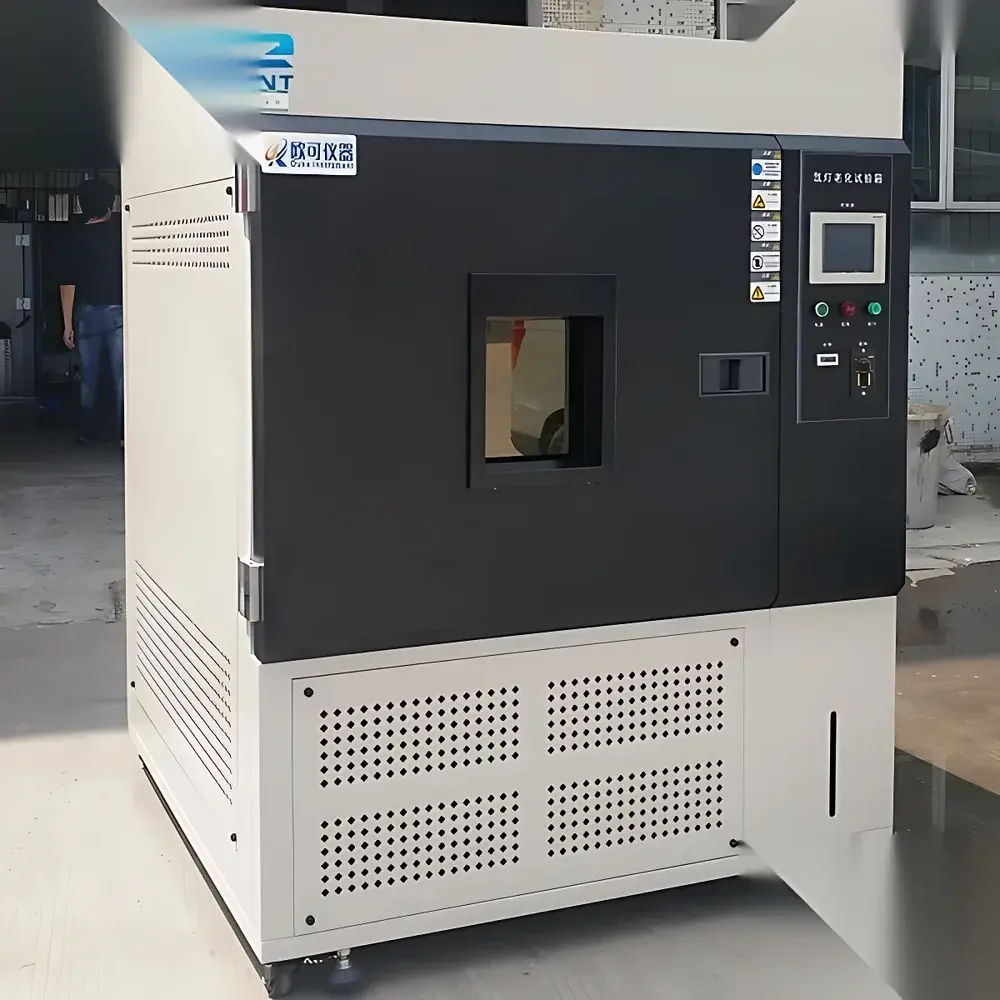
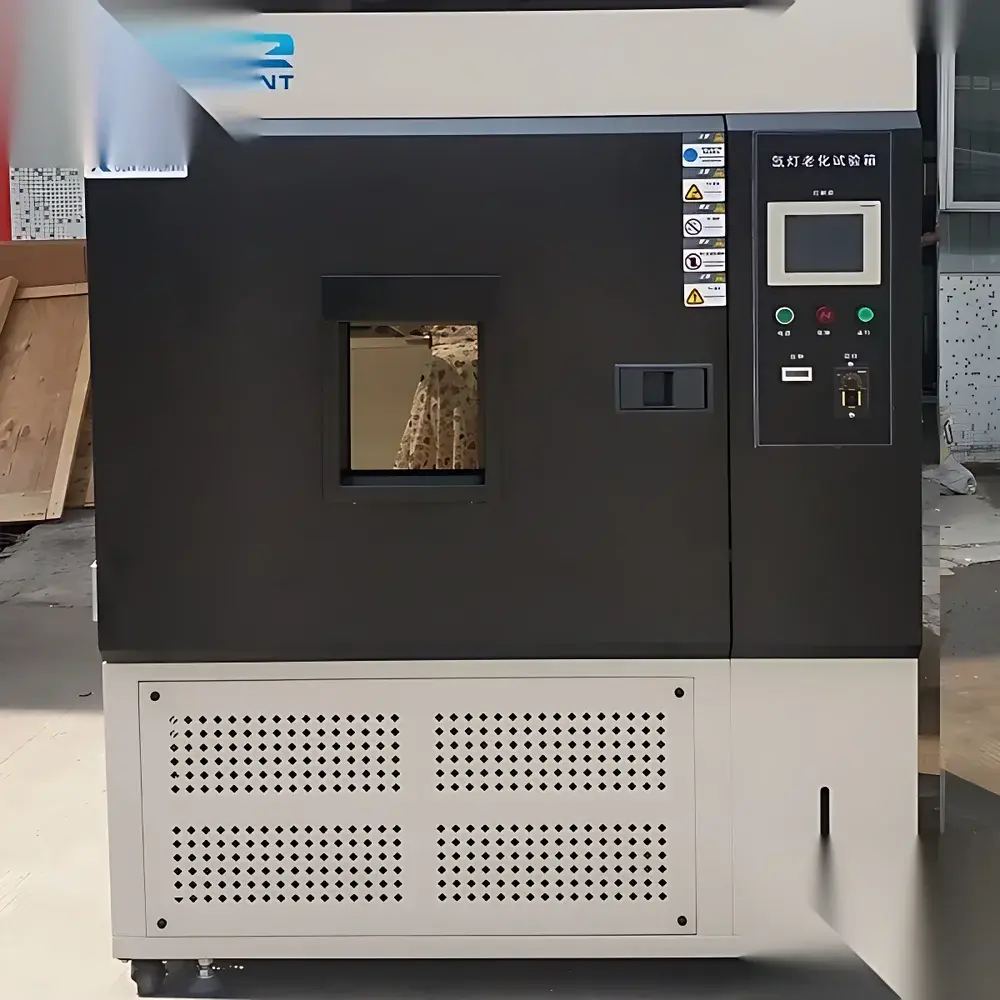
Xenon Arc Weathering Test Chamber OK-XD-1000
| Brand | Other Brands |
|---|---|
| Origin | Imported |
| Manufacturer Type | Authorized Distributor |
| Radiation Intensity | ≤50 W/m² (per GB/T 19394–2003, Clause 5) |
| Temperature Range | 40–70 °C |
| Temperature Uniformity | ±2 °C |
| Temperature Fluctuation | ±0.5 °C |
| Chamber Dimensions (W×D×H) | 1000 × 1000 × 1000 mm |
| Xenon Lamp Quantity | 4 pcs |
| Lamp Power | 40 W each |
| Black Panel Thermometer | Aluminum substrate |
| Sample Mounting Options | Rotating turntable or stainless steel shelf (user-selectable) |
| UV Spectral Options | UV-A (295–360 nm) or UV-B (280–315 nm) |
| Control System | TEMI-880 16-bit true-color touchscreen, 100 programmable profiles × 100 segments/profile, PID temperature regulation with overshoot suppression |
| Communication Interface | RS-485 for remote PC-based monitoring and control |
| Spray Nozzle | 1 unit |
Overview
The OK-XD-1000 Xenon Arc Weathering Test Chamber is an engineered environmental simulation system designed to replicate the damaging effects of sunlight, moisture, and heat on materials—particularly coatings, polymers, textiles, automotive components, and architectural finishes. It employs a xenon arc lamp as its radiation source, closely matching the spectral power distribution (SPD) of natural daylight across the ultraviolet (UV), visible, and near-infrared (NIR) regions (290–800 nm). Unlike fluorescent UV chambers, xenon arc systems provide more realistic solar simulation, enabling accelerated aging assessments aligned with international exposure standards such as ISO 4892-2, ASTM G155, SAE J2527, and AATCC TM16. The chamber’s robust thermal management—featuring PID-controlled heating with minimal overshoot and ±0.5 °C temperature fluctuation—ensures high reproducibility in long-term irradiation cycles. Its 1 m³ test volume accommodates full-size automotive panels, multi-specimen racks, or rotating sample turntables, supporting both static and dynamic exposure configurations.
Key Features
- Four 40 W xenon arc lamps delivering stable, spectrally calibrated irradiance up to 50 W/m² (measured at specimen plane, per GB/T 19394–2003 Clause 5)
- TEMI-880 16-bit true-color touchscreen controller with 100 user-defined test programs, each supporting up to 100 time-temperature-irradiance segments
- PID-regulated temperature system with adaptive overshoot suppression—critical for maintaining thermal stability during rapid irradiance ramping
- Integrated black panel thermometer (aluminum substrate) for accurate surface temperature measurement, complying with ISO 4892-2 requirements
- RS-485 interface enabling remote configuration, real-time data logging, and integration into centralized lab management systems
- Optional UV filter selection (quartz or borosilicate) to simulate outdoor or window-filtered exposure conditions
- Single spray nozzle for controlled water immersion cycles; compatible with deionized water supply systems to prevent mineral deposition on specimens
Sample Compatibility & Compliance
The OK-XD-1000 accommodates diverse sample geometries—including flat panels (up to 1000 mm × 1000 mm), molded parts, and flexible substrates—via either a motorized rotating turntable (ensuring uniform angular exposure) or fixed stainless steel shelves. All internal surfaces are electropolished stainless steel to resist corrosion from condensate and saline mist. The system meets core regulatory prerequisites for material qualification in automotive OEM specifications (e.g., Ford CETP, GMW14872), aerospace (SAE AMS 2772), and building product testing (ASTM D4329, ISO 11341). Its temperature control architecture supports GLP-compliant operation when paired with audit-trail-enabled software; data integrity aligns with FDA 21 CFR Part 11 requirements when used with validated third-party acquisition platforms.
Software & Data Management
While the TEMI-880 controller provides local profile execution and real-time parameter visualization, the RS-485 port enables bidirectional communication with Windows-based laboratory software suites (e.g., LabVIEW, custom Python/QT applications) for automated test sequencing, alarm logging, and raw sensor data export (CSV/Excel). Users may configure automatic irradiance calibration reminders, thermal deviation alerts, and lamp hour tracking—essential for preventive maintenance scheduling. All setpoints, actual values, and event timestamps are timestamped and stored internally for ≥30 days, satisfying minimum traceability expectations under ISO/IEC 17025-accredited testing laboratories.
Applications
This chamber is routinely deployed in R&D labs and QC departments for evaluating photochemical degradation mechanisms—including chalking, gloss loss, color shift (ΔE*), cracking, and adhesion failure—in organic coatings, plastic composites, sealants, and elastomers. It supports comparative studies between substrate pretreatments (e.g., phosphating vs. zinc-nickel plating), primer formulations, and topcoat chemistries under identical spectral and thermal stress profiles. In automotive Tier-1 supplier validation workflows, it replicates multi-year Florida or Arizona exposure in 1,000–2,000 hours—accelerated via controlled irradiance dosing and cyclic wet/dry phases. Academic researchers utilize its programmable UV filtering to isolate wavelength-dependent degradation kinetics in polymer photostabilizer development.
FAQ
What spectral filters are available, and how do they affect test severity?
Standard quartz inner filters yield full-spectrum output (290–800 nm); optional borosilicate outer filters attenuate wavelengths below 295 nm to simulate window-glass-filtered exposure—reducing UV-B intensity and extending test duration for indoor-use materials.
Can the chamber operate unattended for extended cycles (e.g., 1,000+ hours)?
Yes—provided proper lamp replacement intervals (typically every 1,500–2,000 hours), coolant level monitoring, and scheduled quartz sleeve cleaning per manufacturer guidelines. Remote supervision via RS-485 is recommended for long-duration runs.
Is black panel temperature (BPT) measurement traceable to NIST standards?
The aluminum black panel sensor is factory-calibrated against reference thermocouples traceable to national metrology institutes; users may perform field verification using a calibrated infrared thermometer per ASTM E2847.
Does the system support humidity control?
No—the OK-XD-1000 is configured for dry-heat + irradiance + spray cycling only. For combined humidity/irradiance testing, consider the OK-XD-1000H variant equipped with steam humidification and RH sensors.
How is irradiance uniformity verified across the test plane?
Uniformity is validated per ISO 4892-2 Annex B using a calibrated UV radiometer grid scan; typical results show ±15% irradiance variation over the central 70% of the specimen area.



