
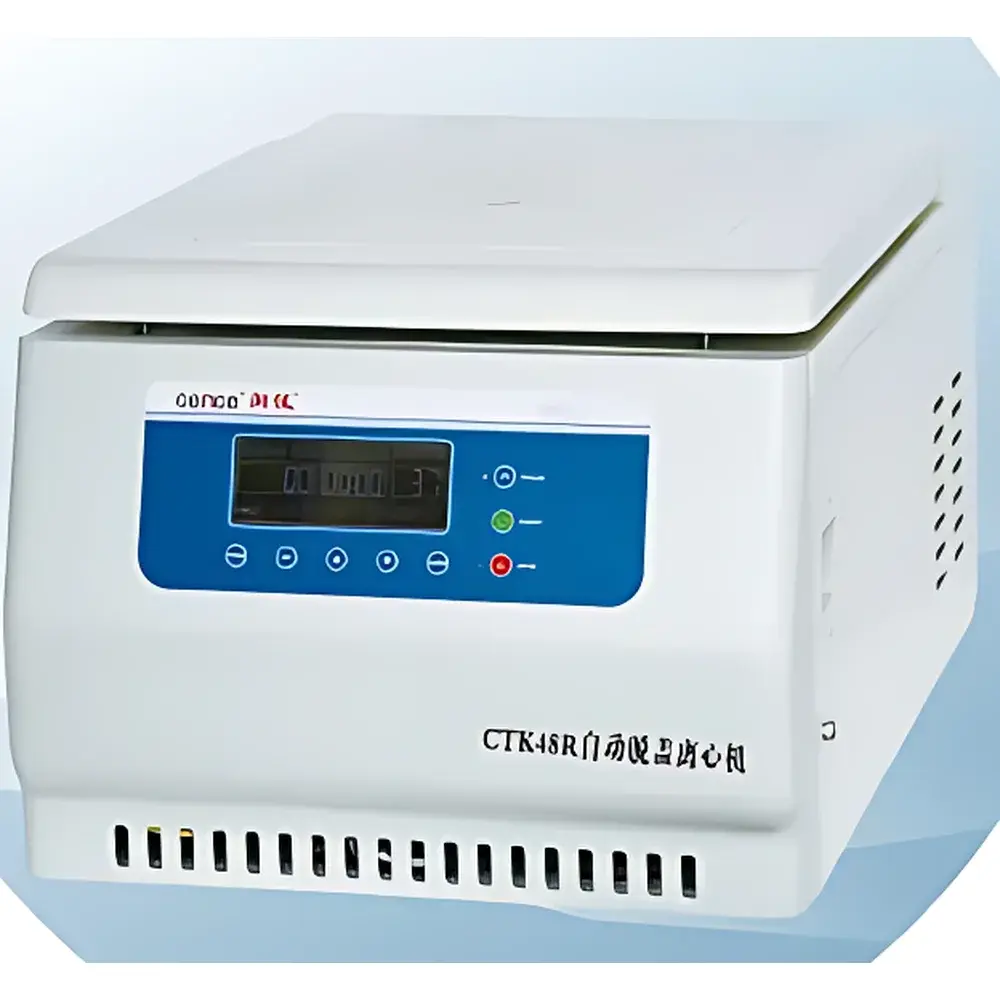
Xiangyi CTK48R Automated Cap-Removal Refrigerated Centrifuge
| Brand | Xiangyi |
|---|---|
| Origin | Hunan, China |
| Manufacturer Type | Direct Manufacturer |
| Product Category | Domestic |
| Model | CTK48R |
| Instrument Type | Benchtop Centrifuge |
| Speed Class | Low-Speed Centrifuge (≤4000 rpm) |
| Function | Refrigerated Centrifuge |
| Rotor Configuration | Horizontal Swing-Out Rotor |
| Separation Target | Large Organelles / Viruses |
| Max Capacity | 48 vacuum blood collection tubes (4 × 12) |
| Max Rotational Speed | 4000 rpm |
| Max RCF | 3030 × g |
| Dimensions | 470 × 730 × 380 mm (L × W × H) |
| Temperature Range | −20 °C to +40 °C |
| Temp. Accuracy | ±1 °C |
| Noise Level | ≤62 dB(A) |
| Power Supply | AC 220 V, 50 Hz, 10 A |
| Total Power | 1200 W |
| Net Weight | 70 kg |
| Refrigerant | R134a |
| Control Interface | Touchscreen LCD |
| Acceleration/Deceleration | Programmable rapid ramp-up/ramp-down |
| Automatic RCF Calculation | Yes |
| Safety Lock | Electronic lid interlock with auto-stop on lid opening during operation |
| Vibration Damping | Integrated high-damping suspension system |
| Balance Detection | Real-time automatic imbalance detection and compensation |
Overview
The Xiangyi CTK48R Automated Cap-Removal Refrigerated Centrifuge is a purpose-engineered benchtop solution designed specifically for high-throughput clinical laboratories processing vacuum blood collection tubes (VBCTs). Unlike conventional centrifuges requiring manual cap removal post-run — a step prone to sample disturbance, cross-contamination risk, and operator fatigue — the CTK48R integrates synchronized mechanical cap ejection directly into the centrifugation workflow. It operates on a horizontal swing-out rotor architecture, delivering precise, temperature-controlled sedimentation at up to 4000 rpm (3030 × g), optimized for separation of whole blood into serum/plasma layers while preserving integrity of large cellular components and viral particles. Its refrigerated capability maintains sample stability across extended runs, with active cooling ranging from −20 °C to +40 °C and thermal accuracy within ±1 °C — critical for assays sensitive to temperature-induced hemolysis or coagulation variability.
Key Features
- Integrated automated cap-removal mechanism achieving >90% success rate across standard 75 mm and 100 mm vacuum blood tubes
- Refrigerated operation with imported high-efficiency compressor and eco-friendly R134a refrigerant
- AC brushless frequency-controlled motor ensuring stable speed control, rapid acceleration/deceleration profiles, and low maintenance
- Intelligent touchscreen LCD interface with intuitive menu navigation, real-time parameter display, and programmable run settings
- Automatic RCF calculation and conversion based on rotor radius and set speed — eliminating manual lookup errors
- Dual-stage vibration suppression system incorporating precision-matched dampers and dynamic auto-balancing algorithms
- Comprehensive safety architecture: electronic lid interlock prevents start-up if door is unlatched; immediate motor cutoff upon abnormal lid movement during operation
- Noise-optimized enclosure design meeting ISO 21501-4 standards for laboratory acoustic environments (≤62 dB(A))
Sample Compatibility & Compliance
The CTK48R accommodates standard evacuated blood collection tubes conforming to CLSI H20-A3 and ISO 6710 specifications, including EDTA, heparin, citrate, and serum separator tubes (SSTs). Its 4×12 horizontal rotor configuration supports uniform load distribution and minimizes tube tilt during deceleration — essential for preventing re-suspension of separated phases. The instrument meets IEC 61010-1:2010 safety requirements for electrical equipment in laboratory use and complies with GB/T 19001–2016 (ISO 9001:2015) quality management standards. While not FDA-cleared as an IVD device, its operational parameters align with routine QC practices in CAP-accredited and GLP-compliant clinical labs performing CBC, coagulation panels, and serology workflows.
Software & Data Management
The embedded firmware supports time-stamped run logging with full traceability: date/time, rotor ID, speed, RCF, temperature, duration, and error codes. All data are stored locally on non-volatile memory and exportable via USB port in CSV format for integration into LIMS or ELN systems. Audit trail functionality records user login events and parameter modifications, supporting compliance with ISO 15189 and CLIA requirements for data integrity. No cloud connectivity or proprietary software installation is required — all operations remain self-contained and network-isolated to ensure data sovereignty and cybersecurity resilience.
Applications
- Routine serum/plasma preparation for clinical chemistry and immunoassay platforms
- Pre-analytical processing in blood banks and transfusion medicine units
- Viral load sample prep where cold chain integrity must be preserved through centrifugation
- Large organelle isolation (e.g., mitochondria, lysosomes) from peripheral blood mononuclear cells (PBMCs)
- High-volume outpatient lab environments requiring walk-away automation between centrifugation and downstream pipetting steps
- Research applications involving biobanking of stabilized biofluids under controlled thermal conditions
FAQ
What tube lengths does the cap-removal system support?
The CTK48R is calibrated for both 75 mm and 100 mm vacuum blood collection tubes, covering most globally standardized formats including BD Vacutainer®, Greiner Bio-One, and Sarstedt tubes.
Does the instrument support rotor validation or calibration reporting?
Yes — each rotor carries a unique identification code; users may log rotor usage cycles and perform periodic verification using external tachometers and thermocouples per internal SOPs.
Is the refrigeration system capable of maintaining −20 °C under continuous 4000 rpm operation?
The compressor and heat exchange system are rated for sustained operation at maximum speed and minimum temperature, verified per GB/T 28210–2011 environmental testing protocols.
Can the CTK48R be integrated into automated laboratory workcells?
It features dry-contact I/O ports (start/stop/pause/status signals) compatible with common PLC-based automation controllers, enabling synchronization with robotic arms or track systems.
What maintenance intervals are recommended for the cap-removal actuator?
Routine inspection every 6 months is advised; wear parts (e.g., silicone gripper pads) are field-replaceable without specialized tools and documented in the service manual.



