

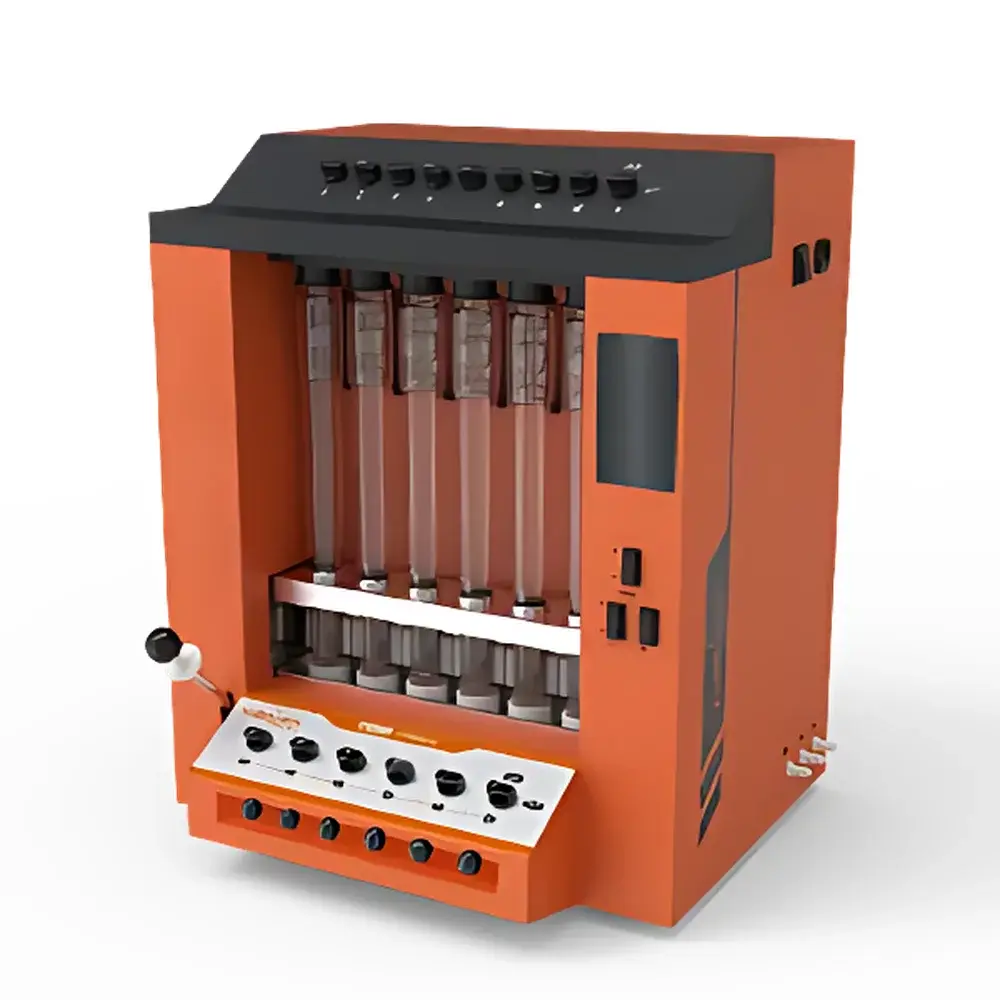
Xianjian SLQ-200 Acid-Base Digestion Fiber Analyzer
| Brand | Xianjian |
|---|---|
| Origin | Shanghai, China |
| Manufacturer Type | Direct Manufacturer |
| Country of Origin | China |
| Model | SLQ-200 |
| Pricing | Upon Request |
| Principle | Acid-Alkali Digestion (AOAC 962.09 / ISO 5498 / GB/T 6434) |
| Sample Capacity | 1–6 samples per run |
| Sample Mass Range | 0.5–3.0 g |
| Measurement Range | 0–100% crude fiber |
| Repeatability | ≤0.4% RSD |
| Total Cycle Time | ≤90 min |
| Heating Method | Semi-circular Silicon Carbide Heaters (Individually Controllable) |
| Temperature Control | Manual/Automatic Dual Mode, 0–200 °C |
| Heating Power Adjustment | Continuously Variable |
| Sealing System | Dual PTFE Isolation Gasket (Top & Bottom) |
| Liquid Delivery | Pressure-Driven Injection (vs. gravity-fed) |
| Reagent Preheating | Automatic Thermostatic Control with Over-Temperature Protection |
| Corrosion Resistance | Certified for H₂SO₄, NaOH, acetone, and other standard digestion solvents |
| Display | 4.3-inch HD Capacitive Touchscreen |
| Filtration System | High-Flow Vacuum Filtration with Chemically Resistant Components |
| Power Supply | 220 V ±10%, 50–60 Hz |
| Rated Power | 1600 W (main unit), 1350 W (anti-dry-boil digestion vessel) |
| Dimensions (W×D×H) | 560 × 460 × 660 mm |
| Net Weight | 45 kg |
Overview
The Xianjian SLQ-200 Acid-Base Digestion Fiber Analyzer is a fully integrated, laboratory-grade instrument engineered for the quantitative determination of crude fiber—defined as the residue remaining after sequential acid and alkali digestion, followed by ash correction—according to internationally recognized standard methods including AOAC Official Method 962.09, ISO 5498:1981, and Chinese national standard GB/T 6434. Unlike spectrophotometric or enzymatic alternatives, the SLQ-200 implements classical gravimetric fiber analysis based on controlled chemical solubilization: non-fibrous components (starches, proteins, lipids, pectins) are selectively removed using hot sulfuric acid and sodium hydroxide solutions, leaving behind lignin, cellulose, and hemicellulose as the crude fiber fraction. The system automates the entire digestion workflow—including reagent dosing, temperature-controlled boiling, vacuum-assisted filtration, and post-digestion rinsing—within a sealed, corrosion-resistant architecture. Its semi-circular silicon carbide heating elements enable precise, independent thermal control per digestion vessel (0–200 °C), eliminating cross-vessel thermal drift and ensuring method compliance across heterogeneous sample matrices.
Key Features
- Pressure-driven reagent injection system ensures rapid, bubble-free, and clog-resistant delivery of concentrated H₂SO₄ and NaOH—eliminating flow inconsistencies inherent in gravity-fed systems.
- Individually addressable silicon carbide heaters with dual-mode (manual/automatic) power regulation allow real-time optimization of digestion kinetics per sample, critical for variable feedstock composition (e.g., alfalfa vs. corn silage).
- PTFE-sealed dual-chamber digestion vessels provide full chemical isolation between acid and alkali stages, preventing cross-contamination and extending component service life under aggressive solvent exposure.
- Integrated anti-dry-boil protection and thermostatically regulated reagent preheating minimize thermal shock, reduce energy consumption by up to 30% versus conventional coil-based systems, and enhance operator safety.
- Ergonomic split-body design places reagent reservoirs at bench level—reducing manual handling strain and improving accessibility for operators of all stature—while maintaining full containment of hazardous vapors.
- 4.3-inch capacitive touchscreen interface supports programmable method storage, real-time temperature/pressure logging, and audible end-of-cycle alerts compliant with ISO/IEC 17025 documentation requirements.
Sample Compatibility & Compliance
The SLQ-200 is validated for use with solid or semi-solid organic matrices requiring standardized fiber quantification: cereal grains (wheat, barley, oats), compound animal feeds (poultry, swine, ruminant formulations), forage materials (hay, straw, silage), food by-products (brewers’ spent grain, soybean hulls), and botanical extracts. It meets mechanical and procedural prerequisites for AOAC 962.09, ISO 5498, and GB/T 6434, and its construction materials (PTFE seals, borosilicate glass digestion tubes, PVDF fluid paths) conform to ASTM D5191 for chemical resistance classification. All electrical components comply with IEC 61010-1 for laboratory equipment safety. Data integrity features—including timestamped method parameters, user ID logging, and non-editable cycle reports—support GLP/GMP-aligned workflows and internal audit readiness.
Software & Data Management
The embedded firmware provides traceable method execution without external PC dependency. Each run generates a CSV-compatible report containing: sample ID, mass recorded, digestion temperatures (acid/alkali phases), duration per stage, final dry/ash weights, and calculated crude fiber % with RSD. Reports include digital signatures verifying operator identity and system calibration status. Optional USB export enables integration into LIMS platforms or statistical process control (SPC) software. Audit trails retain all parameter modifications, error logs, and maintenance events for ≥12 months—fully satisfying FDA 21 CFR Part 11 requirements for electronic records when paired with institutional access controls.
Applications
- Quality assurance laboratories in compound feed mills validating nutritional labeling per EU Regulation 767/2009 and AAFCO guidelines.
- Academic research on forage digestibility modeling, where reproducible crude fiber data anchors NDF/ADF correlation studies.
- Contract testing facilities performing routine batch certification for organic feed certifications (e.g., EC 834/2007 Annex II).
- Grain inspection agencies conducting statutory compliance checks on imported cereals under national feed safety ordinances.
- Food ingredient suppliers characterizing functional fiber content in plant-based protein concentrates prior to regulatory dossier submission.
FAQ
What digestion standards does the SLQ-200 support out-of-the-box?
The instrument is factory-configured for AOAC 962.09 and ISO 5498; custom protocols (e.g., modified Weende or Van Soest fractionation) can be programmed via touchscreen.
Can the SLQ-200 perform sequential NDF/ADF analysis?
No—it is dedicated to crude fiber (CF) per classical acid-alkali definition. For neutral detergent fiber (NDF) or acid detergent fiber (ADF), a separate fiber analyzer with surfactant-compatible fluidics is required.
How is calibration verified during routine operation?
Users perform daily verification using certified reference material (CRM) cellulose (e.g., NIST SRM 1847); deviation >0.4% RSD triggers recalibration per SOP.
Is remote monitoring or network connectivity available?
The base model operates standalone; Ethernet or Wi-Fi modules are available as OEM add-ons for centralized lab management systems.
What maintenance intervals are recommended for sustained accuracy?
PTFE gaskets require replacement every 500 cycles; heating element calibration is advised annually or after 2000 operating hours, per ISO/IEC 17025 Clause 6.4.6.






