
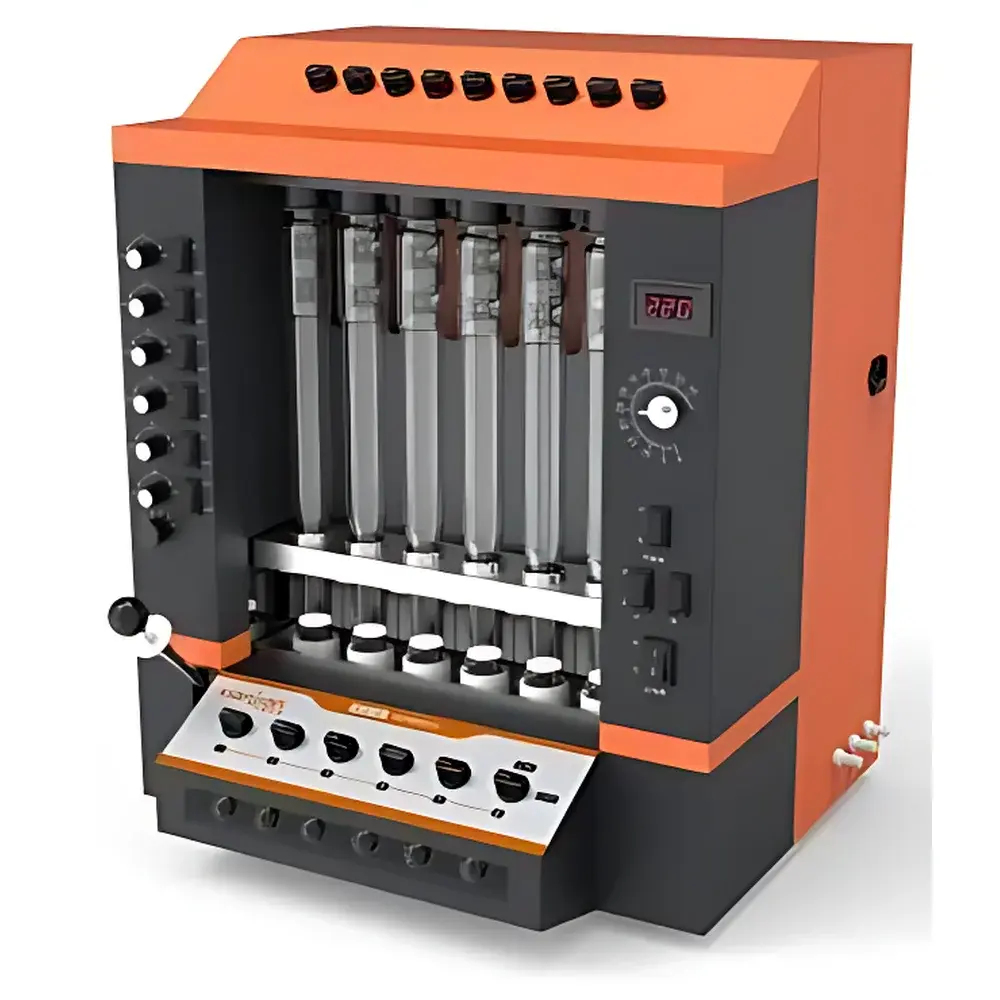
Xianjian SLQ-6A Acid-Base Digestion Fiber Analyzer
| Brand | Xianjian |
|---|---|
| Origin | Shanghai, China |
| Manufacturer Type | Direct Manufacturer |
| Region of Manufacture | Domestic (China) |
| Model | SLQ-6A |
| Pricing | Available Upon Request |
| Measurement Principle | Acid-Alkali Sequential Digestion (AOAC 978.10 / ISO 5498 / GB/T 6434) |
| Sample Throughput | 1–6 samples per run |
| Sample Mass Range | 0.5–3.0 g |
| Measuring Range | 0.00–99.99% (dry basis) |
| Repeatability | ≤0.4% RSD |
| Total Cycle Time | ≤90 min |
| Heating System | Individual Semi-Circular Silicon Carbide Heaters (Independent Temperature Control per Vessel) |
| Sealing Mechanism | Dual PTFE Isolation Gasket (Top & Bottom) |
| Liquid Delivery | Pressurized Injection System |
| Reagent Preheating | Automatic PID-Controlled Constant-Temperature Heating with Over-Temperature Protection |
| Chemical Resistance | Full Compatibility with 1.25 M H₂SO₄, 1.25 M NaOH, Acetone, and Neutral Solvents |
| Power Supply | 220 V ±10%, 50–60 Hz |
| Rated Power | 1600 W (Main Unit), 1350 W (Anti-Dry-Boil Digestion Module) |
| Dimensions (W×D×H) | 560 × 460 × 660 mm |
| Net Weight | 45 kg |
| Compliance | Designed to support AOAC Official Method 978.10, ISO 5498:2022, and GB/T 6434–2007 workflows |
Overview
The Xianjian SLQ-6A Acid-Base Digestion Fiber Analyzer is a dedicated benchtop instrument engineered for the quantitative determination of crude fiber—defined as the residue remaining after sequential acid and alkali digestion, followed by ash correction—according to internationally recognized standard methods including AOAC Official Method 978.10, ISO 5498:2022, and GB/T 6434–2007. Unlike near-infrared or enzymatic screening tools, the SLQ-6A implements a gravimetric wet-chemistry workflow based on controlled thermal hydrolysis under precisely regulated acidic (sulfuric acid) and alkaline (sodium hydroxide) conditions. This principle ensures high methodological fidelity for regulatory-compliant analysis in feed formulation, cereal quality control, nutritional labeling, and agricultural research laboratories where traceability to reference methods is mandatory.
Key Features
- Pressurized reagent injection system eliminates channel clogging and ensures consistent, pulse-free delivery of hot acid and alkali solutions—critical for uniform digestion kinetics across all six vessels.
- Independent semi-circular silicon carbide heating elements provide rapid thermal response and stable temperature maintenance (±1 °C) for each digestion vessel, enabling method-specific ramp profiles without cross-talk.
- Dual PTFE isolation seals prevent vapor leakage during reflux and minimize reagent carryover between cycles, enhancing inter-run reproducibility and reducing operator exposure risk.
- Modular benchtop layout separates reagent reservoirs from the main unit—improving ergonomics, simplifying refilling, and facilitating routine cleaning and maintenance per GLP requirements.
- Integrated anti-dry-boil protection and over-temperature cutoff circuits meet IEC 61000-4-5 surge immunity standards and comply with Class I electrical safety requirements for laboratory environments.
Sample Compatibility & Compliance
The SLQ-6A accommodates solid, powdered, or pelleted matrices typical of animal feedstuffs (e.g., soybean meal, alfalfa hay, corn silage), cereal grains (wheat bran, oat groats), food ingredients (psyllium husk, inulin powders), and botanical extracts. It supports full AOAC 978.10 protocol execution—including pre-extraction with petroleum ether, acid digestion (30 min at boiling), alkaline digestion (30 min at boiling), acetone washing, and final ash correction at 550 °C in an external muffle furnace. All wetted components—including digestion cups, tubing, and filter holders—are constructed from high-purity PTFE, borosilicate glass, and acid-resistant stainless steel (AISI 316), ensuring compatibility with aggressive reagents and long-term calibration stability. The system architecture permits audit-ready documentation when paired with validated lab notebooks and electronic records per FDA 21 CFR Part 11 Annex 11 guidelines.
Software & Data Management
The SLQ-6A operates as a standalone hardware platform with no embedded microprocessor or touchscreen interface. All timing, heating setpoints, and sequence logic are managed via front-panel mechanical timers and analog temperature controllers—ensuring deterministic behavior, electromagnetic interference resilience, and minimal validation burden in regulated settings. Users maintain full procedural control through printed SOPs and manual logbooks. For digital data capture, integration with LIMS or ELN systems is achieved via standardized weighing balance output (RS-232/USB) and optional barcode scanning of sample IDs prior to loading. No proprietary software installation or cloud dependency is required—supporting fully offline operation in GMP-compliant QC labs.
Applications
- Crude fiber quantification in compound feeds and premixes for compliance with EU Regulation (EC) No 767/2009 and AAFCO nutrient profiles.
- Validation of fiber claims on packaged food labels per FDA 21 CFR §101.9(c)(6)(i) and Codex Alimentarius Standard 206-1999.
- Research-grade fractionation of plant cell wall components: crude fiber (cellulose + lignin residues), hemicellulose (calculated by difference), and acid detergent lignin (when used in tandem with ADF analyzers).
- Quality assurance testing of forage crops during harvest and storage—tracking fiber maturity indices such as NDF (neutral detergent fiber) when combined with appropriate detergent formulations.
- Method transfer studies between contract laboratories and internal R&D teams requiring strict adherence to compendial protocols.
FAQ
Does the SLQ-6A comply with AOAC 978.10?
Yes—the instrument’s thermal profile, reagent delivery precision, and digestion vessel geometry are designed to replicate the operational parameters specified in AOAC Official Method 978.10, including reflux duration, temperature stability, and post-digestion filtration criteria.
Can it be used for neutral detergent fiber (NDF) analysis?
No—NDF requires neutral detergent solution (e.g., sodium lauryl sulfate + EDTA + sodium borate buffer) and α-amylase treatment; the SLQ-6A is configured exclusively for acid-alkali crude fiber protocols.
What maintenance is required for long-term accuracy?
Daily rinsing of PTFE seals and glassware with deionized water; quarterly verification of heater calibration using NIST-traceable thermocouples; annual inspection of pressure regulator integrity and hose elasticity.
Is third-party IQ/OQ/PQ documentation available?
Xianjian provides factory-issued Installation Qualification (IQ) templates and Operational Qualification (OQ) test scripts aligned with ISO/IEC 17025:2017 Annex A. Performance Qualification (PQ) must be executed in-house using certified reference materials (e.g., NIST SRM 1846).
How is operator safety ensured during high-temperature acid handling?
The system features full enclosure of boiling vessels, automatic vapor condensation via integrated cooling coils, PTFE-sealed quick-release clamps, and audible over-temperature alarms—meeting OSHA 29 CFR 1910.1200 hazard communication requirements.






