
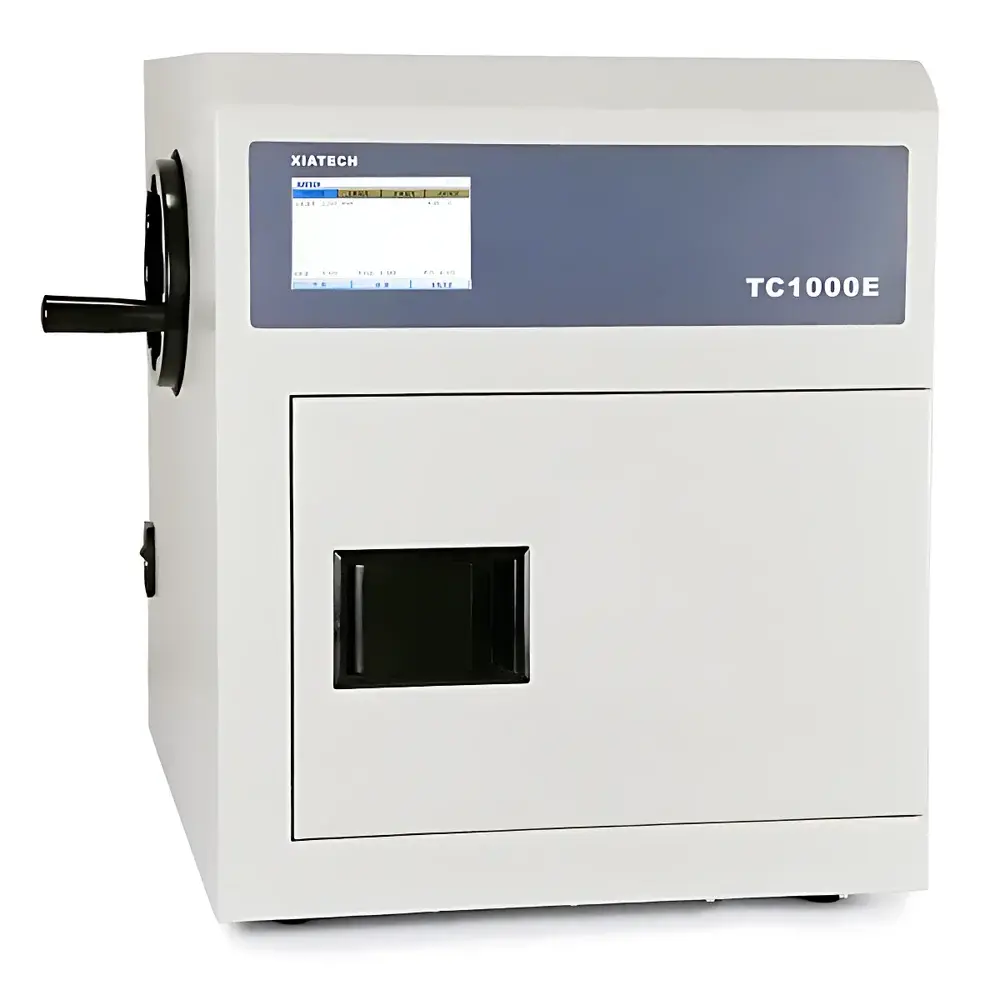
Xiatech TC1500 High-Temperature Guarded Hot Plate Thermal Conductivity Analyzer
| Brand | Xiatech |
|---|---|
| Model | TC1500 |
| Measurement Principle | Guarded Hot Plate Method |
| Temperature Range | Hot Plate RT+10 °C to 500 °C, Cold Plate RT+10 °C to 500 °C |
| Thermal Conductivity Range | 0.002–2.0 W/(m·K) |
| Resolution | 0.0001 W/(m·K) |
| Accuracy | ±5% (±3% within 100 °C) |
| Repeatability | ±1% |
| Sample Dimensions | 300 mm × 300 mm × (5–40) mm |
| Sample Form | Solid Block |
| Test Atmosphere | Ambient Air |
| Compliance | ASTM C177, ISO 8302, GB/T 10294 |
Overview
The Xiatech TC1500 is a precision guarded hot plate thermal conductivity analyzer engineered for high-temperature steady-state characterization of low-conductivity solid materials. Operating on the internationally standardized guarded hot plate principle (ASTM C177 / ISO 8302), the instrument establishes a controlled, one-dimensional heat flux across a flat, homogeneous sample sandwiched between a heated test plate and a cooled guard/backup plate. A concentric guard heater surrounding the main heating plate actively compensates for lateral heat loss—ensuring true unidirectional conduction and eliminating edge effects critical for metrological traceability. With its extended operational range up to 500 °C on both hot and cold plates, the TC1500 enables reliable thermal property evaluation under realistic service conditions encountered in building envelope systems, industrial insulation, fire-resistant composites, and advanced aerogel-based barriers.
Key Features
- High-temperature capability: Dual-zone temperature control supports stable operation from ambient +10 °C to 500 °C on both hot and cold plates, with temperature uniformity better than ±0.05 °C across each plate surface.
- Automated mechanical loading: Integrated motorized actuation applies consistent compressive force to minimize interfacial contact resistance while preventing sample deformation or fracture—particularly essential for fragile foams, fibers, and porous ceramics.
- Real-time thickness measurement: Non-contact displacement sensors capture sample thickness at test temperature, enabling dynamic correction of thermal resistance calculations and reducing systematic error from thermal expansion.
- Guarded thermal architecture: Active guard ring heating maintains isothermal boundary conditions around the central test area, enforcing strict adherence to the ideal one-dimensional Fourier conduction model required by international standards.
- Windows-native control software: Proprietary application provides fully automated temperature ramping, equilibrium monitoring, data acquisition, and uncertainty estimation per ISO/IEC 17025 guidelines; includes audit trail logging compatible with GLP/GMP environments.
Sample Compatibility & Compliance
The TC1500 accommodates rigid and semi-rigid solid blocks measuring 300 mm × 300 mm × 5–40 mm, including heterogeneous, anisotropic, and multi-layered configurations. It is validated for use with insulating materials such as polyurethane and phenolic foams, mineral wool, ceramic fiber boards, aerogel composites, refractory bricks, lightweight concretes, and metallized polymer laminates. All measurements comply with the fundamental requirements of ASTM C177 (Standard Test Method for Steady-State Heat Flux Measurements and Thermal Transmission Properties), ISO 8302 (Thermal insulation—Determination of steady-state thermal resistance and related properties—Guarded hot plate apparatus), and China’s GB/T 10294. The system meets traceability requirements for reference material calibration and supports uncertainty budgeting in accordance with ISO/IEC Guide 98-3 (GUM).
Software & Data Management
The TC1500 operates via a dedicated Windows-based platform featuring intuitive workflow navigation, real-time thermal profile visualization, and automated pass/fail validation against equilibrium criteria (e.g., <0.1 °C/h drift over 30 min). Raw sensor data—including thermocouple voltages, load cell outputs, and displacement readings—are timestamped and stored in open-format CSV files. The software implements built-in calculation routines aligned with ASTM C177 Annex A1 for thermal conductivity derivation, including corrections for lateral heat loss, contact resistance, and temperature-dependent sample expansion. Audit trails record all user actions, parameter changes, and calibration events, satisfying FDA 21 CFR Part 11 requirements for electronic records and signatures when configured with appropriate access controls.
Applications
- Building science: Quantification of λ-values for exterior insulation finishing systems (EIFS), structural insulated panels (SIPs), vacuum insulation panels (VIPs), and novel bio-based insulants under elevated service temperatures.
- Industrial insulation: Characterization of refractory linings, ceramic fiber modules, and calcium silicate boards used in petrochemical furnaces, kilns, and steam distribution networks.
- Aerospace & defense: Thermal property validation of ablative composites, nanostructured aerogel blankets, and multilayer insulation (MLI) assemblies for cryogenic and hypersonic applications.
- Materials R&D: Benchmarking of next-generation insulators including silica aerogels, carbon nanotube-reinforced foams, and phase-change composite boards.
- Standards laboratories: Primary certification of reference materials (e.g., NIST SRM 1450c) and inter-laboratory comparison studies under ISO/IEC 17025 accreditation scopes.
FAQ
What standards does the TC1500 comply with?
The TC1500 conforms to ASTM C177, ISO 8302, and GB/T 10294 for guarded hot plate method implementation, and supports uncertainty reporting in line with ISO/IEC Guide 98-3.
Can the TC1500 measure anisotropic or layered samples?
Yes—it accepts multi-layer stacks and orthotropic solids; however, directional conductivity requires orthogonal sample orientation and separate testing per axis.
Is vacuum or inert gas testing possible?
No—the TC1500 operates exclusively in ambient air; optional purge enclosures are not available in this configuration.
How is sample thickness measured during testing?
Integrated linear variable differential transformers (LVDTs) perform non-contact, temperature-compensated thickness monitoring before and during thermal equilibrium.
Does the system support automated calibration verification?
Yes—the software includes routines for periodic verification using certified reference materials and logs all calibration activities with user attribution and timestamps.



