
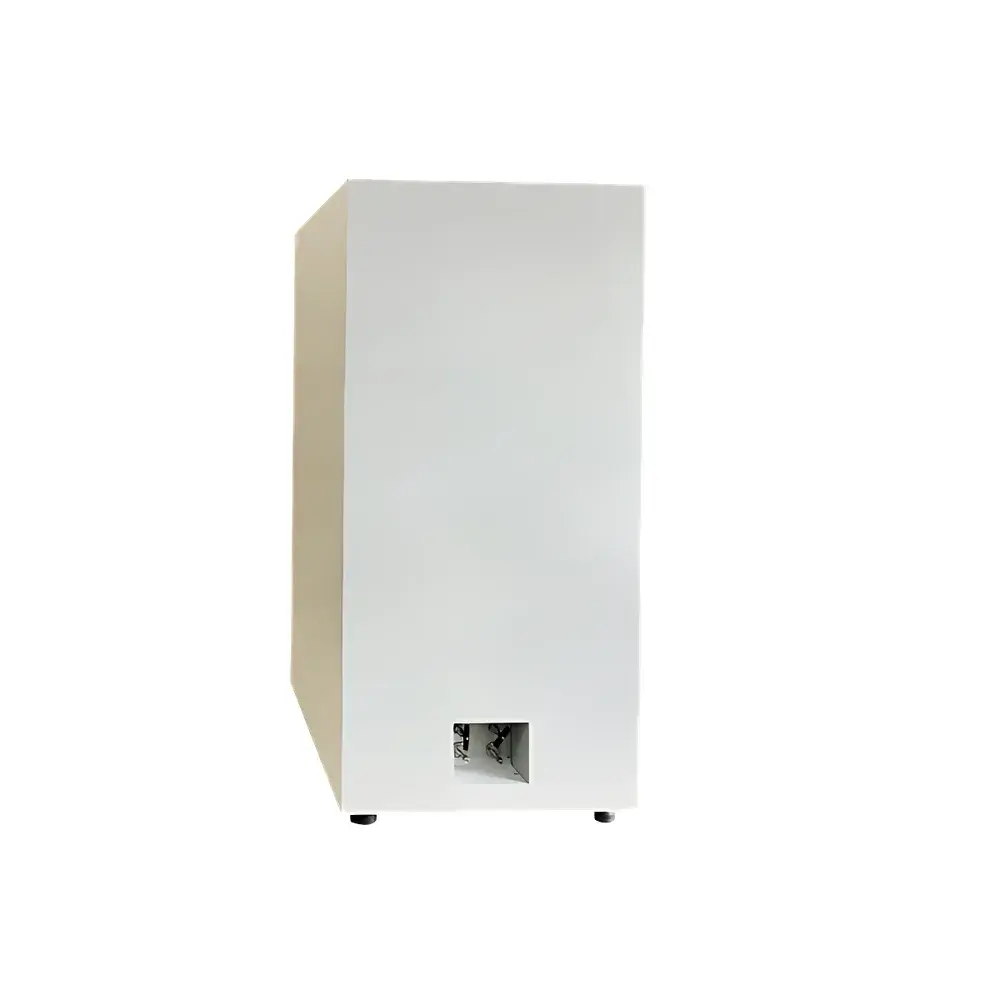
Xiatech TC3400L Cryogenic Gas Thermal Conductivity Analyzer
| Brand | Xiatech |
|---|---|
| Origin | Shaanxi, China |
| Model | TC3400L (Gas Version) |
| Measurement Principle | Transient Hot-Wire Method |
| Temperature Range | −160 °C to 25 °C |
| Thermal Conductivity Range | 0.0005–2 W/(m·K) |
| Accuracy | ±3 % |
| Repeatability | ±3 % |
| Pressure Range | 0.1–15 MPa |
| Sample Form | Gaseous |
| Test Duration | ≤2 s |
| Dimensions (L×W×H) | 50 cm × 50 cm × 80 cm |
| Compliance | Designed for ISO 22007-2 and ASTM D7896-compliant thermal transport characterization |
Overview
The Xiatech TC3400L Cryogenic Gas Thermal Conductivity Analyzer is an engineered solution for high-precision thermal transport characterization of gaseous media under extreme thermodynamic conditions. Based on the transient hot-wire (THW) method—recognized in ISO 22007-2 and ASTM D7896 as a primary standard for absolute thermal conductivity measurement—the instrument delivers traceable, model-independent results without calibration against reference fluids. Its core architecture integrates a micro-fabricated platinum wire sensor embedded in a hermetically sealed, pressure-rated cell capable of operation from −160 °C (73 K) up to ambient temperature (25 °C), enabling direct quantification of gas-phase thermal conductivity across cryogenic, sub-ambient, and near-room-temperature regimes. The THW principle relies on monitoring the time-dependent temperature rise of the heated wire following a short current pulse; thermal diffusivity is derived from the slope of the ln(ΔT) vs. ln(t) plot, and thermal conductivity is calculated via λ = α·ρ·cp, where density (ρ) and specific heat capacity (cp) are either known or determined in situ via pressure–temperature–density relationships. This first-principles approach ensures minimal dependence on empirical correlations and eliminates convective interference through sub-second measurement duration (≤2 s), effectively suppressing natural convection even at low-viscosity gases under high-pressure conditions.
Key Features
- Cryogenic capability down to −160 °C with active temperature control and high-stability Pt100/PT1000 sensing, enabling reproducible measurements across phase boundaries of common refrigerants (e.g., N2, CH4, CO2, H2)
- High-pressure cell rated to 15 MPa, with integrated pressure transducers (0.1–15 MPa range) and automated PID-controlled pressure regulation for isothermal P–λ mapping
- Transient hot-wire sensor with <1 µm diameter platinum filament, optimized for minimal perturbation and rapid thermal response
- Integrated data acquisition system sampling at ≥100 kHz, resolving thermal transients with sub-millisecond resolution
- Compact footprint (50 × 50 × 80 cm) designed for integration into gloveboxes, cryostats, or controlled-environment laboratories
- Thermal conductivity accuracy of ±3 % (k = 0.0005–2 W/(m·K)) and repeatability of ±3 %, validated per ISO Guide 98-3 (GUM) uncertainty propagation protocols
Sample Compatibility & Compliance
The TC3400L is exclusively configured for gaseous samples—including pure components (He, Ar, N2, O2, H2, CO2, CH4), binary and ternary mixtures, and reactive or corrosive gases (e.g., NH3, H2S) when compatible wetted materials (Hastelloy C-276, 316L SS, sapphire viewports) are selected. It supports inert and reducing atmospheres and is compatible with ultra-high-purity (UHP) gas handling systems. All measurement procedures adhere to the metrological framework outlined in ISO/IEC 17025:2017 for testing laboratories. Data integrity meets FDA 21 CFR Part 11 requirements for electronic records and signatures when operated with audit-trail-enabled software configuration. The system is routinely deployed in GLP-compliant R&D environments for thermophysical property validation in support of ASME B31.8, ISO 14489, and IEC 60270 applications.
Software & Data Management
Xiatech’s proprietary TC-Control Suite provides full instrument orchestration: real-time temperature/pressure ramping, automatic THW pulse triggering, raw transient signal visualization, and on-the-fly λ–T and λ–P curve generation. Export formats include CSV, HDF5, and XML for traceable interchange with MATLAB, Python (SciPy/Pandas), and commercial thermodynamic modeling platforms (e.g., REFPROP, Thermo-Calc). Audit trails record operator ID, timestamp, environmental parameters, and raw sensor voltage traces. Software supports user-defined test sequences, multi-point isobaric/isothermal sweeps, and batch processing of replicate runs with statistical summary (mean, SD, CV%). Optional integration with LIMS via RESTful API enables automated result ingestion into enterprise quality management systems.
Applications
- Development and validation of equation-of-state (EOS) models for cryogenic fluids used in LNG transport, hydrogen storage, and aerospace propulsion
- Thermal design of superconducting magnet cooling circuits, vacuum-jacketed piping, and cryocooler heat exchangers
- Characterization of greenhouse gas transport properties for climate modeling and carbon capture process simulation
- Quality assurance of industrial gas purity and composition verification (e.g., semiconductor-grade N2/Ar blends)
- Fundamental research on kinetic theory of gases, including rarefied gas effects and slip-flow regime transitions at elevated pressures
- Support for ASTM E2584 and ISO 10456 thermal property databases used in building energy simulation tools
FAQ
What gases can be measured with the TC3400L?
The analyzer supports all permanent and liquefiable gases, provided compatibility with wetted materials is confirmed. Common test media include nitrogen, argon, helium, methane, carbon dioxide, hydrogen, oxygen, ammonia, and sulfur hexafluoride.
Is calibration required before each test?
No. The transient hot-wire method is an absolute technique; calibration is performed once during factory verification using certified reference gases (N2, Ar) at NIST-traceable conditions. In-field verification uses internal resistance standards and temperature reference junctions.
Can the system operate inside a cryostat or environmental chamber?
Yes. The TC3400L features external feedthroughs for electrical, pressure, and temperature connections, allowing seamless integration into custom cryogenic enclosures while maintaining Class 1000 cleanroom-compatible sealing.
How is convection suppressed at low temperatures and high pressures?
By limiting measurement duration to ≤2 seconds—well below the characteristic convection timescale (τconv ∝ L²/α)—the THW method inherently decouples conductive heat transfer from buoyancy-driven flow, even for low-density gases at cryogenic temperatures.
Does the software support automated compliance reporting for ISO/ASTM standards?
Yes. TC-Control Suite includes preconfigured report templates aligned with ISO 22007-2 Annex A and ASTM D7896 Section 9, including uncertainty budgeting, outlier detection (Grubbs’ test), and metadata tagging for regulatory submission.



