
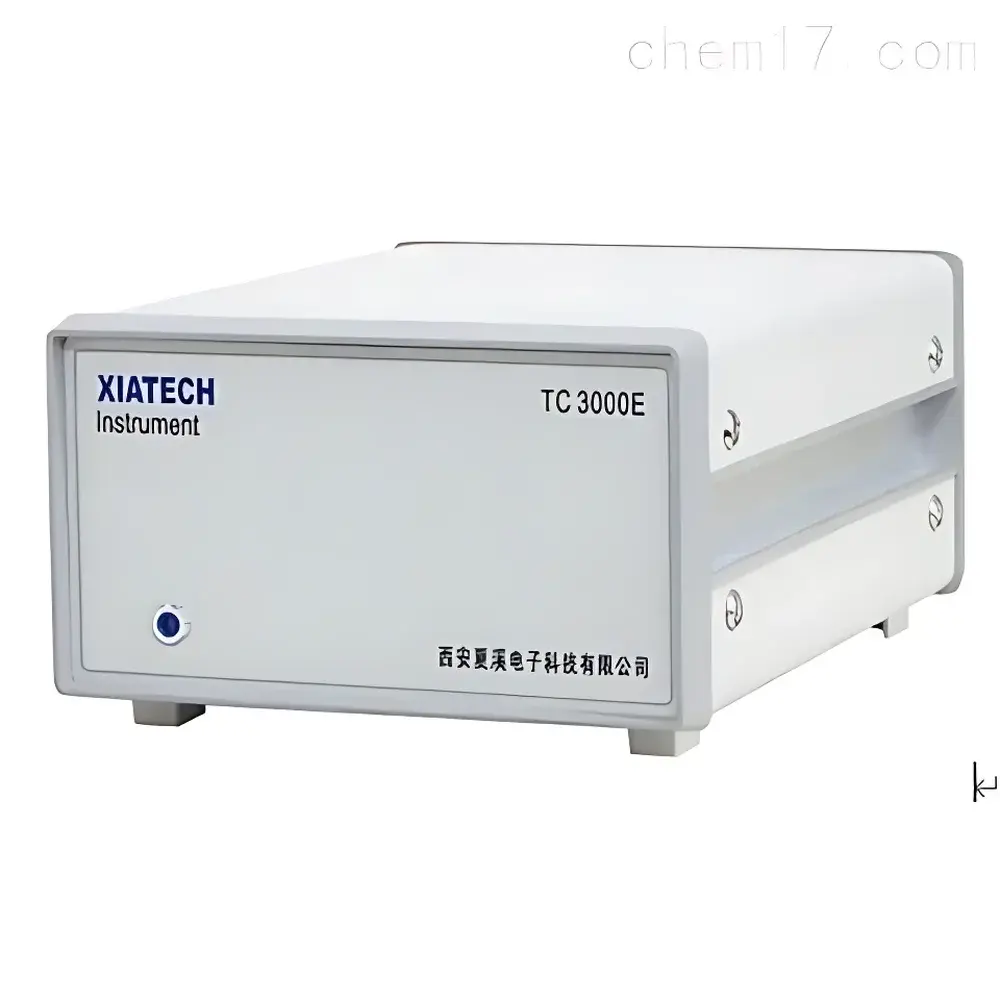
Xiatech TC5000E Transient Plane Source (TPS) Thermal Conductivity Analyzer
| Brand | Xiatech |
|---|---|
| Origin | Shaanxi, China |
| Model | TC5000E Series |
| Measurement Principle | Transient Plane Source (TPS) Method |
| Thermal Conductivity Range | 0.005–20 W/(m·K) |
| Accuracy | ±3% (thermal conductivity), ±5% (thermal diffusivity), ±7% (volumetric heat capacity) |
| Repeatability | ±3% (thermal conductivity), ±5% (thermal diffusivity), ±5% (volumetric heat capacity) |
| Sample Thickness Minimum | 0.3 mm |
| Sample Planar Dimension Minimum | 30 mm (side length or diameter) |
| Probe Diameter | 12.8 mm |
| Test Atmosphere | Ambient air |
| Temperature Range | −30 °C to 100 °C |
| Sample Forms Supported | Solid blocks, sheets, films, pastes, powders, granules, gels, and liquids |
| Shape Flexibility | Circular, square, or irregular |
| Data Interface | USB |
| Operating System | Windows-compatible |
| Compliance | ISO 22007-2, GB/T 32064–2015 |
Overview
The Xiatech TC5000E Transient Plane Source (TPS) Thermal Conductivity Analyzer is an engineered solution for rapid, non-destructive measurement of thermal transport properties in heterogeneous and temperature-sensitive materials. Based on the internationally standardized transient plane source method (ISO 22007-2), the TC5000E applies a thin, sandwiched nickel foil sensor that serves simultaneously as both a resistive heater and a resistance thermometer. Upon application of a constant current pulse, the sensor generates controlled joule heating while monitoring its own temperature rise over time. The resulting thermal response curve—governed by Fourier’s law and the heat diffusion equation—is inverted numerically to extract three fundamental thermophysical parameters in a single test: thermal conductivity (λ), thermal diffusivity (α), and volumetric heat capacity (ρcp). Unlike steady-state techniques, the TPS method inherently compensates for interfacial contact resistance, eliminating the need for thermal interface compounds or pressure-controlled clamping fixtures—critical for fragile, hygroscopic, or low-density samples such as aerogels, soils, biological tissues, and phase-change composites.
Key Features
- Single-test tri-parameter output: Simultaneous determination of λ, α, and ρcp without sequential calibration or auxiliary instrumentation.
- Minimal sample requirements: Accepts specimens as thin as 0.3 mm and as small as 30 mm in lateral dimension; no machining or surface polishing required.
- True non-destructive operation: No sample penetration, embedding, or thermal cycling beyond ambient conditions; preserves structural integrity and moisture content—essential for geotechnical, agricultural, and pharmaceutical applications.
- Universal geometry tolerance: Accommodates irregularly shaped solids, loose powders, semi-solids (e.g., thermal greases), and free-standing films without custom fixtures or sensor reconfiguration.
- Robust environmental adaptability: Validated performance across −30 °C to +100 °C; operates reliably under standard atmospheric conditions with no purge gas or vacuum enclosure needed.
- Integrated metrological traceability: Factory-calibrated against NIST-traceable reference materials; uncertainty budgets aligned with ISO/IEC 17025 guidance for accredited laboratories.
Sample Compatibility & Compliance
The TC5000E supports broad material classes—including insulating foams, graphite composites, polymer nanocomposites, hydrated soils, frozen foods, and organic phase-change materials—without sensor replacement or hardware modification. Its contact-resistance-immune architecture ensures stable measurements on low-conductivity media (e.g., silica aerogel, λ ≈ 0.015 W/(m·K)) and high-conductivity metals (e.g., aluminum, λ ≈ 200 W/(m·K)), though upper-range validation is limited to 20 W/(m·K) per ISO 22007-2 scope. All measurements comply with ISO 22007-2:2015 (“Plastics — Determination of thermal conductivity and thermal diffusivity — Part 2: Transient plane source (hot disc) method”) and GB/T 32064–2015 (“Determination of thermal conductivity of solid materials — Transient plane source method”). The system meets GLP documentation requirements through full audit trails, electronic signatures, and raw-data archiving—supporting regulatory submissions under FDA 21 CFR Part 11 when deployed with validated software configurations.
Software & Data Management
Bundled Windows-native software provides real-time acquisition, automated curve fitting, and uncertainty propagation per GUM (JCGM 100:2008). Each test session logs timestamped metadata—including ambient temperature, probe resistance drift, pulse duration, and signal-to-noise ratio—enabling retrospective root-cause analysis. Export formats include CSV, XML, and PDF reports compliant with LIMS integration standards. Version-controlled firmware updates preserve backward compatibility with legacy datasets, while role-based user permissions (administrator, technician, reviewer) enforce procedural adherence in multi-user QC environments.
Applications
- Quality control of thermal interface materials (TIMs) in electronics packaging
- Thermal property mapping of building insulation products per ASTM C518
- R&D screening of battery electrode composites and thermal barrier coatings
- In-field characterization of soil thermal resistivity for underground cable rating (IEC 60287)
- Stability assessment of paraffin-based phase-change materials across melt/freeze cycles
- Validation of computational fluid dynamics (CFD) input parameters for HVAC simulation
FAQ
Does the TC5000E require calibration standards for routine use?
No—factory calibration is retained across >10,000 test cycles; however, periodic verification using certified reference materials (e.g., SRM 1450c Standard Reference Glass) is recommended every 6 months for ISO 17025 compliance.
Can the instrument measure anisotropic materials?
Yes—the included anisotropy module enables directional thermal conductivity profiling via orthogonal sensor orientation and tensor-based inversion algorithms.
Is liquid-phase testing supported?
Yes; optional sample containment cells maintain meniscus stability during immersion tests, with correction for convective artifacts applied algorithmically per ISO 22007-2 Annex D.
What data security protocols are implemented?
All measurement files are SHA-256 hashed upon creation; electronic signatures adhere to PKI-based certificate authority frameworks compatible with enterprise identity management systems.
How is thermal contact resistance mitigated in practice?
The TPS method mathematically decouples interfacial resistance from bulk conduction by modeling the sensor-sample system as a two-layer transient diffusion problem—no mechanical pressure or thermal paste is necessary to achieve measurement validity.



