
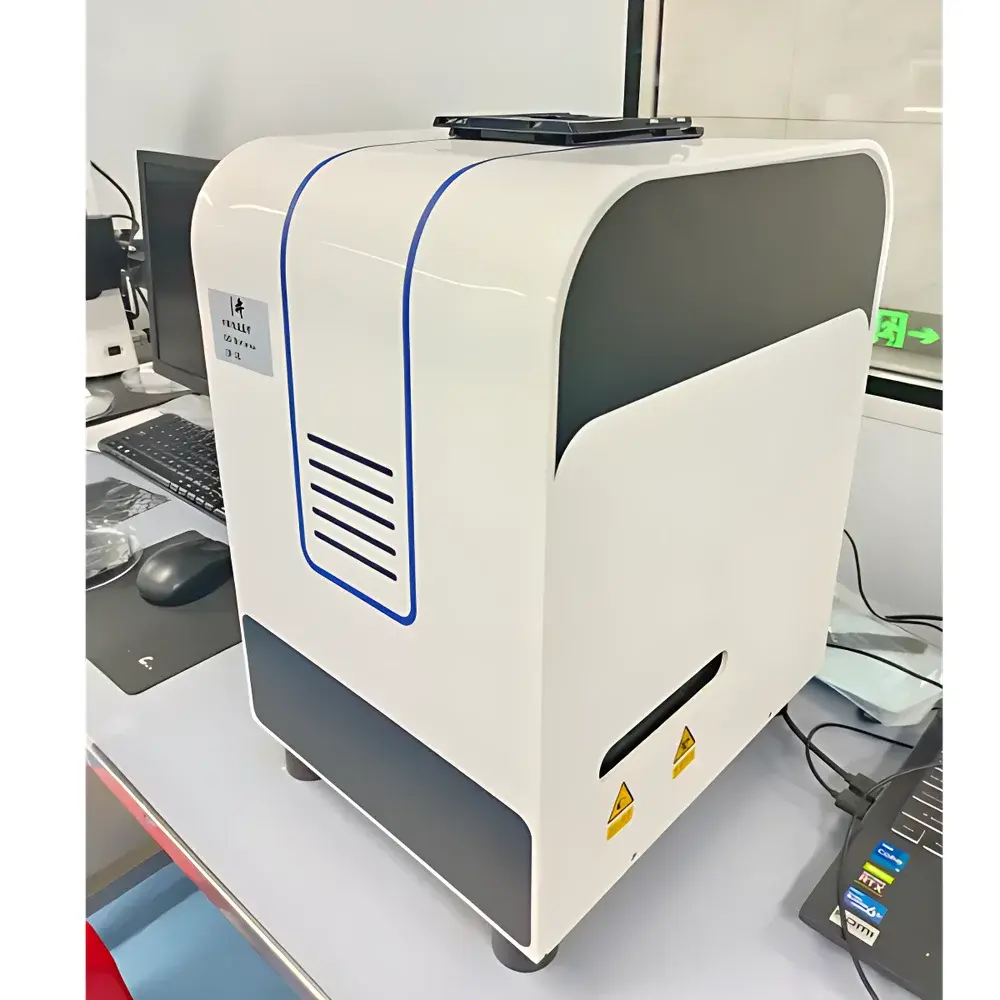
Xin Qiji® JX-8B Digital ELISA Biochip Scanner
| Brand | Bo-Semitech |
|---|---|
| Origin | Guangdong, China |
| Manufacturer Type | Authorized Distributor |
| Country of Origin | China |
| Model | JX-8B |
| Price | USD 42,000 (FOB) |
Overview
The Xin Qiji® JX-8B Digital ELISA Biochip Scanner is a compact, high-sensitivity optical detection platform engineered for digital enzyme-linked immunosorbent assay (dELISA) quantification on planar biochip substrates. Unlike conventional microplate-based ELISA readers, the JX-8B employs single-molecule fluorescence imaging coupled with automated pixel-level signal segmentation and Poisson statistical analysis to resolve analyte concentrations at sub-femtomolar levels. Its core architecture integrates a stabilized 488 nm solid-state laser excitation source, high-quantum-efficiency sCMOS imaging sensor (16-bit dynamic range, 6.5 µm pixel pitch), and precision motorized XYZ stage with sub-micron positioning repeatability. Designed specifically for chip-based immunoassays, the system supports both pre-patterned antibody arrays and user-defined spatial encoding—enabling true multiplexed quantification without spectral overlap constraints. The JX-8B operates under ambient laboratory conditions and requires no vacuum, cryogenic cooling, or fluidic integration, making it suitable for QC labs, translational research cores, and decentralized clinical testing environments where footprint, operational simplicity, and assay flexibility are critical.
Key Features
- Digital quantification via single-molecule counting: Converts analog fluorescence intensity into discrete event counts per defined detection zone, eliminating calibration curve dependency and improving inter-lot reproducibility.
- Modular detection zone configuration: Supports 2–10 independently addressable assay regions on a single chip—each configurable with unique capture antibodies, enabling custom multi-analyte panels without hardware modification.
- Ultra-rapid acquisition: Full-chip scan completed in ≤10 minutes (including autofocus, background subtraction, and digital count aggregation), reducing total assay turnaround time by >95% versus standard 3–4 hour ELISA protocols.
- Low-noise optical path: Optimized dichroic filtering and EMCCD-free sCMOS detection yield signal-to-noise ratios >120:1 at 0.1 pg/mL IL-6, validated across 16 independent replicates (CV < 16.2%).
- Embedded thermal stabilization: Peltier-controlled sensor housing maintains ±0.2°C stability during acquisition, minimizing thermal drift-induced pixel variance.
Sample Compatibility & Compliance
The JX-8B accepts standard 25 × 75 mm glass or polymer biochips with printed or spotted antibody microarrays—including nitrocellulose, PVDF, and hydrogel-coated substrates. It is compatible with common dELISA labeling chemistries (e.g., biotin-streptavidin-HRP/TSA amplification, Alexa Fluor 488/647 conjugates) and supports both direct and sandwich assay formats. All firmware and acquisition software comply with ISO/IEC 17025:2017 requirements for testing laboratories, and audit trail functionality meets FDA 21 CFR Part 11 criteria for electronic records and signatures. Raw image data and digital count logs are stored in vendor-neutral TIFF + JSON metadata format, ensuring interoperability with LIMS and third-party analysis pipelines.
Software & Data Management
The proprietary ScanQuant v3.2 software provides integrated workflow control—from auto-focus and exposure optimization to pixel thresholding, cluster identification, and Poisson-corrected concentration estimation. Each assay run generates traceable .qdx project files containing full acquisition parameters, raw TIFF stacks, segmented ROI maps, and export-ready CSV tables with confidence intervals. Built-in validation modules support linearity assessment (R² > 0.99 over 4-log dynamic range), cross-reactivity matrix evaluation, and LOD/LOQ calculation per ICH Q2(R2) guidelines. Data export supports ASTM E1384-compliant structured reporting and GLP-compliant archiving with role-based access controls.
Applications
- High-sensitivity cytokine profiling: Simultaneous quantification of human IL-4, IL-5, IL-6, IL-8, IL-1β, TNF-α, IFN-γ, and mouse IL-6, IL-1β, IFN-γ, IL-10 from serum, plasma, or cell culture supernatant.
- Clinical biomarker verification: Rapid validation of low-abundance markers (e.g., IL-6/PCT dual detection with LODs <1 pg/mL and <10 pg/mL, respectively) in sepsis triage workflows.
- Therapeutic antibody development: Monitoring target engagement and pharmacodynamic response in preclinical models using custom multi-epitope chips.
- Diagnostic assay translation: Bridging discovery-phase digital immunoassays to regulated use through scalable, GMP-aligned scanning infrastructure.
- Academic core facility deployment: Enabling shared-resource access to digital immunoassay capabilities without requiring dedicated cleanroom space or complex service contracts.
FAQ
What is the minimum detectable concentration for IL-6 using the JX-8B?
The limit of detection (LOD) for IL-6 is 0.054 pg/mL in single-analyte mode and <1 pg/mL in dual-analyte (IL-6/PCT) configuration, as determined by 3.3×σ of blank replicate measurements.
Does the JX-8B require specialized consumables or proprietary chips?
No. It accepts open-format biochips fabricated via standard contact/non-contact spotting or photolithography; users may source chips from third-party vendors or fabricate in-house.
How is calibration performed across multiple detection zones?
Each zone undergoes independent exposure optimization and background modeling; absolute quantification relies on internal reference standards co-spotted on-chip—not external plate-based calibrators.
Is remote monitoring or integration with laboratory information systems supported?
Yes. The system supports RESTful API endpoints for job submission, status polling, and result retrieval; HL7 and ASTM E1384 message mapping is available via optional middleware module.
What regulatory documentation is provided for installation qualification (IQ) and operational qualification (OQ)?
A complete IQ/OQ protocol package—including test scripts, acceptance criteria, and executed reports—is supplied with each unit and conforms to ISO 13485:2016 Annex A for in vitro diagnostic equipment.






