
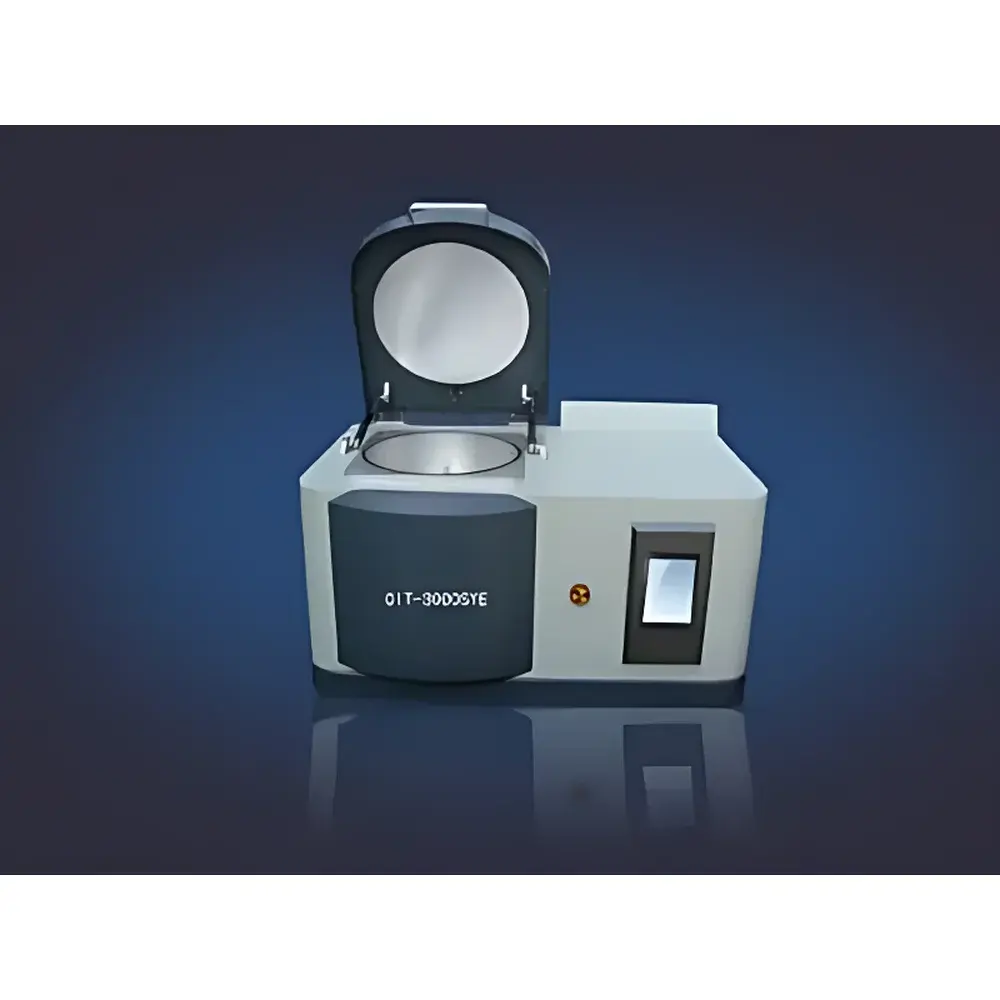
Xinxianda CIT-3000SYE Energy Dispersive X-Ray Fluorescence Spectrometer
| Brand | Xinxianda |
|---|---|
| Model | CIT-3000SYE |
| Origin | Sichuan, China |
| Detector Energy Resolution | <130 eV |
| Elemental Range | Na (Z=11) to U (Z=92) |
| Detection Limit | 1 ppm |
| Analysis Time | 120 s (auto-optimized) |
| Operating Voltage | 0–40 kV |
| Power Supply | AC 220 V ±10%, 50 Hz |
| Dimensions | 740 × 450 × 430 mm |
| Weight | ~55 kg |
| Sample Chamber | Ø300 × 100 mm (downward illumination) |
| Vacuum Capability | Yes |
| Software | Proprietary Windows-based EDXRF analysis suite with FP, empirical coefficient, and α-factor quantification methods |
| Compliance Support | ASTM E1621, ISO 8256, IEC 62321-5 for RoHS, GLP-ready audit trail & user access control |
Overview
The Xinxianda CIT-3000SYE is a benchtop energy dispersive X-ray fluorescence (EDXRF) spectrometer engineered for high-precision elemental analysis of metallic alloys and industrial materials. It operates on the fundamental principle of X-ray fluorescence: primary X-rays from a high-stability end-window X-ray tube (0–40 kV) irradiate the sample, causing inner-shell electron ejection; subsequent relaxation emits characteristic secondary X-rays whose energies are element-specific and intensities proportional to concentration. The instrument employs a Peltier-cooled silicon drift detector (SDD) with energy resolution better than 130 eV at Mn Kα, enabling robust peak separation and accurate quantification across the full detectable range—from sodium (Na, Z=11) to uranium (U, Z=92). Its downward-illumination geometry, combined with a vacuum-capable sample chamber (Ø300 × 100 mm), significantly enhances sensitivity for light elements (e.g., Mg, Al, Si, P, S) critical in brass, aluminum alloys, and RoHS-compliant electronics. Designed for laboratory and QC environments, the CIT-3000SYE delivers reproducible results with detection limits down to 1 ppm and quantitative accuracy validated against certified reference materials (CRMs) per ISO/IEC 17025 practices.
Key Features
- Digital pulse processing architecture with 2048-channel MCA for real-time spectral acquisition and automatic peak identification
- Vacuum-compatible sample chamber enabling optimized excitation and detection of elements from Na to U without matrix interference from air absorption
- Modular hardware design supporting future upgrades including additional collimators, automated sample changers, or helium purge options
- Integrated digital front panel displaying real-time parameters: tube voltage/current, sample stage position, vacuum status, and live count rate
- Bluetooth-enabled wireless communication for remote diagnostics and data transfer—eliminating cable clutter while maintaining secure, low-latency connection to host PCs
- Intelligent power management software that dynamically adjusts tube voltage and current based on sample composition, density, and thickness—maximizing detector utilization and extending X-ray tube service life
- Advanced spectral processing algorithms including FFT-based noise filtering, iterative background subtraction, derivative-based peak search, and Quasi-Newton optimization for peak fitting
- Multi-method quantification engine supporting Fundamental Parameters (FP), empirical coefficient calibration, and theoretical alpha-factor correction—ensuring traceability and adaptability across diverse alloy matrices
Sample Compatibility & Compliance
The CIT-3000SYE accommodates solid metals (cast, forged, machined), pressed powders, and thin-film coatings without chemical digestion or binder addition. Its circular downward-illumination cavity accepts irregularly shaped parts up to 300 mm in diameter and 100 mm in height. For regulatory compliance, the system supports full implementation of IEC 62321-5:2018 for restricted substance screening (Pb, Cd, Hg, Cr⁶⁺, Br) in electronics, as well as ASTM E1621–22 for alloy verification. Data integrity is reinforced through password-protected user roles, electronic signatures, and time-stamped audit trails compliant with FDA 21 CFR Part 11 requirements for regulated manufacturing. All calibrations are traceable to NIST SRMs, and measurement uncertainty budgets can be generated per ISO/IEC 17025 Annex A.5 guidelines.
Software & Data Management
The proprietary Windows-based analysis platform provides a fully localized GUI with context-sensitive help and intuitive workflow navigation. It includes an open calibration framework allowing users to build and validate custom calibration curves using in-house standards. Quantitative reports are exportable in Excel (.xlsx), PDF, or CSV formats—with configurable templates meeting internal QA/QC, supplier certification, or ERP integration needs. Spectral libraries support automatic phase identification for multi-phase alloys. Raw spectra and processed results are stored in a relational database with version-controlled backups; all modifications are logged with operator ID, timestamp, and reason code. Software updates are delivered free of charge for the instrument’s operational lifetime, incorporating new CRM libraries, regulatory method updates (e.g., EU RoHS 2023 revisions), and algorithm enhancements.
Applications
- High-volume verification of copper-zinc ratios in brass grades (C26000, C36000, etc.) and rapid sorting of scrap metal streams
- Quantitative analysis of aluminum alloys (e.g., 6061, 7075) for Mg, Si, Cu, Fe, and Mn content per ASTM B928
- RoHS and WEEE compliance testing of PCBs, connectors, solder, and housing materials
- Quality assurance of nickel-based superalloys (Inconel, Hastelloy) for Cr, Mo, Co, and Ti homogeneity
- Research-grade compositional mapping of intermetallic phases in heat-treated steels and titanium alloys
- Batch-to-batch consistency monitoring in foundry and extrusion processes
FAQ
Does the CIT-3000SYE require liquid nitrogen cooling?
No—the detector uses thermoelectric (Peltier) cooling, eliminating cryogen handling and enabling continuous unattended operation.
Can it analyze coated or plated samples?
Yes; the adjustable tube voltage (0–40 kV) and optional multi-layer calibration models allow depth-resolved analysis of electroplated layers (e.g., Ni/Cu on steel) and conversion coatings.
Is method validation documentation provided?
Yes—each system ships with a Factory Acceptance Test (FAT) report, spectral performance verification data, and a method development guide aligned with ISO 11097 for XRF validation.
What maintenance is required beyond routine vacuum pump oil changes?
Annual recalibration of high-voltage supply and detector energy scale is recommended; no optical alignment or mechanical servicing is needed due to solid-state detector and fixed-geometry design.
How is data security ensured during networked operation?
All Bluetooth and LAN communications use AES-128 encryption; local database access requires role-based authentication, and audit logs cannot be edited or deleted without administrator privileges.
Related Products





