
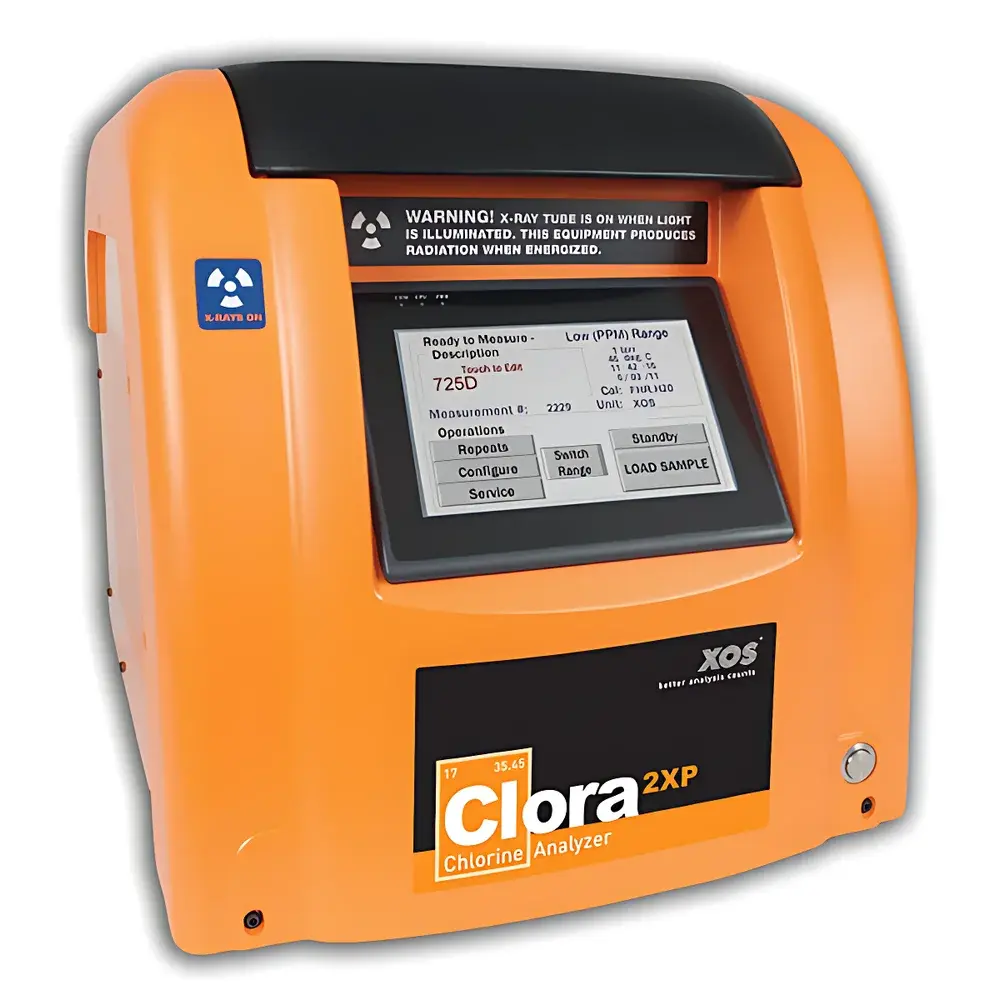
XOS Clora 2XP Monochromatic Wavelength-Dispersive X-Ray Fluorescence Chlorine Analyzer
| Brand | XOS |
|---|---|
| Model | Clora 2XP |
| Instrument Type | Benchtop |
| Excitation Principle | Monochromatic WDXRF (Single-Wavelength XRF) |
| Target Element | Chlorine (Cl) |
| X-ray Tube Power | 75 W |
| Detection Limit | 0.07 ppm (at 600 s) |
| Quantification Range | 0.07 ppm – 2 wt% |
| Sample Volume | ≤10 mL |
| Sample Membrane | Ethylene Tetrafluoroethylene (ETFE) film |
| Measurement Time | Adjustable from 30 to 900 seconds |
| Calibration | Multi-curve storage with automatic high-sulfur/low-chlorine correction |
| Motion-Free Optics | Dual hyperbolic bent-crystal optics (monochromator + analyzer) |
| Compliance | ASTM D7536-16, ASTM D4929-19 (Method C), SH/T 0977-2019 |
Overview
The XOS Clora 2XP is a benchtop monochromatic wavelength-dispersive X-ray fluorescence (WDXRF) analyzer engineered for ultra-trace chlorine quantification in petroleum and petrochemical matrices. Unlike energy-dispersive (EDXRF) or broadband WDXRF systems, the Clora 2XP employs a dual bent-crystal optical architecture to isolate and deliver a single, precisely tuned excitation line—optimized for resonant K-shell ionization of chlorine (Kα absorption edge at ~2.62 keV). This monochromatic excitation minimizes bremsstrahlung background and matrix-induced spectral interference, enabling exceptional signal-to-noise ratios essential for sub-ppm detection. The instrument is purpose-built for laboratories requiring regulatory-grade chlorine measurement in hydrocarbon liquids—including gasoline, diesel, jet fuel, naphtha, crude oil, lubricants, and biodiesel blends—as well as aqueous samples. Its design aligns with the physical principles of selective excitation and wavelength-specific fluorescence collection, delivering high reproducibility without chemical digestion, combustion, or carrier gas consumption.
Key Features
- Monochromatic excitation via dual hyperbolic bent-crystal optics: first crystal selects and focuses Cl-resonant X-rays (λ ≈ 0.473 nm) from a 75 W low-power X-ray tube; second crystal isolates only Cl Kα fluorescence for detection.
- Detection limit of 0.07 ppm Cl at 600-second counting time—validated per ASTM D7536-16 and SH/T 0977-2019 protocols.
- Zero-moving-parts optical path ensures long-term stability, eliminates mechanical drift, and reduces calibration frequency.
- Non-destructive analysis: samples remain intact post-measurement; no acid digestion, high-temperature oxidation, or gas-phase conversion required.
- ETFE sample containment: chemically inert, low-background polymer film supports direct liquid loading (≤10 mL) with minimal preparation.
- Integrated sulfur–chlorine inter-element correction algorithm compensates for spectral overlap and matrix effects in high-sulfur, low-chlorine hydrocarbons.
- Benchtop footprint (W × D × H: 45 × 50 × 35 cm) enables deployment in QA/QC labs, refinery on-site facilities, or third-party testing centers without infrastructure modification.
Sample Compatibility & Compliance
The Clora 2XP accepts homogeneous liquid samples—including volatile fuels, viscous residues, and aqueous chloride solutions—without derivatization. It complies with three core international standards governing chlorine analysis in petroleum products: ASTM D7536-16 (for aromatic hydrocarbons), ASTM D4929-19 Method C (for organic chloride in crude oil), and SH/T 0977-2019 (for light distillates in China’s refining sector). All method validations were performed using NIST-traceable reference materials and certified calibration standards. The system architecture supports GLP-compliant operation: audit trails, user access controls, electronic signatures, and data integrity features align with FDA 21 CFR Part 11 requirements when configured with validated software modules. No hazardous reagents, high-pressure gases, or open flames are involved—reducing operational safety risks and simplifying regulatory permitting.
Software & Data Management
Instrument control, acquisition, and quantification are managed through XOS’ Clora Studio software—a Windows-based application supporting method setup, multi-curve calibration management, real-time spectrum visualization, and automated report generation. Each measurement stores raw counts, net peak area, background-subtracted intensity, dwell time, and environmental metadata (temperature, humidity, tube voltage/current). Calibration curves are stored with full version history, including date/time stamps, operator ID, and reference standard lot numbers. Export formats include CSV, PDF, and XML for LIMS integration. Software updates are delivered via secure HTTPS; firmware revisions undergo full regression testing against ASTM-defined performance criteria prior to release.
Applications
The Clora 2XP serves critical quality assurance functions across the hydrocarbon value chain. In refineries, it monitors chlorine ingress during crude blending and feedstock procurement—preventing catalyst deactivation and ammonium chloride salt deposition in overhead systems. Downstream, it verifies chlorine compliance in finished fuels (e.g., ≤5 ppm Cl in ULSD per ISO 8217 and ASTM D975) and detects trace organochlorides in biofuel blends that may compromise engine durability. Third-party labs use it for contract testing under API RP 990 or CNAS accreditation scopes. Additional applications include monitoring chlorinated solvents in lube base oils, verifying chloride removal efficiency in desalting units, and screening water wash effluents for residual chloride prior to wastewater discharge.
FAQ
Does the Clora 2XP require daily calibration?
No. Due to its monochromatic, motion-free optical design and stable X-ray source, calibration verification is recommended every 72 hours or after major maintenance—per ASTM D7536-16 Section 9.4.
Can it analyze solid or viscous samples like asphalt or heavy fuel oil?
It is optimized for liquids. Highly viscous or suspended-phase samples must be homogenized and filtered (≤0.45 µm) prior to ETFE-film loading to ensure representative layer thickness and avoid self-absorption artifacts.
Is spectral interference from sulfur corrected automatically?
Yes. The built-in high-sulfur/low-chlorine correction applies empirically derived matrix coefficients based on simultaneous S Kα measurement and pre-loaded calibration models.
What detector technology is used?
A high-resolution silicon drift detector (SDD) with Peltier cooling ensures optimal energy resolution for Cl Kα (2.62 keV) discrimination against nearby spectral features.
Does the system support remote diagnostics or predictive maintenance alerts?
When connected to a corporate network and licensed for XOS RemoteConnect, firmware health metrics, tube aging trends, and crystal alignment diagnostics are transmitted securely for proactive service planning.
Related Products






