
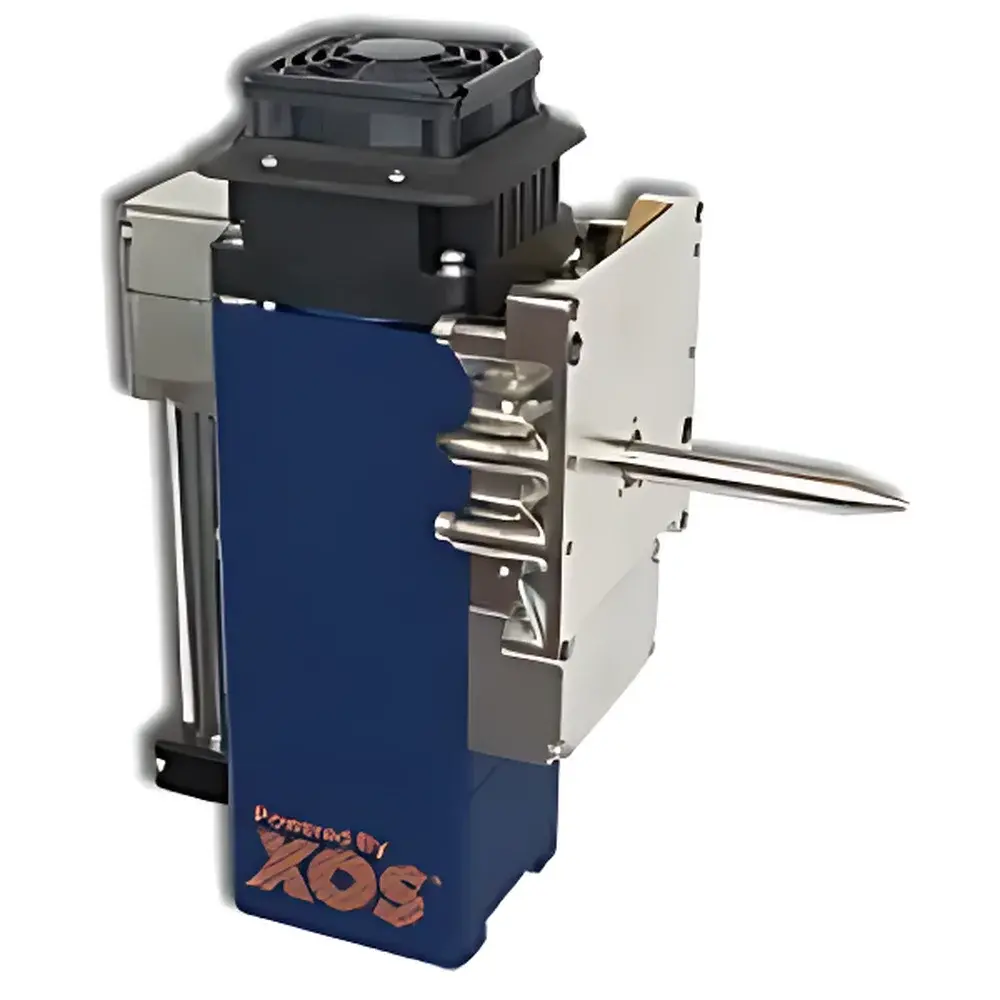
XOS fleX-Beam Multi-Capillary Microfocus X-ray Source
| Brand | XOS |
|---|---|
| Origin | USA |
| Model | fleX-Beam |
| Power Rating | 50 W |
| Focal Spot Size | 5 µm @ Rh Kα (20.162 keV) |
| Flux Density | >12 kW/mm² (with focusing optic) |
| Cooling | Integrated air-cooling system |
| Safety Compliance | PTB-compliant shutter, oil-free packaging, safety interlocks |
| Control Interface | PC-based software API |
| Optical Configurability | Interchangeable capillary optics or collimating apertures |
| Form Factor | Compact, OEM-integration optimized |
Overview
The XOS fleX-Beam is a high-brightness, microfocus X-ray source engineered for demanding analytical and imaging applications requiring exceptional spatial resolution and photon flux density. Based on advanced multi-capillary X-ray optics technology, the fleX-Beam operates on the principle of total external reflection within hollow glass capillaries—each acting as a waveguide to collect, steer, and focus divergent X-rays from a conventional microfocus electron-beam target. Unlike conventional sealed-tube or rotating-anode sources, the fleX-Beam achieves a focal spot size of ≤5 µm at Rh Kα (20.162 keV), enabling sub-micron-scale excitation volumes in X-ray fluorescence (XRF), micro-XRD, and high-resolution X-ray imaging systems. Its 50 W electron-beam power rating delivers >12 kW/mm² flux density when coupled with a focusing capillary optic—surpassing typical rotating anode performance while maintaining the reliability and footprint advantages of a compact, air-cooled architecture. Designed explicitly for OEM integration into benchtop analyzers, process monitors, and laboratory-grade instrumentation, the fleX-Beam serves as a core enabling component in next-generation elemental mapping, thin-film characterization, and non-destructive testing platforms.
Key Features
- Sub-5 µm focal spot size at Rh Kα emission line, verified per ISO 20632:2017 methodology for microfocus source characterization
- Multi-capillary optic assembly enabling high solid-angle collection efficiency (>40% geometric acceptance) and beam confinement without compromising source stability
- Modular optical interface supporting rapid interchange between focusing capillary optics and precision collimating apertures—enabling application-specific beam shaping without hardware reconfiguration
- Fully integrated air-cooling system eliminating need for external chillers or water lines; validated for continuous operation at rated power under ambient temperatures up to 35°C
- PTB-certified fast-response mechanical shutter with <5 ms actuation time and hardware-enforced safety interlock circuitry compliant with IEC 61010-1
- Oil-free vacuum packaging and all-metal internal construction ensuring long-term vacuum integrity and compatibility with cleanroom environments (ISO Class 5 compliant handling)
- PC-hosted control firmware with TCP/IP and USB 2.0 interfaces; supports remote triggering, real-time power monitoring, and fault logging via standardized SCPI command set
Sample Compatibility & Compliance
The fleX-Beam is compatible with a broad range of sample geometries and matrices—including powders, solids, liquids, thin films, and layered structures—when integrated into properly configured XRF, XRD, or X-ray tomography systems. Its low-power, high-brightness output minimizes thermal load on heat-sensitive samples (e.g., polymers, biological tissues, battery electrodes) while maintaining sufficient photon flux for quantitative trace-element detection down to sub-ppm levels in optimized configurations. The source meets electromagnetic compatibility requirements per FCC Part 15 Class B and CE EN 55011 Group 2 Class A. Vacuum integrity and radiation shielding design conform to ANSI N43.3-2020 and IEC 62495:2010 standards for analytical X-ray equipment. Full documentation package includes EU Declaration of Conformity, RoHS 2011/65/EU compliance statement, and traceable calibration records for focal spot measurement.
Software & Data Management
XOS provides a vendor-neutral software development kit (SDK) supporting Windows and Linux environments, enabling seamless integration into third-party instrument control frameworks (e.g., EPICS, LabVIEW, Python-based automation). The SDK includes APIs for real-time parameter adjustment (beam current, HV, shutter state), diagnostic telemetry (vacuum pressure, anode temperature, filament emission), and event-driven logging. All operational parameters are timestamped and stored in HDF5 format, supporting audit-ready data provenance required under GLP and FDA 21 CFR Part 11 environments. Optional add-on modules provide automated alignment routines, beam stability trending reports, and predictive maintenance alerts based on cumulative operating hours and emission drift thresholds.
Applications
- Micro-spot energy-dispersive X-ray fluorescence (μ-EDXRF) for geological core scanning and semiconductor wafer contamination analysis
- Confocal micro-XRF for 3D elemental depth profiling in cultural heritage artifacts and battery cathode cross-sections
- High-resolution X-ray diffraction (HR-XRD) of epitaxial thin films and nanocrystalline catalysts
- Phase-contrast and absorption-based micro-CT for low-Z material visualization (e.g., composites, foams, plant vasculature)
- In-line elemental monitoring in petrochemical refining and polymer extrusion processes using compact OEM spectrometers
FAQ
What is the expected lifetime of the fleX-Beam under continuous operation?
Typical cathode lifetime exceeds 8,000 hours at nominal 50 W operating conditions, with filament replacement possible in situ without breaking vacuum.
Does the fleX-Beam require external vacuum pumping after installation?
No—units ship fully evacuated and sealed with non-evaporable getter (NEG) technology; no user-initiated pump-down is required.
Can the source be operated in pulsed mode for time-resolved experiments?
Yes—shutter control supports TTL-triggered pulses down to 10 ms duration with jitter <100 ns; optional high-speed HV modulation available upon request.
Is the 5 µm focal spot size guaranteed across all X-ray energies?
Spot size is specified at Rh Kα (20.162 keV); measured values scale approximately with λ0.5, yielding ~6.2 µm at Cu Kα (8.04 keV) and ~4.3 µm at Mo Kα (17.48 keV).
How is beam alignment performed during system integration?
Integrated laser-assisted optical axis alignment tooling and motorized optic positioning allow field alignment to within ±2 µm positional accuracy using standard alignment targets and digital camera feedback.





