
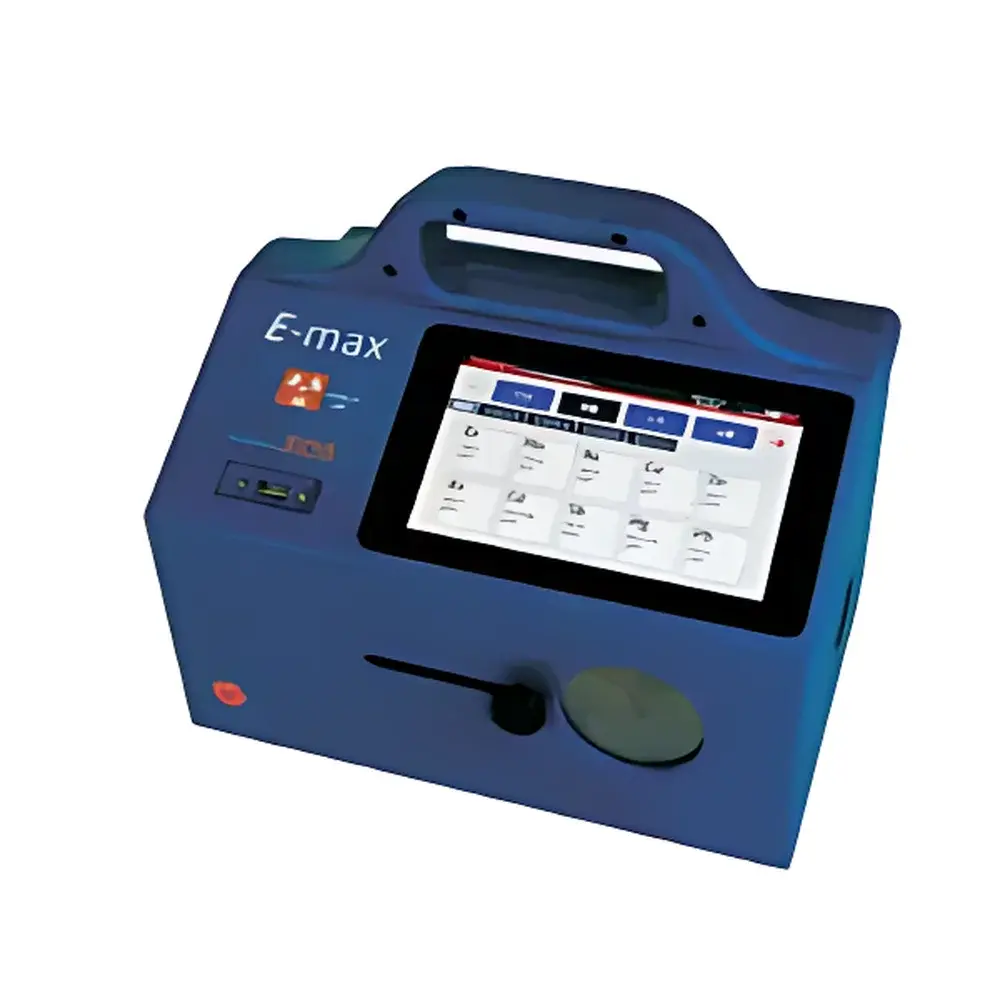
XOS E-max HDXRF Heavy Metal Analyzer
| Origin | USA |
|---|---|
| Manufacturer Type | Authorized Distributor |
| Origin Category | Imported |
| Model | E-max |
| Pricing | Available Upon Request |
Overview
The XOS E-max HDXRF Heavy Metal Analyzer is a field-deployable, high-performance benchtop instrument engineered for rapid, non-destructive quantification of toxic heavy metals in complex environmental and agricultural matrices. It leverages High-Definition X-ray Fluorescence (HDXRF) — a proprietary advancement over conventional Energy-Dispersive XRF (EDXRF) — to deliver laboratory-grade accuracy without sample digestion or chemical reagents. At its core, HDXRF employs a doubly curved crystal (DCC) optic that monochromatizes and focuses the primary X-ray beam onto a sub-millimeter spot on the sample surface. This targeted excitation dramatically enhances signal-to-noise ratio (SNR), enabling ultra-low detection limits and exceptional precision across heterogeneous substrates such as soils, sediments, rice flour, wheat grain powders, and dried plant tissues. Designed specifically for regulatory compliance workflows, the E-max meets the stringent sensitivity requirements of GB 15618–2018 (China’s Soil Risk Screening Values for Agricultural Land), EPA Method 6200 (Field Portable XRF for Elemental Analysis), and ASTM D8064–16 (Standard Practice for Determination of Metals in Soils by Portable XRF). Its measurement principle adheres to fundamental X-ray fluorescence spectroscopy: incident photons eject inner-shell electrons; characteristic secondary X-rays emitted during electron relaxation are energy-resolved by a Fast Silicon Drift Detector (SDD), enabling simultaneous multi-element identification and quantification.
Key Features
- Non-destructive analysis: No acid digestion, no hazardous reagents, no lab infrastructure required
- Sub-minute measurement cycles: Configurable acquisition time from 30 s to 600 s per sample
- Ultra-low detection limits: Cd LOD = 0.07 mg/kg in rice flour; 0.09 mg/kg in soil — well below GB 15618–2018’s 0.3 mg/kg screening threshold
- Multi-element capability: Simultaneous quantification of ≥40 elements including As, Cd, Cr, Cu, Hg, Ni, Pb, Se, Zn, and Sb
- Rugged portable design: 8 kg mass, 30 × 23.5 × 27 cm footprint, operational across –50 °C to +50 °C ambient conditions
- Dual power options: AC input (110–240 VAC ±10%, 50–60 Hz) and integrated 24 VDC/8 A rechargeable battery for extended field use
- High-fidelity optics: DCC monochromator with 50 kV / 1 mA microfocus X-ray tube and Fast SDD detector optimized for trace-level fluorescence yield
Sample Compatibility & Compliance
The E-max is validated for direct solid-phase analysis of unprocessed, minimally homogenized samples — eliminating matrix-induced bias from incomplete digestion. Certified reference materials (CRMs) including GBW100360 (rice flour), GSS-4 (soil), and NIST SRM 2710a (Montana soil) demonstrate consistent accuracy and reproducibility across diverse matrices. For soil testing, it complies fully with GB 15618–2018 Table 1 screening values and supports decision-making for land classification (e.g., priority control vs. safe utilization zones). In food safety applications, its quantification of Cd in polished rice meets China’s GB 2762–2022 maximum residue limits (0.2 mg/kg). Instrument performance aligns with EPA 6200 validation criteria for field-portable XRF: relative standard deviation (RSD) ≤10% for replicate analyses, limit of quantification (LOQ) ≤3×LOD, and recovery rates within 85–115% for certified concentrations. The system architecture supports audit-ready data integrity under GLP/GMP frameworks, with full traceability of calibration history, measurement parameters, and operator logs.
Software & Data Management
The E-max operates via XOS’ proprietary SpectraTrace™ software, providing intuitive workflow navigation for both novice and expert users. Software modules include Qualitative Scan Mode (elemental survey), Quantitative Mode (calibration-curve-based concentration reporting), and Method Editor (customizable acquisition protocols per matrix type). All spectral data, peak deconvolution results, and statistical summaries (mean, SD, RSD, LOD/LOQ) are stored in vendor-neutral .csv and .xlsx formats. SpectraTrace™ enforces secure user authentication, electronic signatures, and 21 CFR Part 11-compliant audit trails — including timestamped records of method changes, calibration updates, and result exports. Data synchronization with LIMS is supported via ODBC drivers and RESTful API endpoints. Firmware updates preserve backward compatibility with historical calibration sets and CRM libraries.
Applications
- Regulatory soil screening: Rapid cadmium mapping at agricultural sites to assess compliance with GB 15618–2018
- Crop safety monitoring: On-site quantification of As, Cd, Pb, and Hg in milled rice, wheat flour, and legume powders
- Remediation verification: Real-time tracking of metal removal efficiency during soil washing or phytoremediation campaigns
- Industrial site assessment: Multi-element profiling of contaminated sediments, sludges, and construction debris
- Research & development: High-throughput elemental phenotyping in plant breeding programs targeting low-metal-accumulating cultivars
- Import/export inspection: Border control screening of bulk grains and feedstuffs against national and Codex Alimentarius limits
FAQ
Does the E-max require sample digestion prior to analysis?
No. The HDXRF methodology enables direct solid-sample analysis without acid digestion, filtration, or solvent extraction.
What is the typical measurement time for a soil sample?
Standard protocol uses 120–300 seconds per measurement, depending on required LOD and target element concentration.
Can the E-max distinguish between different oxidation states of an element (e.g., Cr(III) vs. Cr(VI))?
No. HDXRF reports total elemental concentration only; speciation requires complementary techniques such as HPLC-ICP-MS.
Is factory calibration transferable between instruments?
Yes. XOS provides matrix-specific calibration kits traceable to NIST and CNAS-certified CRMs, enabling cross-instrument method portability.
How often must the instrument be recalibrated?
Calibration stability is verified daily using check standards; full recalibration is recommended every 90 days or after hardware maintenance.
Does the E-max support ISO/IEC 17025-compliant reporting?
Yes. SpectraTrace™ generates reports containing uncertainty budgets, CRM traceability statements, and measurement uncertainty estimates per ISO/IEC 17025 Annex A.3.







