
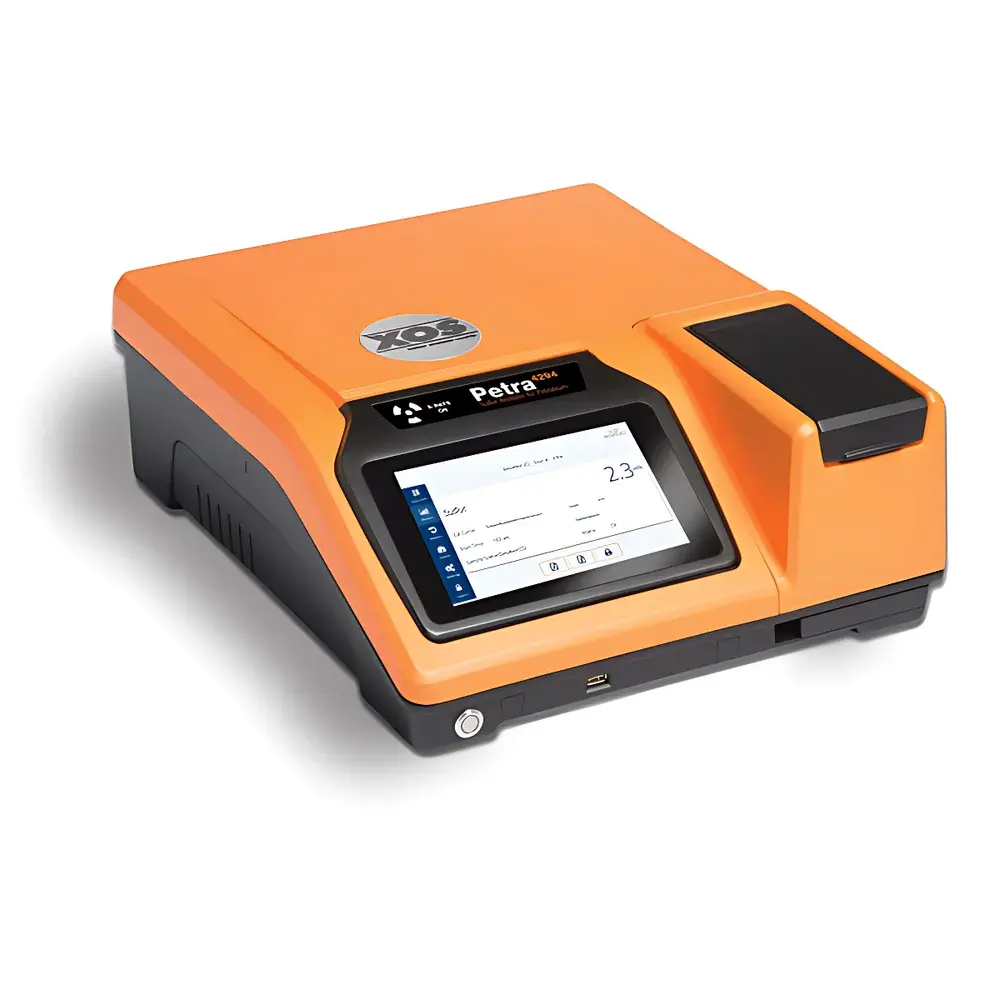
XOS Petra 4294 High-Resolution Energy Dispersive X-Ray Fluorescence (HDXRF) Sulfur Analyzer
| Brand | XOS |
|---|---|
| Model | Petra 4294 |
| Element Range | Sulfur (S) |
| Detection Limit | 2.6 ppm @ 600 s |
| Quantification Range | 2.6 ppm – 10 wt% |
| Energy Resolution | <140 eV (Mn Kα) |
| Repeatability | ≤2% RSD |
| Detector | Silicon Drift Detector (SDD) |
| Sample Format | Liquid or solid in disposable cups (vertical loading) |
| Compliance | ASTM D4294, ISO 8754, IP 336, GB/T 17040, GB/T 17606 |
| Power Requirement | Standard AC outlet (no gas, no combustion, no high-temperature operation) |
| Measurement Time | Adjustable from 30 to 900 seconds |
| Sample Volume | ≤10 mL |
| Footprint | Benchtop configuration with integrated drip tray and spill containment |
Overview
The XOS Petra 4294 is a benchtop high-resolution energy dispersive X-ray fluorescence (HDXRF) sulfur analyzer engineered for precise, non-destructive quantification of sulfur in petroleum-based liquids and solid fuels. Unlike combustion-based methods (e.g., UV fluorescence or microcoulometry), the Petra 4294 operates on fundamental XRF physics: primary X-rays excite sulfur atoms in the sample, inducing characteristic Kα (2.307 keV) and Kβ (2.464 keV) fluorescence emission, which is resolved by its high-performance silicon drift detector (SDD). The instrument’s <140 eV energy resolution at Mn Kα enables exceptional peak separation and ultra-low background detection—critical for achieving a certified limit of detection (LOD) of 2.6 ppm at 600-second integration time. Designed specifically for refinery QC labs, third-party testing facilities, and regulatory compliance units, the Petra 4294 delivers ASTM D4294–16–compliant results without sample digestion, inert gas consumption, or thermal decomposition—reducing operational overhead while maintaining metrological traceability.
Key Features
- High-resolution HDXRF optics with optimized beam collimation and dual-stage vacuum path for enhanced signal-to-noise ratio
- Vertical sample cup orientation with integrated spill containment system: accidental overflow is directed into a removable drip tray, isolating liquid from optical components and detector housing
- Silicon drift detector (SDD) with Peltier cooling and real-time pulse processing—no moving parts, no cryogenic maintenance
- Pre-configured calibration libraries for gasoline, diesel, jet fuel, crude oil, lubricants, coal, and biodiesel blends—each traceable to NIST SRMs and CRM-certified reference materials
- Optional QR-code–enabled sample cups: automatic metadata capture (batch ID, operator, timestamp) upon scanning—supports audit-ready data lineage
- Modular architecture permitting future integration of an automated XYZ sample handler (up to 48 positions)
- Self-diagnostic firmware with built-in spectral stability monitoring and daily performance verification protocol
Sample Compatibility & Compliance
The Petra 4294 accommodates homogeneous liquid samples (≤10 mL) in standard polyethylene or Mylar-bottomed cups, as well as finely ground solid fuels (e.g., coal, coke, catalysts) in low-background quartz cups. No filtration, dilution, or derivatization is required. All measurement protocols adhere strictly to internationally recognized standards: ASTM D4294–16 (standard test method for sulfur in petroleum and petroleum products via EDXRF), ISO 8754:2003, IP 336, and Chinese national standards GB/T 17040–2019 and GB/T 17606–2009. Instrument validation includes linearity assessment across the full 2.6 ppm–10 wt% range, precision verification per ASTM E177, and long-term stability monitoring per ISO/IEC 17025 requirements. Data output supports GLP/GMP-compliant reporting with electronic signatures and full audit trail functionality.
Software & Data Management
Controlled via XOS AnalyzePro™ v5.x software, the Petra 4294 provides intuitive workflow management—from method selection and acquisition parameter setup to real-time spectral visualization and statistical reporting. All raw spectra are stored in vendor-neutral .csv and .spc formats; processed results include concentration values, uncertainty estimates (k=2), and spectral quality metrics (peak-to-background ratio, FWHM stability index). The software complies with FDA 21 CFR Part 11 requirements through role-based access control, electronic signature logging, and immutable audit trails for all analytical events—including calibration updates, user logins, and report generation. Data export supports LIMS integration via ASTM E1384-compliant XML schema or direct ODBC connectivity.
Applications
The Petra 4294 serves as a primary sulfur screening tool across upstream, midstream, and downstream hydrocarbon value chains. It is routinely deployed for: sulfur specification verification in finished gasoline (Tier 3, Euro 6), diesel (ULSD), jet fuel (Jet A/A-1), and marine fuels (IMO 2020 compliance); rapid crude assay screening prior to distillation; catalyst poisoning assessment in FCC units; sulfur speciation support in hydrotreater feedstock qualification; and routine QC of lubricant additives and biofuel blends (B5–B20). Its robustness and minimal infrastructure demands make it equally suitable for mobile labs, field service vans, and contract testing laboratories operating under ISO/IEC 17025 accreditation.
FAQ
Does the Petra 4294 require helium purge or vacuum for sulfur analysis?
No—sulfur K-line fluorescence is efficiently detected in air. Optional vacuum mode is available for light-element enhancement (e.g., Cl, P), but not required for sulfur-only workflows.
Can the instrument analyze viscous or high-sulfur residuals like bunker fuel or bitumen?
Yes—provided samples are homogenized and loaded as stable, particle-free liquids. For highly viscous materials, pre-warming to 40–50°C (within cup tolerance) improves flow and surface uniformity.
How frequently must calibration be verified?
Per ASTM D4294, daily verification using a check standard is recommended; full multi-point calibration is typically performed weekly or after hardware maintenance.
Is method transfer possible between different Petra 4294 units?
Yes—calibration models are exportable and reproducible across instruments when using identical cup geometry, detector settings, and spectral processing parameters.
What cybersecurity measures are implemented in AnalyzePro™ software?
The software supports TLS 1.2+ encrypted communications, Windows Active Directory integration, and configurable password policies aligned with NIST SP 800-63B guidelines.
Related Products





