
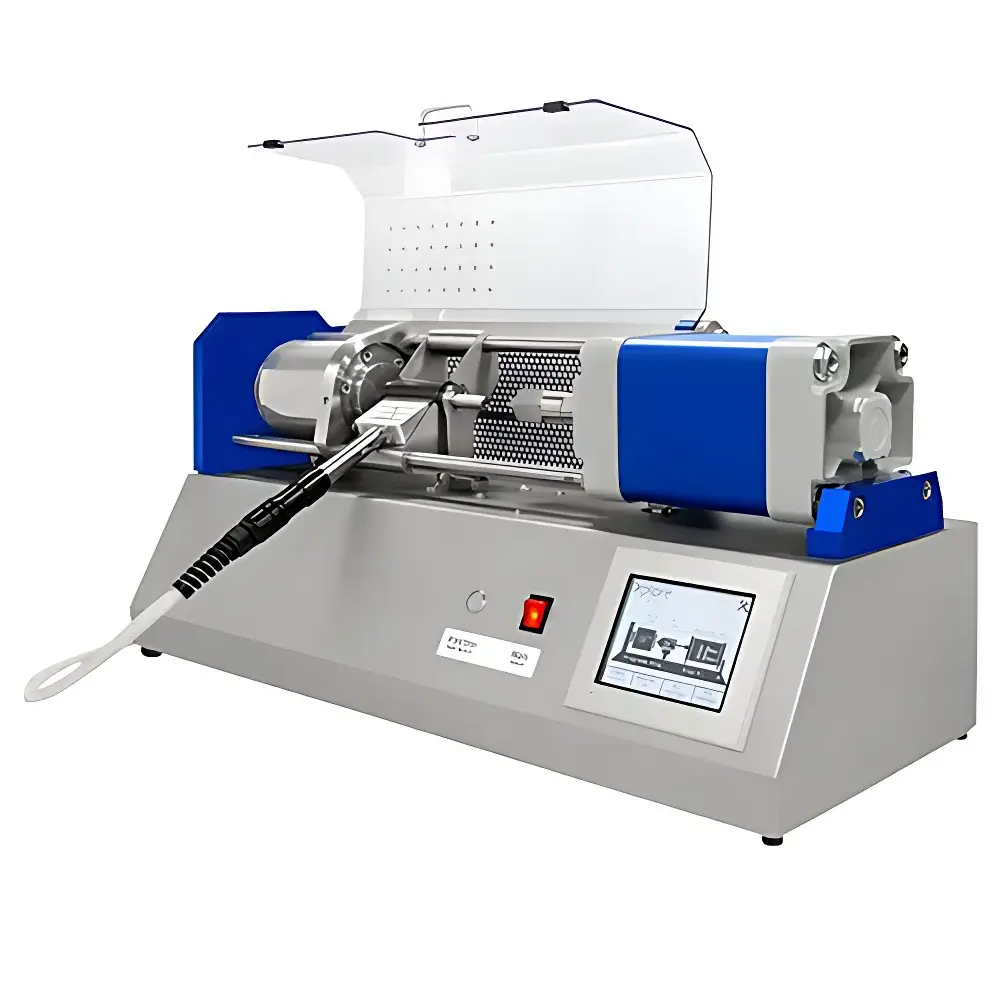
Xplore IM12 Micro Injection Molding Machine
| Brand | Xplore |
|---|---|
| Origin | Netherlands |
| Model | IM12 |
| Maximum Shot Volume | 12 mL |
| Mold Cavity Capacity | Up to 12 mL (geometry-dependent) |
| Split Mold Design | Heatable/Coolable |
| Max Barrel Temperature | 450 °C |
| Max Mold Temperature | 300 °C |
| Cooling Integration | Compatible with External Coolants |
| Max Injection Force | 12 kN @ 10 bar (1200 bar system pressure), 18 kN @ 16 bar (1800 bar system pressure) |
| Nozzle Heating Time (20 → 240 °C) | < 8 min |
| Power Supply | 208–240 V AC, Custom Voltages Available |
| Data Interface | USB for Real-Time Process Logging |
Overview
The Xplore IM12 Micro Injection Molding Machine is an engineered platform for precision thermoplastic processing at laboratory scale. Based on reciprocating screw injection molding principles—identical in core mechanics to industrial-scale systems—the IM12 delivers full process fidelity in a compact footprint. Its 12 mL maximum shot volume enables representative part production using as little as 5–20 g of polymer per cycle, making it ideal for formulation screening, material qualification, and regulatory-compliant prototype development where raw material cost, scarcity, or toxicity restrict conventional trials. Designed for benchtop or fume hood integration, the system maintains full thermal control, mechanical repeatability, and closed-loop pressure management—critical for generating data suitable for DOE-based optimization and ASTM D3641/D790/D638 correlation studies.
Key Features
- Compact, Modular Architecture: Fully self-contained unit with integrated drive, heating, cooling, and control electronics—no external hydraulic power units or chilled water loops required.
- Dual-Zone Thermal Management: Independent barrel and nozzle temperature control (up to 450 °C) paired with mold temperature regulation (up to 300 °C) across two discrete zones; compatible with both electric cartridge heaters and liquid-cooled mold inserts.
- Programmable Process Sequencing: Full cycle definition including plasticization time, injection speed profile, switch-over point (from velocity- to pressure-controlled phase), holding pressure duration and decay, and cooling time—all stored and recalled via onboard controller.
- High-Fidelity Force Delivery: Servo-hydraulic injection unit delivering up to 18 kN clamping force at 16 bar system pressure (equivalent to 1800 bar peak hydraulic pressure), ensuring consistent cavity filling even with high-viscosity or filled polymers.
- Split Mold Compatibility: Standard interface accepts custom-machined, two-plate split molds with integrated thermocouples and coolant channels; rapid mold change enabled by standardized mounting plates and alignment pins.
- Real-Time Data Acquisition: USB interface streams time-synchronized process variables—including melt temperature, nozzle pressure, screw position, injection speed, and mold surface temperature—at 10 Hz resolution for post-cycle analysis and traceability.
Sample Compatibility & Compliance
The IM12 accommodates a broad spectrum of thermoplastic materials, including commodity resins (PP, PE, PS), engineering polymers (PA6, PBT, PC), high-performance thermoplastics (PEEK, PEI, PPS), and reactive systems (e.g., LCPs, thermoplastic elastomers). Its low minimum shot volume supports evaluation of expensive or hazardous compounds—such as medical-grade biopolymers or flame-retarded formulations—without compromising statistical validity. The system meets essential safety and electromagnetic compatibility requirements per CE Directive 2006/42/EC (Machinery) and 2014/30/EU (EMC). While not certified as GMP-compliant out-of-the-box, its programmable parameters, audit-ready USB logging, and deterministic cycle execution support validation under ISO 13485, FDA 21 CFR Part 11 (when paired with compliant software), and internal GLP protocols for preclinical device prototyping.
Software & Data Management
Control and monitoring are managed via Xplore’s proprietary Windows-based IM-Studio software, which provides intuitive graphical configuration of all process parameters and real-time visualization of pressure/temperature/speed curves. All cycle logs are saved in CSV format with embedded timestamps, operator ID fields, and version-stamped parameter sets—enabling full traceability from raw material lot to molded specimen. The software supports automated report generation aligned with ISO 9001 documentation standards, including cycle summary statistics (mean, standard deviation, Cp/Cpk) for key outputs such as part weight, dimensional stability, and surface finish consistency. Optional API integration allows direct linkage to LIMS or MES platforms for enterprise-level data governance.
Applications
- Rapid screening of polymer formulations prior to pilot-scale extrusion or full-scale molding
- Development and validation of medical device components under ISO 10993 biocompatibility testing workflows
- Processing window mapping for novel bio-based or recycled feedstocks
- Thermal degradation studies via controlled residence time variation at elevated melt temperatures
- Tooling verification using functional micro-parts prior to investment casting or insert molding tool fabrication
- Academic research in polymer rheology, crystallization kinetics, and fiber orientation modeling
FAQ
Can the IM12 be used without a twin-screw micro-compounder?
Yes. While optimized for seamless integration with the Xplore MC15 micro-compounder for in-line blending and masterbatch dilution, the IM12 operates independently with pre-dried or pre-compounded granules.
What mold interface standard does the IM12 use?
It employs a proprietary Xplore quick-change plate system (120 mm × 120 mm mounting pattern) compatible with custom aluminum or steel molds; third-party adapters for standard DME or Hasco base plates are available upon request.
Is vacuum venting supported for moisture-sensitive resins?
The standard configuration includes a vented barrel option with optional vacuum pump interface (−0.8 bar absolute) for volatiles removal during plasticization.
How is calibration maintained over time?
Temperature sensors are NIST-traceable Class A PT100 elements; pressure transducers are factory-calibrated annually. Users may perform routine verification using reference thermocouples and dead-weight testers per ASTM E74.




