Xplore MC 40 Micro Vertical Compounder
| Brand | Xplore |
|---|---|
| Origin | Netherlands |
| Model | MC 40 |
| Max Torque | 40 Nm (1–500 rpm) |
| Batch Capacity | 40 mL |
| Max Temperature | 425 °C |
| Heating Time (80 → 240 °C) | <15 min |
| Cooling Time (240 → 80 °C) | <10 min (water-cooled) |
| Screw Speed | 1–500 rpm |
| Max Melt Pressure | 250 bar |
| Barrel Material | DIN 1.4112 steel, 54 HRC, 2000 HV coating |
| Screw Coating | 1000 HV |
| Heating Zones | 7 thermocouples + 12 heater cartridges |
| Drive Power | 1350 W |
| Dimensions (H×W×D) | 95 × 50 × 27 cm |
| Weight | 150 kg |
| Control Interface | Integrated touchscreen or USB-connected PC software (Excel-exportable data) |
Overview
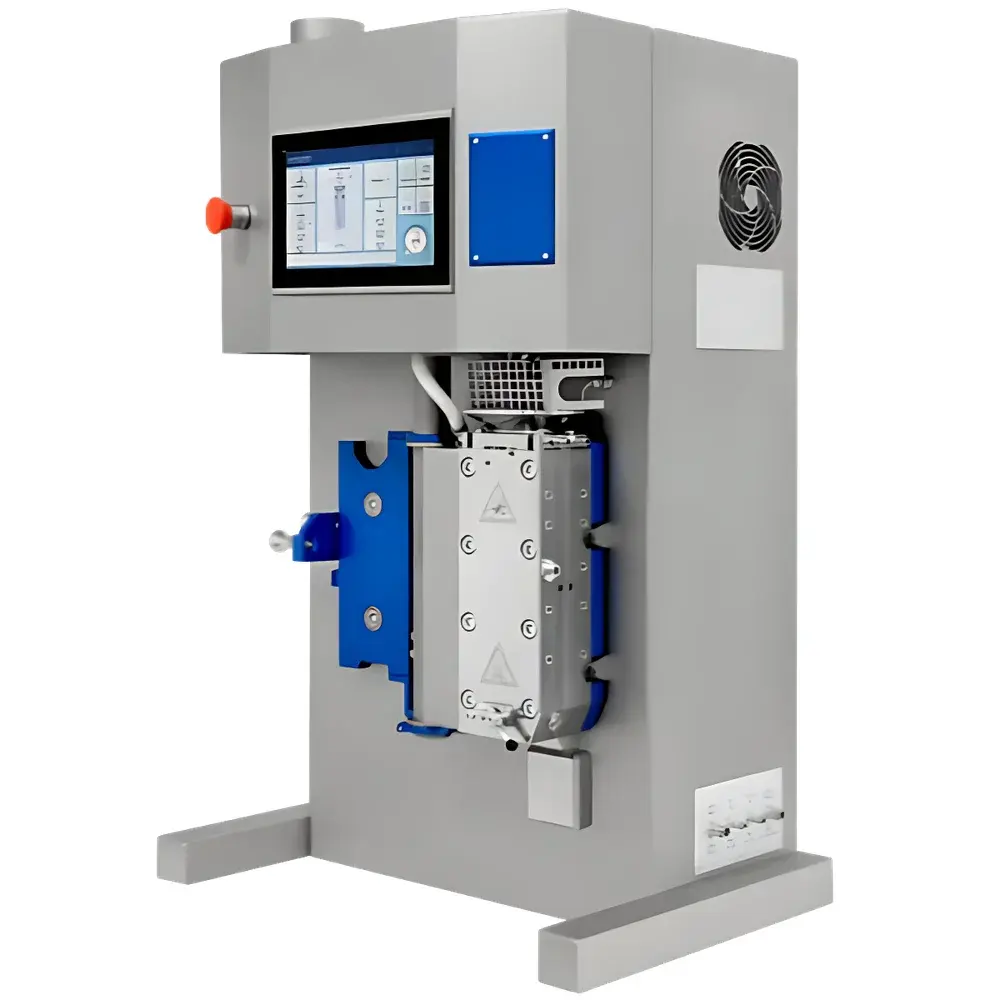
The Xplore MC 40 Micro Vertical Compounder is a high-torque, laboratory-scale twin-screw compounding system engineered for precision material development in polymer R&D environments. Designed and manufactured in the Netherlands with over three decades of extrusion expertise, the MC 40 operates on co-rotating or counter-rotating screw configurations within a vertically oriented, liquid-tight barrel assembly. Its core measurement principle relies on real-time torque monitoring (up to 40 Nm across the full 1–500 rpm speed range), melt pressure sensing (up to 250 bar), and multi-zone temperature control—enabling quantitative assessment of rheological behavior, dispersion efficiency, thermal stability, and compound homogeneity under process-relevant shear conditions. Unlike macro-scale extruders, the MC 40’s 40 mL batch capacity supports rapid formulation screening with minimal raw material consumption—critical for high-value additives, nanocomposites, biopolymers, and pharmaceutical excipients where sample scarcity constrains iterative testing.
Key Features
- Full-speed constant-torque architecture delivering 40 Nm across the entire 1–500 rpm operating range, ensuring consistent shear history regardless of viscosity or throughput.
- Vertically aligned, sealed barrel design compatible with fume hood integration and precise liquid dosing via gravimetric or peristaltic feed systems.
- Compact footprint—50% smaller than predecessor models—with reduced height (95 cm) and weight (150 kg), facilitating benchtop deployment in constrained lab spaces.
- Industrial-grade mechanical construction: hardened DIN 1.4112 steel barrel (54 HRC, 2000 HV PVD coating), fully intermeshing conical feed screw (1000 HV coating), and reinforced motor drive train rated for >10 years of continuous R&D use.
- Dual cooling capability: integrated water-cooling circuit achieves <10-minute cooldown from 240 °C to 80 °C; optional forced-air mode provides flexibility when coolant infrastructure is unavailable.
- Modular thermal management: 12 independently controlled heating cartridges and 7 embedded thermocouples enable programmable axial temperature gradients—essential for simulating industrial extrusion profiles and studying thermal degradation kinetics.
Sample Compatibility & Compliance
The MC 40 accommodates a broad spectrum of thermoplastic, thermoset, elastomeric, and reactive formulations—including filled composites (glass/carbon fiber, mineral fillers), conductive polymers, masterbatches, and solvent-based pastes. Its liquid-tight barrel and optional gravimetric liquid injection module support ASTM D3835-compliant melt compounding of moisture-sensitive resins and low-viscosity monomers. All temperature, torque, and pressure data streams are timestamped and logged with traceable calibration metadata, supporting GLP-compliant documentation requirements. While the instrument itself does not carry CE marking for medical device manufacturing, its hardware architecture and data integrity features align with foundational elements of FDA 21 CFR Part 11 for audit-ready electronic records when deployed with validated software protocols.
Software & Data Management
The MC 40 is controlled either via an integrated industrial-grade touchscreen HMI or through USB-connected Windows-based software. The native interface provides real-time visualization of torque, melt pressure, barrel zone temperatures, screw speed, and motor current. All operational parameters—including setpoints, ramp profiles, hold times, and alarm thresholds—are programmable and stored as reusable method files. Raw sensor data is acquired at ≥10 Hz and exported directly to .xlsx format without proprietary conversion layers, enabling immediate statistical analysis in MATLAB, Python (Pandas), or JMP. The software includes built-in cleaning cycle automation (thermal soak + purge sequence), automatic zero-torque compensation prior to each run, and configurable data logging intervals to balance resolution with storage efficiency.
Applications
- Rapid screening of polymer blends and compatibilizer efficacy under shear-stabilized conditions.
- Dispersion quality assessment of nanofillers (e.g., graphene, CNTs) using torque hysteresis and melt pressure variance metrics.
- Thermal stability profiling of heat-sensitive biopolymers (PLA, PHA) via controlled ramp-and-hold experiments with inline melt temperature feedback.
- Process window definition for downstream extrusion or injection molding—correlating lab-scale torque curves with industrial screw design parameters.
- Development of high-viscosity engineering compounds (PEEK, PSU, PPS) requiring sustained high-torque operation at elevated temperatures (up to 425 °C).
- Formulation validation for regulatory submissions where batch reproducibility, thermal history control, and data traceability are mandatory.
FAQ
What is the minimum recommended batch size for reliable torque measurement?
For optimal signal-to-noise ratio and thermal uniformity, the recommended minimum batch volume is 25 mL. Below this threshold, localized shear heating and incomplete barrel filling may compromise repeatability.
Can the MC 40 be integrated into automated lab workflows?
Yes—the USB interface supports command-line control via SCPI-like syntax, enabling orchestration through LabVIEW, Python scripts, or LIMS middleware for unattended sequential runs.
Is barrel disassembly required for routine maintenance?
No. The modular feed throat, removable die head, and quick-release barrel clamps allow full internal access without specialized tools or alignment fixtures.
Does the system support nitrogen purging for oxygen-sensitive compounds?
The standard configuration includes a dedicated gas inlet port on the feed throat; optional mass flow controllers and O₂ sensors can be added to implement inert atmosphere protocols per ISO 11357-6.
How is temperature calibration verified across zones?
Each of the seven thermocouple channels is factory-calibrated against NIST-traceable reference probes; users may perform field verification using calibrated immersion thermometers inserted into designated barrel ports.
Related Products