
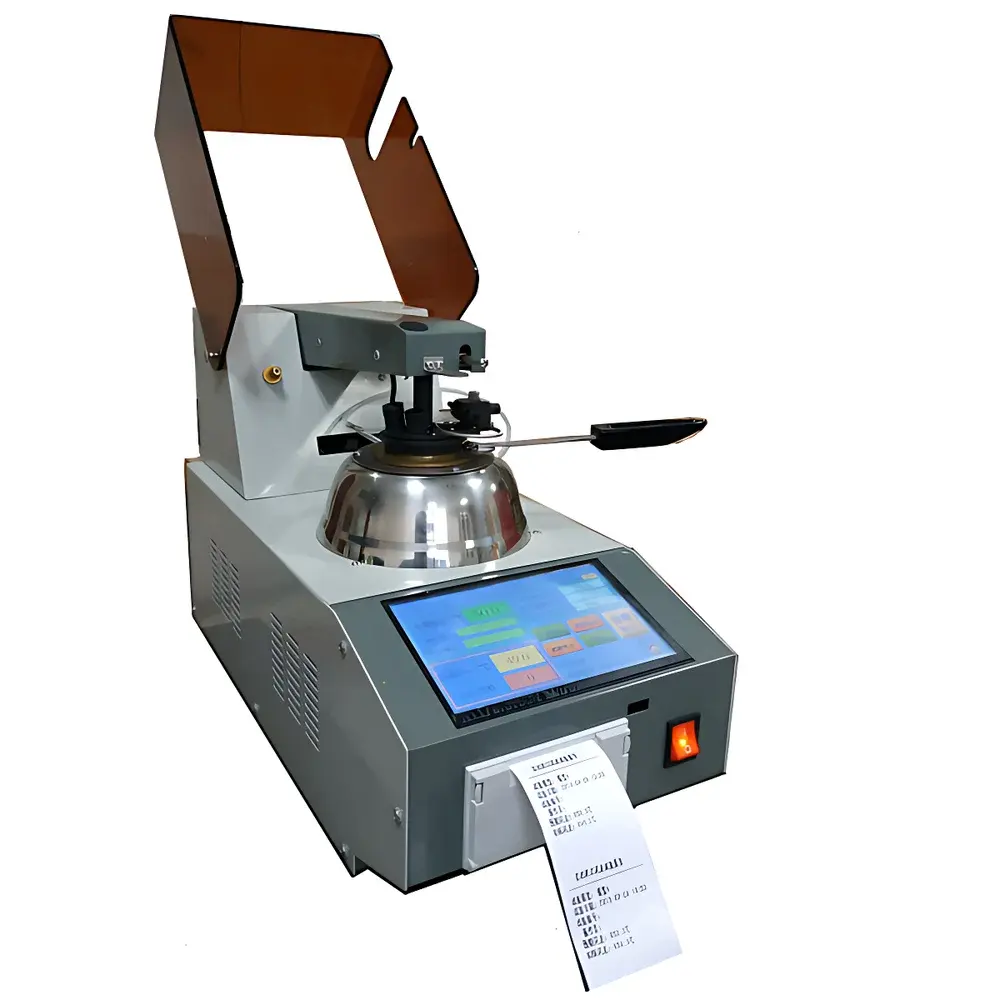
Xufeng XF-92S Automatic Cleveland Open-Cup Flash Point Tester with Dual Ignition (Gas & Electronic)
| Brand | Xufeng |
|---|---|
| Origin | Shanghai, China |
| Model | XF-92S |
| Detection Method | Open-Cup |
| Operation Mode | Fully Automatic |
| Temperature Range | 80 °C to 400 °C |
| Ignition Modes | Electric Spark Ignition and External Fuel-Gas Ignition |
| Repeatability | Compliant with ASTM D92 and GB/T 3536 test protocols |
| Applicable Standards | ASTM D92, GB/T 3536 |
Overview
The Xufeng XF-92S Automatic Cleveland Open-Cup Flash Point Tester is an engineered solution for precise, repeatable determination of flash point and fire point of petroleum products, bituminous materials, lubricants, and other combustible liquids using the standardized Cleveland open-cup method. Based on the fundamental principle of controlled heating and sequential ignition—where a test specimen is heated at a defined rate in a standardized Cleveland cup while an ignition source is periodically applied—the instrument detects the lowest temperature at which vapors above the sample ignite momentarily under specified atmospheric conditions. Designed for compliance with both ASTM D92 (“Standard Test Method for Flash and Fire Points by Cleveland Open Cup Tester”) and GB/T 3536 (“Petroleum Products—Determination of Flash and Fire Points—Cleveland Open Cup Method”), the XF-92S supports full traceability, operator-defined test profiles, and dual ignition capability—ensuring operational flexibility across diverse laboratory environments and regulatory frameworks.
Key Features
- Fully automated test execution: Pre-programmed temperature ramping, timed ignition cycles, and real-time thermal monitoring eliminate manual intervention after START initiation.
- Dual ignition architecture: Supports both electric spark ignition (XF-92SE variant) and external fuel-gas ignition (XF-92S), enabling seamless adaptation to lab infrastructure constraints and safety policies.
- Three operational modes: (1) ASTM D92-compliant Cleveland open-cup flash point mode; (2) GB/T 3536-compliant open-cup mode; (3) Auto-search mode for unknown samples—dynamically adjusting heating rate and ignition frequency to rapidly estimate initial flash point.
- Precision temperature control: Stainless-steel heating bath with PID-controlled heating element achieves ±0.1 °C stability over 0–400 °C range; standard operating range is 80–400 °C.
- Integrated thermal detection: High-sensitivity thermocouple array coupled with flame-detection logic ensures accurate, unambiguous flash event recognition per standard requirements.
- Self-diagnostic system: Real-time hardware status monitoring with on-screen fault codes and audible alerts for heater failure, sensor drift, ignition misfire, or communication loss.
- Expandable multi-unit configuration: Optional modular interface allows connection to additional test modules (e.g., XF-2S dual-cup or XF-9293 combo open/closed cup units) for parallel testing under independent or synchronized protocols.
Sample Compatibility & Compliance
The XF-92S accommodates standard Cleveland open cups (ASTM D92/GB/T 3536 dimensions: 63.5 mm inner diameter × 33.3 mm depth) and accepts viscous, semi-solid, and high-boiling-point samples—including base oils, asphalt binders, transformer oils, and industrial lubricants—without pre-dilution. All operational parameters—including heating rate (14–17 °C/min for ASTM D92; 5–6 °C/min for GB/T 3536), ignition interval (every 2 °C after reaching 79 °C), and cup geometry—are programmatically enforced per selected standard. The instrument’s firmware embeds calibration traceability to NIST-traceable reference standards and supports audit-ready documentation required under GLP and ISO/IEC 17025-accredited laboratories. It meets mechanical and electrical safety requirements per IEC 61010-1 and carries CE marking for use in EU-regulated facilities.
Software & Data Management
The embedded control system features a 5.7-inch monochrome LCD with tactile membrane keypad, delivering intuitive navigation through test setup, real-time graphical temperature curves, and step-by-step status prompts. All test data—including ambient pressure input, observed flash temperature, ignition count, final fire point (if determined), and timestamped event logs—are stored internally (up to 200 test records). RS-232C serial interface enables bidirectional communication with LIMS or centralized QA/QC servers; optional USB-to-serial adapters support modern PC integration. A built-in thermal printer outputs compliant test reports with header fields for operator ID, sample ID, standard reference, and pass/fail annotation per ASTM D92 Section 11 or GB/T 3536 Clause 9. Audit trails include user login timestamps, parameter modifications, and calibration history—supporting FDA 21 CFR Part 11 readiness when paired with validated third-party electronic signature software.
Applications
This instrument serves quality control and R&D laboratories in refining, petrochemical manufacturing, lubricant formulation, and regulatory testing agencies. Typical applications include batch release testing of diesel fuels and residual oils per ASTM D92; specification verification of bitumen penetration grade binders per GB/T 3536; fire safety classification of hydraulic fluids under UN GHS Category 3; and comparative flash point analysis during oxidation stability studies. Its robust construction (full stainless-steel chassis, IP20-rated enclosure) ensures stable performance in ambient lab conditions ranging from 15–30 °C and 30–80% RH. Power consumption remains within 800 W nominal load, minimizing thermal loading in shared instrumentation rooms.
FAQ
What is the difference between XF-92S and XF-92SE?
The XF-92S requires an external fuel-gas supply (e.g., propane or butane) for ignition, whereas the XF-92SE uses a high-voltage electric spark generator—eliminating dependency on gas cylinders and enhancing safety in confined or ventilation-limited labs.
Does the instrument support fire point measurement?
Yes. After flash point detection, the test automatically continues heating at the same rate until sustained combustion occurs for ≥5 seconds—recording the fire point per ASTM D92 Section 8.1 and GB/T 3536 Clause 7.3.
Can it be integrated into a networked QA system?
Yes. Via its RS-232C port and ASCII-based command protocol, the XF-92S supports automated data export to SQL databases, ELN platforms, or custom MES interfaces when configured with appropriate drivers and middleware.
Is calibration verification supported?
Yes. The system includes a dedicated calibration mode allowing verification against certified reference materials (e.g., n-decane, squalane) and adjustment of thermocouple offset values—documented in the internal log with operator signature and date stamp.
What maintenance is required for long-term reliability?
Routine cleaning of the Cleveland cup and ignition tip, annual verification of thermocouple linearity, and biannual inspection of gas line integrity (for XF-92S) are recommended. All critical components—including heating element, controller board, and display module—are field-replaceable using standardized service kits.



