
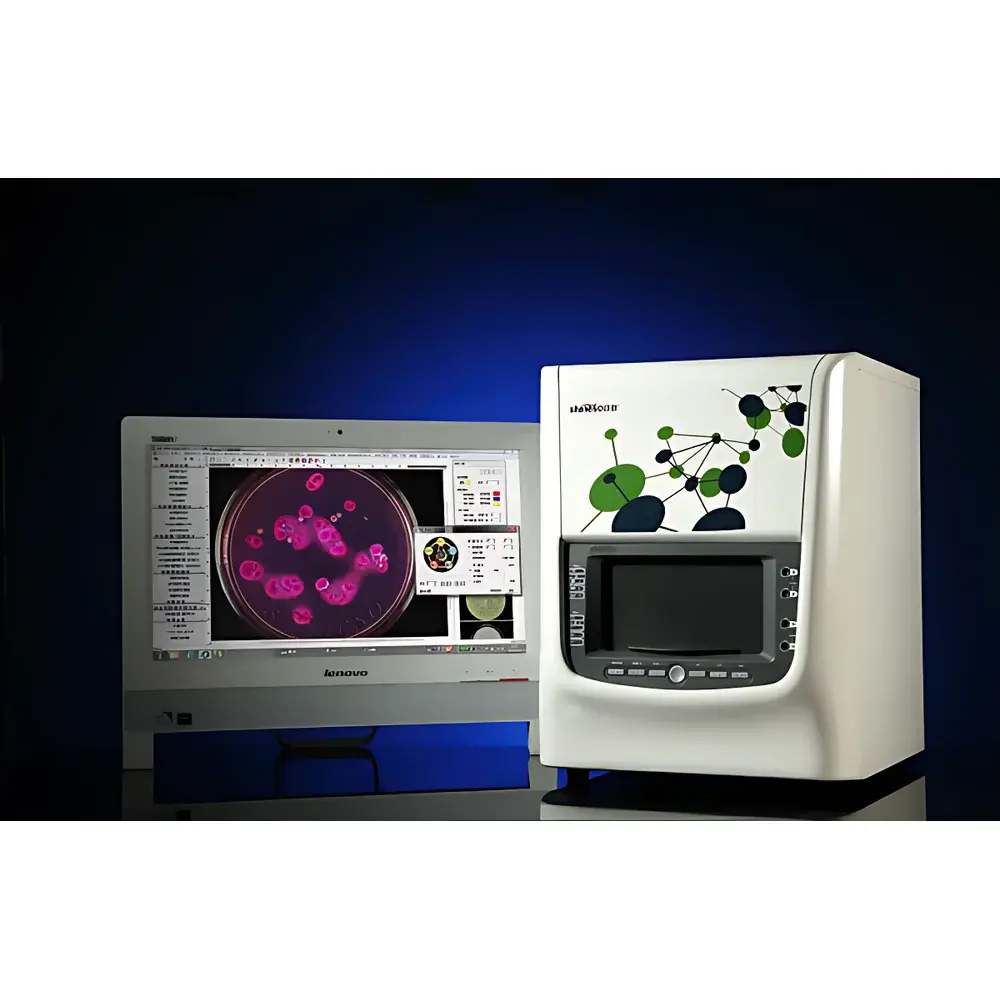
Xunshu Czone G6T Fourth-Generation Automated Colony Counter and Inhibition Zone Analyzer
| Brand | Xunshu |
|---|---|
| Origin | Zhejiang, China |
| Manufacturer Type | Direct Manufacturer |
| Product Origin | Domestic (China) |
| Model | Czone G6T |
| Price Range | USD 7,000–11,500 |
| Instrument Type | Fully Automated Colony Counter & Inhibition Zone Analyzer |
| Counting Speed | <1 second for up to 500 colonies |
Overview
The Xunshu Czone G6T is a fourth-generation, fully automated colony counter and inhibition zone analyzer engineered for precision, reproducibility, and regulatory compliance in high-throughput microbiological laboratories. It operates on digital image analysis principles—leveraging high-resolution CMOS imaging, multi-spectral illumination, and adaptive segmentation algorithms—to quantify microbial colonies and measure antibiotic inhibition zones with metrological rigor. Designed for food safety labs, pharmaceutical QC/QA departments, environmental monitoring agencies, and clinical microbiology units, the Czone G6T integrates dual optical pathways (top diffuse illumination and bottom suspended dark-field illumination), triple-wavelength LED lighting (RGB + 254 nm and 366 nm UV), and a sealed optical chamber to eliminate ambient light interference—ensuring consistent, traceable, and operator-independent results across diverse sample types including pour plates, spread plates, membrane filters, spiral plates, 3M™ Petrifilm™, and chromogenic media.
Key Features
- Sealed optical dark chamber with ergonomic porthole door—eliminates stray light artifacts (e.g., halos, refraction spots) caused by ambient illumination on Petri dish surfaces.
- Dual-path illumination system: top-mounted 360° flexible diffuse LED array for surface texture and color fidelity; bottom-mounted suspended dark-field illumination for enhanced contrast between colonies and agar matrix.
- Triple-wavelength visible-light source (RGB LEDs) with adjustable correlated color temperature (3500–8500 K) and intensity—delivers true-color colony representation without blue-shift bias common in standard white LEDs.
- Integrated dual-band UV system: 254 nm UV lamp for internal chamber sterilization and UV mutagenesis; dual-side 366 nm UV modules for fluorescence excitation of Escherichia coli, coliforms, and GFP-expressing strains.
- 10-megapixel industrial-grade CMOS sensor coupled with an f/1.4 fixed-focus lens—enables high-fidelity capture of subtle morphological features, including subsurface colonies, agar bubbles, and plate scratches.
- Real-time background switching between suspended dark-field and white reflective modes—optimizes contrast for both light-colored and dark-pigmented colonies (e.g., fungal hyphae on herbal matrices).
Sample Compatibility & Compliance
The Czone G6T supports standardized microbiological testing protocols across multiple international frameworks. It accommodates conventional and specialized culture formats—including ISO 4833-1:2013 (microbial enumeration), ISO 7218:2017 (general requirements for microbiological examinations), USP / (microbiological examination of nonsterile products), and Chinese Pharmacopoeia 2020 Edition (ChP) Volume IV. Its software modules comply with data integrity expectations under FDA 21 CFR Part 11 through role-based access control (operator, analyst, administrator), audit trail logging, electronic signature support, and encrypted database storage. The instrument meets GLP/GMP documentation requirements for microbial limit testing, media suitability verification, and control organism identification—providing traceable statistical outputs for regulatory submissions.
Software & Data Management
The embedded software suite comprises four validated modules: (1) Colony Analysis, (2) Szone Inhibition Zone Measurement, (3) Antibiotic Potency Calculation (aligned with ChP 2010 two- and three-dose methods), and (4) Sulbactam-Sensitive β-Lactamase Detection. Advanced algorithms include “Reverse Statistics” for mixed-culture plates, “Multi-phase Level Set Active Contour Modeling” for halo-affected colonies, and “RGB-Constrained Level Set” for chromogenic medium analysis. Morphological filtering allows size-, shape-, and color-based exclusion of debris (e.g., agar clumps, undissolved particulates). All statistical outputs—including total CFU, size-classified counts, colony morphology descriptors, inhibition zone diameters, and potency values—are exportable to Excel with customizable report templates. Database security includes three-tier password protection (application launch, database access, administrative privileges), timestamped audit logs, and immutable raw image archiving.
Applications
The Czone G6T serves as a central platform for regulated microbiological testing workflows: enumeration of aerobic mesophilic bacteria, yeasts, molds, and specific pathogens (e.g., Staphylococcus aureus, E. coli) in food, water, and pharmaceutical products; antimicrobial susceptibility screening via inhibition zone measurement; quantitative assessment of antifungal performance per GB/T 24128–2009 (plastic anti-mold testing); validation of culture media suitability per ChP and USP; and β-lactamase detection in dairy samples using sulbactam-based differential assays. Its modular design supports method development for novel chromogenic substrates and complex matrix samples (e.g., traditional Chinese medicine extracts), where conventional manual counting fails due to pigment interference or low-contrast colony growth.
FAQ
Does the Czone G6T support FDA 21 CFR Part 11 compliance?
Yes—the system implements electronic signatures, user authentication, audit trails, and data immutability controls aligned with Part 11 requirements for regulated environments.
Can it distinguish between bacterial and fungal colonies on mixed-culture plates?
Yes—via its “Reverse Statistics” module, which applies context-aware segmentation to differentiate morphologically distinct colonies without requiring pre-labeling or manual thresholding.
Is calibration traceable to national standards?
Yes—built-in calibration routines include reference disk verification and user-adjustable pixel-to-mm mapping; calibration records are stored with timestamps and operator IDs.
What file formats does it export for regulatory reporting?
Raw images (TIFF), processed data (CSV), and summary reports (Excel-compatible XLSX) with configurable metadata fields—including sample ID, operator name, date/time stamp, and instrument serial number.
How is contamination during long-term operation prevented?
The integrated 254 nm UV lamp automatically sterilizes the imaging chamber between runs, minimizing cross-contamination risk while maintaining optical path cleanliness.




