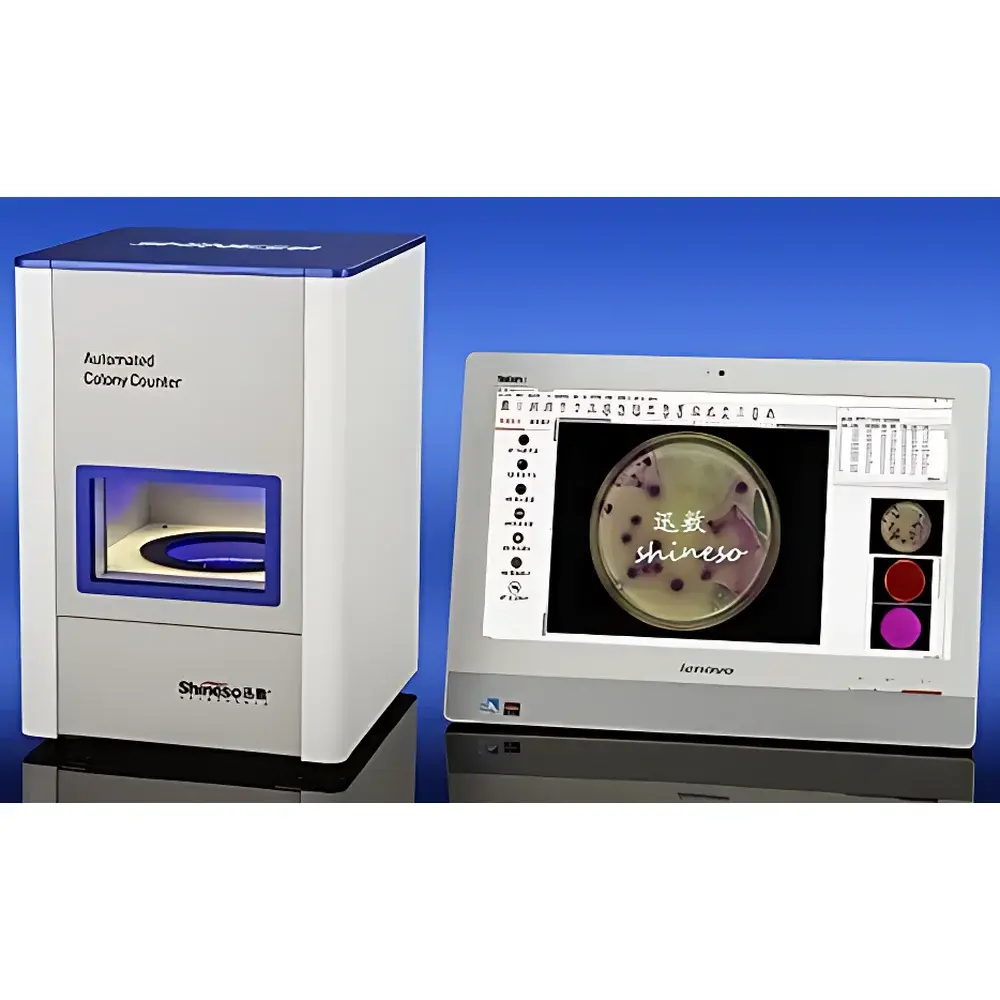
Xunso Czone 9 / Czone 9 Pro Automated Colony Counter and Zone-of-Inhibition Analyzer
| Brand | Xunso |
|---|---|
| Origin | Zhejiang, China |
| Manufacturer Type | Direct Manufacturer |
| Instrument Type | Fully Automated Colony Counter & Zone-of-Inhibition Analyzer |
| Sample Types | Liquid media, solid media (pour plate, spread plate, membrane filtration, spiral plate, commercial test strips) |
| Petri Dish Capacity | 35–150 mm diameter |
| Counting Speed | 20,000 colonies/sec |
| Resolution | 0.01 mm |
| Imaging System | Fixed-focus 8 mm lens (Czone 9: 6 MP, 170 lp/mm |
| Czone 9 Pro | 10 MP, 200 lp/mm), 1/2.33″ color CMOS sensor (Czone 9) / 1/2.2″ Sony color CMOS sensor (Czone 9 Pro), 16 MP (Czone 9) / 18 MP (Czone 9 Pro) effective resolution |
| Software Suite | Colony analysis software with audit trail, automated zone-of-inhibition measurement software, antibiotic potency calculation software (Chinese Pharmacopoeia 2020 Edition compliant) |
Overview
The Xunso Czone 9 and Czone 9 Pro are fully automated digital colony counters and zone-of-inhibition analyzers engineered for precision, regulatory compliance, and high-throughput microbiological quantification in GLP- and GMP-aligned laboratories. Based on high-fidelity digital imaging and advanced computational morphology, the system employs a multi-modal illumination architecture—comprising suspended dark-field, chromatic trans-illumination, and diffuse reflectance—to optimize contrast across diverse microbial growth substrates. Measurement principles adhere to standardized optical detection protocols defined in ISO 4833-1:2013 (microbiological methods — horizontal method for enumeration of microorganisms), USP and , and Chinese Pharmacopoeia 2020 Edition for antimicrobial susceptibility testing. The platform delivers traceable, repeatable colony enumeration and inhibition zone quantification without manual intervention, supporting critical applications in pharmaceutical quality control, food safety validation, environmental monitoring, and antimicrobial stewardship research.
Key Features
- Triple-mode illumination system: Suspended dark-field (for high-contrast zone-of-inhibition imaging), 5-channel chromatic trans-illumination (RGB+amber+cool white LEDs), and uniform 360° diffuse reflectance lighting (3100–5800 K, 50–7000 lux)
- Optimized optical train: Fixed-focus 8 mm lens with ultra-low chromatic aberration (170 lp/mm for Czone 9; 200 lp/mm for Czone 9 Pro), paired with industrial-grade CMOS sensors (16 MP Panasonic for Czone 9; 18 MP Sony for Czone 9 Pro)
- Fully automated image segmentation: Integrates fast active contour models, multi-phase level-set algorithms, and topology-aware morphological partitioning to resolve densely clustered, overlapping, or morphologically heterogeneous colonies
- Regulatory-grade data integrity: Four-tier user permission architecture (System Admin, Data Manager, Operator, Reviewer), immutable electronic records, time-stamped audit trails, watermark-signed reports, and full test-environment reconstruction capability
- Pharmacopoeial compliance: Built-in algorithms for Chinese Pharmacopoeia 2020 two-dose and three-dose potency assays, including automatic edge detection, circle-fitting approximation, and three-point manual calibration modes for ambiguous zones
Sample Compatibility & Compliance
The Czone 9/9 Pro accommodates standard microbiological sample formats including pour plates, spread plates, membrane filters (with black-grid background), spiral plates, and commercial test strips (e.g., 3M Petrifilm™ for total aerobic count, Staphylococcus aureus, coliforms, and E. coli). Its illumination adaptability ensures robust performance on chromogenic, TTC-, and selective media—even with low-contrast colonies (e.g., pale Enterobacteriaceae on violet red bile agar) or translucent inhibition zones on turbid lawns. The system meets ISO/IEC 17025:2017 requirements for method validation, supports FDA 21 CFR Part 11-compliant electronic signatures and audit trails, and aligns with EU Annex 11 and WHO TRS 992 Annex 5 for computerized system validation in regulated environments.
Software & Data Management
The embedded software suite includes three integrated modules: (1) Smart Colony Analysis, featuring real-time parameter tuning via mouse-wheel interaction and context-aware segmentation presets (e.g., “mold”, “TTC plate”, “test strip”); (2) Szone Zone-of-Inhibition Analyzer, applying adaptive edge detection and geometric fitting to quantify inhibition diameters with ≤0.002 mm repeatability; and (3) Antibiotic Potency Calculator, implementing pharmacopoeial statistical models (including parallel-line assay logic) with built-in repeatability and uniformity self-checks (relative error ≤0.01% and ≤0.05%, respectively). All raw images, processing parameters, operator actions, reviewer approvals, and metadata (sample ID, dilution factor, plate dimensions) are stored in an encrypted relational database. Export options include PDF reports with embedded watermarks and Excel-compatible structured datasets for LIMS integration.
Applications
This instrument serves as a core quantitative tool in pharmaceutical QC labs performing microbial limit tests per USP / and EP 2.6.12; in food and beverage facilities conducting shelf-life studies and pathogen enumeration per ISO 6887 and AOAC standards; in clinical microbiology units validating disinfectant efficacy (EN 13697, ASTM E2149); and in academic and industrial R&D settings evaluating novel antimicrobials or preservative systems. Specific use cases include enumeration of Pseudomonas aeruginosa on cetrimide agar, Candida albicans on CHROMagar™, and Salmonella on XLD plates—alongside simultaneous zone measurement for ampicillin, ciprofloxacin, or vancomycin discs. Its ability to distinguish subtle morphological differences enables strain-level discrimination in bioburden investigations.
FAQ
Does the system comply with 21 CFR Part 11 requirements for electronic records and signatures?
Yes—the software implements role-based access control, immutable audit logs, electronic signatures with timestamped watermarks, and full reconstructability of analysis workflows, satisfying all technical and procedural criteria under FDA 21 CFR Part 11.
Can the instrument process 3M Petrifilm™ test strips without manual pre-processing?
Yes—dedicated one-click recognition algorithms are preconfigured for 3M Total Aerobic Count, S. aureus, coliform, and E. coli/coliform rapid test strips, including automatic grid alignment and background compensation.
What is the maximum petri dish size supported?
The imaging chamber accommodates standard circular plates from 35 mm to 150 mm in diameter, including stacked dual-layer plates up to 20 mm height.
Is UV sterilization integrated into the system?
Yes—a 254 nm UV-C LED module is embedded in the sealed chamber for post-analysis decontamination and optional mutagenesis protocols.
How does the system handle overlapping or chain-forming colonies?
It applies a hybrid segmentation approach combining watershed transformation, level-set boundary evolution, and user-guided interactive splitting—enabling accurate separation of streptococcal chains, bacillary clusters, or fungal hyphal networks while preserving biological context.
Related Products