
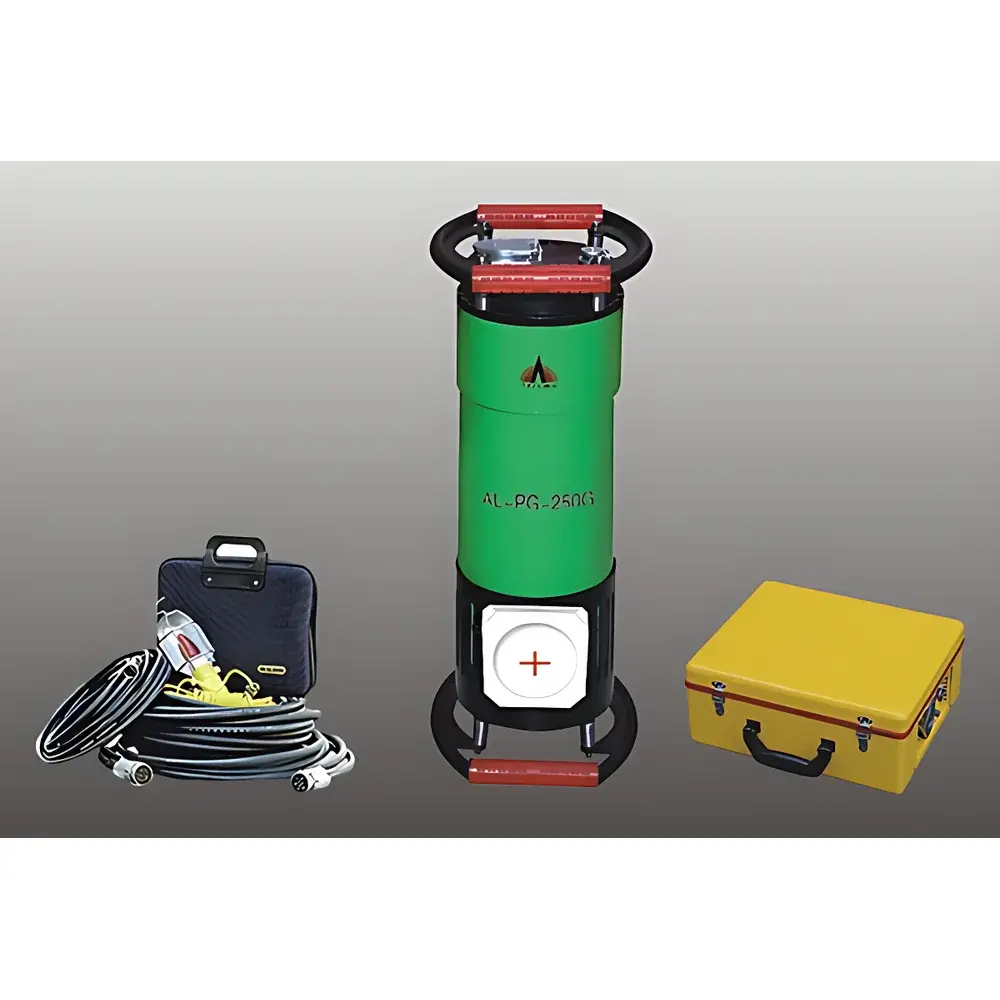
Along XXG-3005ZH Constant-Frequency Portable X-ray Radiographic Inspection System
| Brand | Along |
|---|---|
| Origin | Liaoning, China |
| Manufacturer Type | OEM Manufacturer |
| Country of Origin | China |
| Model | XXG-3005ZH |
| Voltage Range | 50–300 kV |
| Current Range | 1–5 mA |
| Focal Spot Size | 2.5 × 2.5 mm |
| Radiation Beam Angle | 40° ± 5° |
| Duty Cycle | 1:1 (Continuous Operation Mode) |
| Max. Penetration in A3 Steel | 50 mm |
| Generator Weight | 28 kg |
| Generator Dimensions | 345 × 345 × 670 mm |
Overview
The Along XXG-3005ZH is a constant-frequency portable X-ray radiographic inspection system engineered for field-deployable non-destructive testing (NDT) of metallic and composite structures. It operates on the principle of X-ray transmission radiography: a high-voltage electron beam strikes a tungsten target within the X-ray tube, generating bremsstrahlung radiation; differential attenuation of this radiation through test objects produces contrast-rich radiographic images on film, phosphor imaging plates, or digital detectors. Unlike variable-frequency systems that modulate switching frequency to regulate output—potentially introducing waveform instability—the XXG-3005ZH maintains a fixed high-frequency inverter frequency while independently controlling tube voltage (kV) and tube current (mA) via digital pulse-width modulation. This architecture ensures consistent spectral distribution, enhanced exposure repeatability, and minimized thermal drift during extended duty cycles—critical for compliance with ASTM E94/E1742 and ISO 5579 requirements for industrial radiography.
Key Features
- Constant-frequency inverter design delivers stable kV/mA output across the full operating range (50–300 kV / 1–5 mA), minimizing spectral shift and improving image contrast consistency.
- Compact generator unit (345 × 345 × 670 mm; 28 kg) enables single-operator transport and deployment in confined spaces, scaffolds, pipelines, and offshore platforms.
- Digital control interface with embedded auto-conditioning algorithm performs real-time filament preheating, anode warm-up, and tube aging compensation—reducing operator dependency and ensuring reproducible tube performance over service life.
- Low-kV start capability (50 kV minimum) extends applicability to thin-walled aluminum castings, welds in stainless steel tubing, and composite laminates, while 300 kV maximum supports thick-section carbon steel weld inspection up to 50 mm in A3 steel.
- Optimized thermal management system—including forced-air convection and thermally isolated high-voltage components—supports sustained 1:1 duty cycle operation without derating, enabling continuous radiographic surveys in time-critical QA/QC workflows.
- EMI-hardened control circuitry and shielded HV cabling ensure operational stability in electrically noisy environments such as fabrication yards, shipyards, and power generation facilities.
Sample Compatibility & Compliance
The XXG-3005ZH is validated for radiographic examination of ferrous and non-ferrous metals, welded joints, castings, forgings, and fiber-reinforced polymer (FRP) components. Its focal spot size (2.5 × 2.5 mm) meets EN 12543-2 Class 2 requirements for medium-resolution industrial radiography. The 40° ± 5° nominal radiation cone angle allows efficient coverage of standard 300 × 400 mm imaging plates or DR panels. The system conforms to IEC 61331-1 (radiation protection), GB/T 23909.1–2009 (Chinese NDT standard equivalent to ISO 5579), and supports traceable calibration per ISO/IEC 17025 when used with accredited dosimetry services. Optional lead-lined collimators and remote trigger kits facilitate compliance with local radiation safety regulations (e.g., NRC 10 CFR 34, EU Directive 2013/59/Euratom).
Software & Data Management
While the XXG-3005ZH operates as a hardware-controlled X-ray source (no onboard imaging processing), its digital interface provides RS-485 and Ethernet connectivity for integration into third-party NDT data acquisition ecosystems. Compatible with industry-standard PACS, RIS, and radiographic workflow platforms—including GE SensitX, Nikon XT H, and Waygate Technologies’ Go|Radiography—the system supports DICOM SR metadata embedding (exposure parameters, timestamps, operator ID) and audit-trail logging. When paired with FDA 21 CFR Part 11–compliant imaging software, full electronic record retention—including exposure logs, calibration certificates, and maintenance history—is achievable for regulated manufacturing environments (aerospace AS9100, nuclear NQA-1, pharmaceutical equipment qualification).
Applications
- Field inspection of girth welds in oil & gas pipelines (API RP 1104, ASME B31.4/B31.8)
- In-service assessment of pressure vessel nozzles and heat exchanger tubes
- Quality assurance of railway axle forgings and bogie weldments (EN 15085)
- Radiographic verification of additive-manufactured titanium components (ASTM F3049)
- Pre-commissioning weld mapping in offshore platform modules
- Educational and vocational NDT training under controlled radiation licensing
FAQ
Does the XXG-3005ZH support pulsed or microfocus operation?
No. It is a conventional constant-potential portable X-ray generator with a fixed 2.5 × 2.5 mm focal spot. Pulsed or microfocus modes are not implemented.
What radiation shielding accessories are available?
Along offers optional lead-acrylic collimators (with adjustable aperture), portable lead barriers (2 mm Pb equivalence), and telescopic exposure distance rods compliant with IAEA SSG-11 guidelines.
Is the system certified for use in intrinsically safe (IS) environments?
Not inherently. Explosion-proof enclosures or IS-rated remote control interfaces must be supplied by qualified third-party integrators per ATEX/IECEx Zone 1 specifications.
Can exposure parameters be logged and exported for QA documentation?
Yes—via RS-485 or Ethernet, exposure kV, mA, time, date/time stamp, and operator ID can be streamed to external SCADA or LIMS platforms supporting Modbus TCP or custom ASCII protocols.
What is the recommended recalibration interval for the kV/mA monitoring circuitry?
Annual calibration against NIST-traceable reference meters is advised; full system verification—including focal spot measurement and beam alignment—should occur every 24 months or after 500 operational hours, whichever comes first.



