
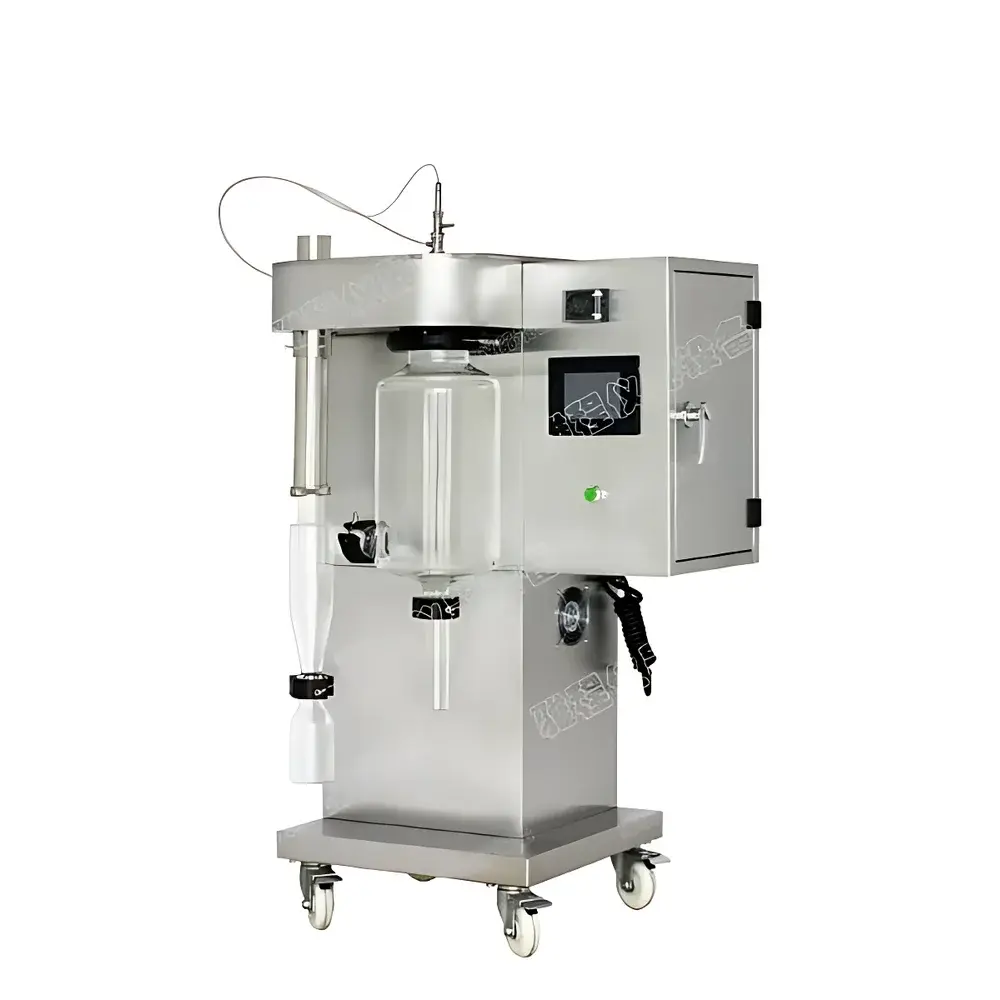
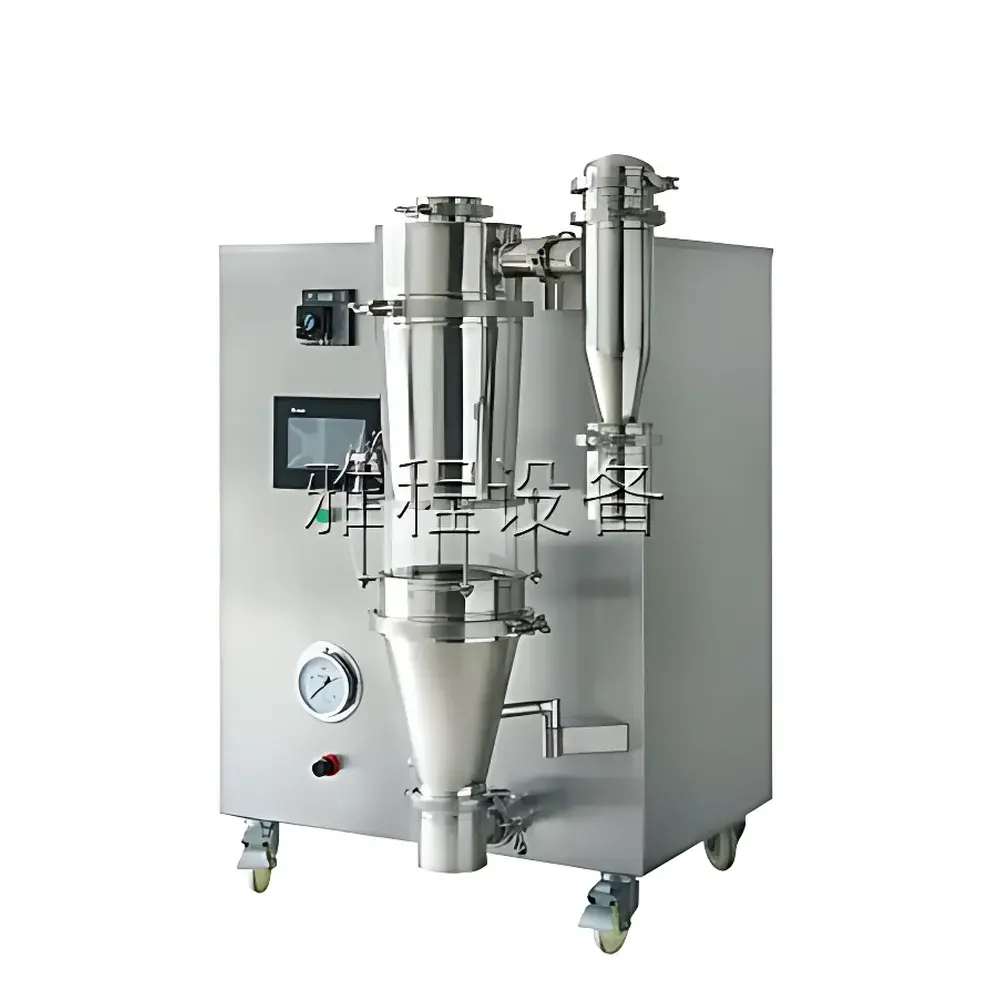
Yacheng PILOTECH YC-1800 Lab-Scale Spray Dryer
| Brand | Yacheng / PILOTECH |
|---|---|
| Origin | Shanghai, China |
| Manufacturer Type | Direct Manufacturer |
| Model | YC-1800 |
| Max Evaporation Rate | 1500 mL/h |
| Inlet Air Temperature Range | 105–200 °C |
| Minimum Feed Volume | 50 mL |
| Temperature Control Accuracy | ±1 °C (PID) |
| Drying Time | 1.0–1.5 s |
| Nozzle Orifice Options | 0.5 / 0.7 / 1.0 / 1.5 / 2.0 mm |
| Noise Level | <60 dB(A) |
| Power Supply | 4 kW / 220 V |
| Construction | Stainless Steel 316L + Borosilicate Glass |
| Compressor | Oil-Free Air Compressor |
| Optional Upgrade | Nitrogen-Closed Loop System (YC-1800A) |
Overview
The Yacheng PILOTECH YC-1800 Lab-Scale Spray Dryer is an engineered solution for precise, reproducible, and thermally gentle drying of heat-sensitive materials in research and development environments. It operates on the principle of two-fluid nozzle atomization—where liquid feed is pneumatically sheared into fine droplets by compressed air, followed by rapid convective drying via controlled hot air flow in a coaxial drying chamber. Unlike conventional lab-scale spray dryers with minimum inlet temperatures ≥180 °C, the YC-1800 achieves stable operation down to 105 °C, enabling sub-second thermal exposure (<1.5 s residence time) while preserving molecular integrity. This makes it particularly suitable for biologics, herbal extracts, fruit juices, enzyme formulations, and polymer dispersions where Maillard reactions, caramelization, or structural denaturation must be avoided. Its compact, self-contained architecture eliminates dependency on external HVAC, vacuum, or exhaust ducting—allowing deployment directly on standard laboratory benches or stainless steel support frames.
Key Features
- Integrated color LCD touchscreen interface with real-time animated process visualization—displaying inlet/outlet temperature, peristaltic pump speed, airflow rate, and system status.
- Dual-mode control architecture: fully automated startup/shutdown sequence (one-button operation) with programmable PID temperature regulation, plus manual override for dynamic parameter adjustment during experiments.
- Patented low-temperature drying capability (105–200 °C inlet range), validated for high-yield powder recovery from high-sugar matrices (e.g., polysaccharide-rich botanical extracts) without wall adhesion or agglomeration.
- Self-cleaning nozzle system with adjustable automatic needle-clearing frequency—critical for viscous, particulate-laden, or fiber-containing feeds such as plant cell suspensions or protein hydrolysates.
- Optimized two-fluid nozzle design with interchangeable orifices (0.5–2.0 mm) to tune droplet size distribution; combined with oil-free air compressor, yields narrow, near-normal particle size distribution (PSD) and excellent powder flowability.
- Modular construction using electropolished stainless steel 316L and ASTM E438 Type I, Class A borosilicate glass—ensuring chemical resistance, visual process monitoring, and compliance with GLP cleaning validation requirements.
- Active nozzle cooling system (air-cooled or optional water-cooled configuration) minimizes thermal loading at the atomization point, reducing local overheating and enhancing reproducibility across repeated runs.
Sample Compatibility & Compliance
The YC-1800 demonstrates broad compatibility with aqueous and organic solvent-based solutions, emulsions, colloidal suspensions, and nano-dispersions. It has been routinely deployed for drying thermolabile actives including monoclonal antibody fragments, lactic acid bacteria cultures, anthocyanin-rich berry extracts, chitosan nanoparticles, and pH-sensitive liposomal formulations. All wetted components meet USP Class VI and FDA 21 CFR Part 11–ready data logging standards when paired with optional audit-trail-enabled software. The system supports ISO 22000–aligned food R&D workflows and complies with ASTM E2912–22 (Standard Guide for Spray Drying Process Development) for method transfer scalability. Optional nitrogen recirculation (YC-1800A configuration) enables safe processing of flammable solvents (e.g., ethanol, acetone) under inert atmosphere—meeting OSHA 1910.106 and ATEX Zone 2 requirements.
Software & Data Management
The embedded microprocessor controller logs all critical process parameters—including temperature ramps, pump speed profiles, airflow transients, and event timestamps—at 1 Hz resolution. Raw data exports to CSV format for post-hoc analysis in MATLAB, JMP, or Python-based statistical platforms. Optional PC-connected software provides remote monitoring, multi-user access control, electronic signature support, and 21 CFR Part 11–compliant audit trails (including user logins, parameter changes, and run completions). All calibration constants (thermocouple offsets, flowmeter coefficients) are stored in non-volatile memory and traceable to NIST-certified references. Data integrity is maintained via cyclic redundancy check (CRC) verification and write-protected storage partitions.
Applications
- Pharmaceutical formulation: lyophilization alternative for amorphous solid dispersions, inhalable dry powders, and vaccine stabilizers.
- Natural product research: scalable drying of polyphenol-rich plant extracts, essential oil microcapsules, and probiotic-loaded carriers.
- Food science: production of instant tea powders, dairy protein aggregates, encapsulated omega-3 oils, and allergen-free flavor carriers.
- Materials science: synthesis of ceramic precursors (e.g., LiFePO₄ cathode slurries), metal-organic framework (MOF) composites, and conductive polymer microparticles.
- Agrochemical development: formulation of biopesticide suspensions, nanopesticide carriers, and slow-release fertilizer microspheres.
FAQ
What is the minimum feed volume required for a valid run?
A minimum of 50 mL is recommended to ensure stable pump priming and representative drying kinetics; smaller volumes may be used with custom syringe-pump integration.
Can the YC-1800 handle organic solvents like ethanol or methanol?
Yes—when upgraded to the YC-1800A configuration with nitrogen recirculation, explosion-proof instrumentation, and solvent-resistant seals, it complies with IEC 60079–0 for Class I, Division 2 environments.
Is GMP-compliant documentation available for regulatory submissions?
Factory-issued IQ/OQ protocols, material traceability certificates (EN 10204 3.1), and calibration records against ISO/IEC 17025–accredited labs are provided upon request.
How is particle morphology affected by inlet temperature reduction?
Lower inlet temperatures (105–120 °C) yield denser, less porous particles with reduced surface wrinkling—ideal for sustained-release applications—while higher temperatures (≥160 °C) produce more hollow, low-density microspheres suited for pulmonary delivery.
Does the system support continuous operation for extended stability studies?
Yes—continuous feeding up to 1500 mL/h is supported; however, routine maintenance (nozzle inspection, cyclone cleaning) is advised every 4–6 hours to maintain aerosol uniformity and collection efficiency.



