
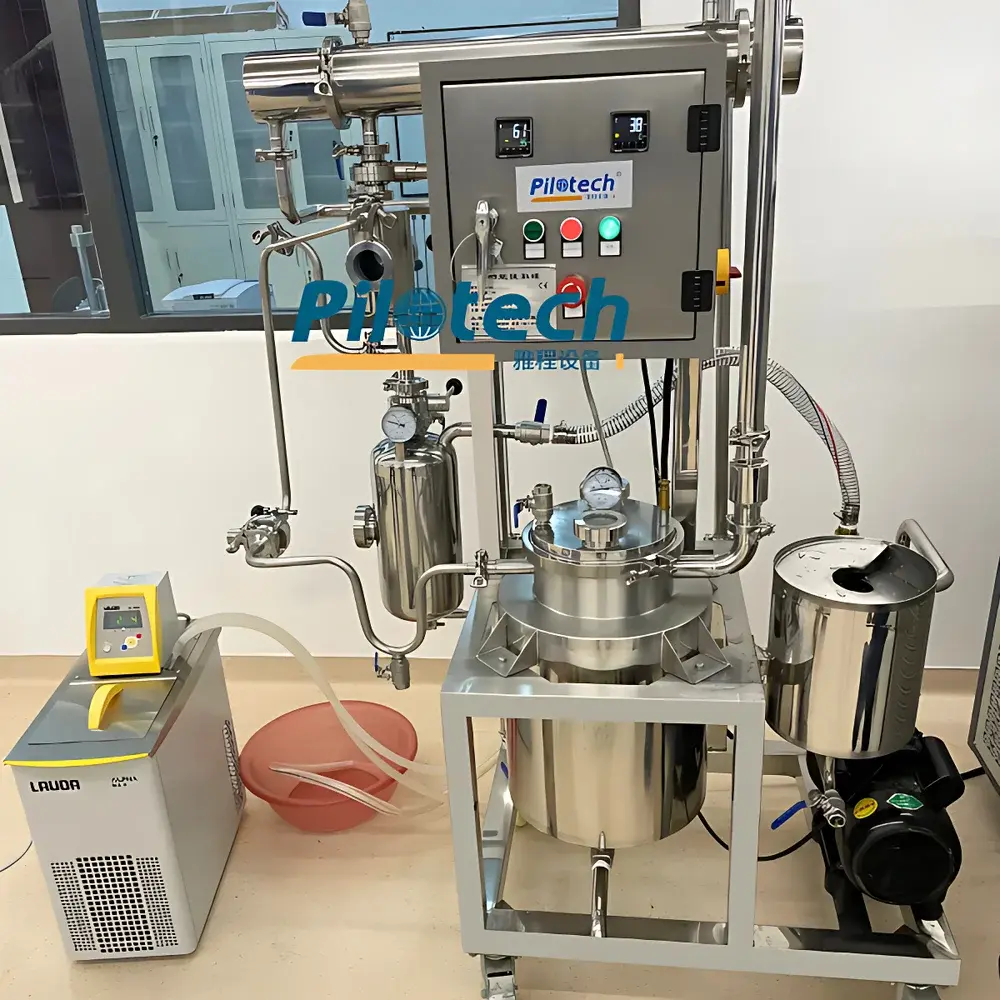
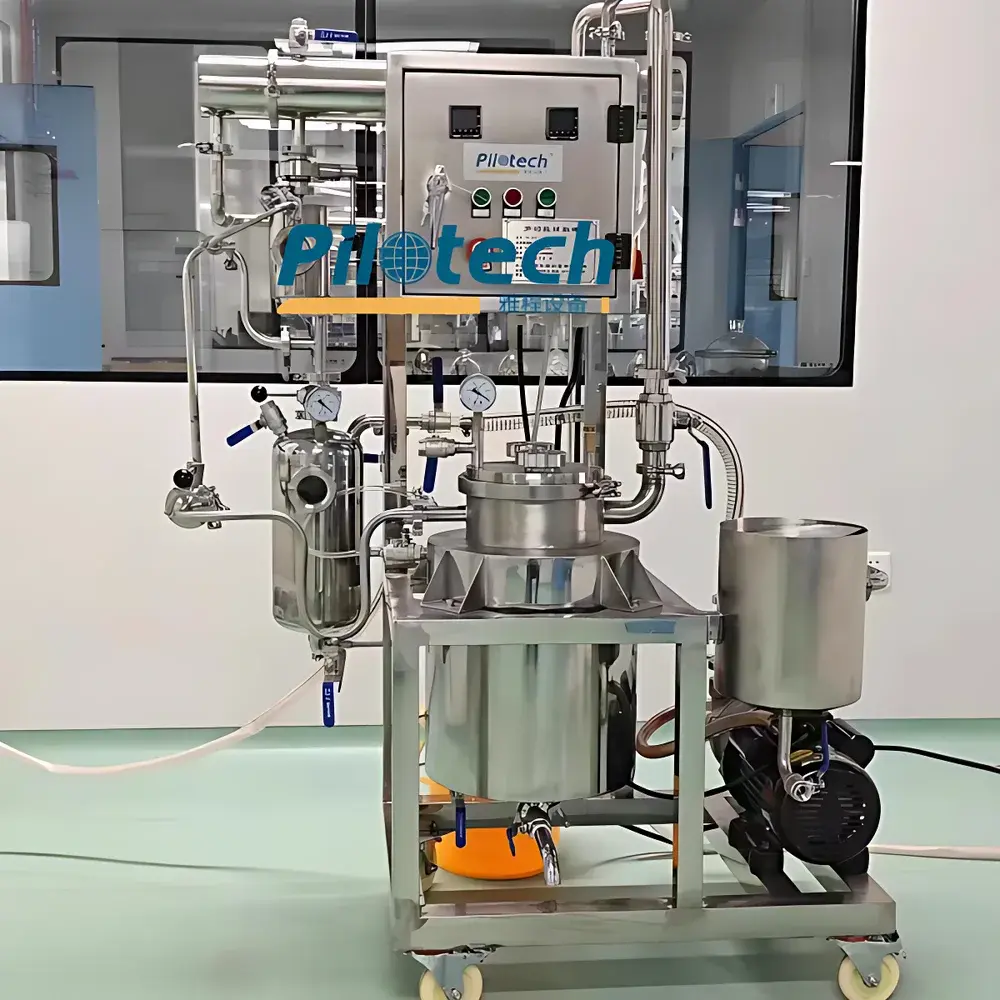
YaCheng YC-010 Laboratory-Scale Multifunctional Extraction and Concentration System
| Brand | YaCheng / PILOTECH |
|---|---|
| Origin | Shanghai, China |
| Manufacturer Type | Direct Manufacturer |
| Country of Origin | China |
| Model | YC-010 |
| Extraction Chamber Volume | 10 L |
| Temperature Control Accuracy | ±2 °C |
Overview
The YaCheng YC-010 Laboratory-Scale Multifunctional Extraction and Concentration System is an integrated, benchtop-grade unit engineered for precise, scalable extraction and vacuum concentration of botanical matrices—including traditional Chinese medicinal herbs, tea leaves, fruit juices, and aromatic plant materials. It operates on the principles of reflux extraction, solvent-based (aqueous or alcoholic) percolation, and low-temperature vacuum evaporation—enabling simultaneous or sequential extraction, phase separation, condensation, and concentration within a single stainless-steel architecture. Designed for laboratory-scale process development and pilot-stage validation, the system supports both batch and semi-continuous operation under controlled thermal, pressure, and flow conditions. Its compact footprint (≤1 m²), modular configuration, and compatibility with common organic solvents (e.g., ethanol, methanol, ethyl acetate) and water make it suitable for formulation screening, active ingredient recovery, and stability-driven process optimization in compliance with early-phase R&D workflows.
Key Features
- Integrated 10 L stainless-steel triple-layer extraction vessel with insulated polyurethane jacket, internal heating via thermostatically regulated thermal oil circulation, and polished inner surface (Ra ≤ 0.8 µm) for full cleanability and corrosion resistance.
- PID-controlled temperature regulation (range: ambient to 120 °C) with ±2 °C accuracy; digital Omron temperature controller with real-time setpoint logging and alarm thresholds.
- Onboard vacuum concentration module featuring a 0.5 m² tubular condenser, oil–water separator for selective recovery of volatile aromatic compounds (e.g., terpenes, monoterpenoids), and adjustable vacuum range (0 to –0.08 MPa).
- Dynamic reflux loop enabling continuous solvent recirculation, reducing solvent consumption and improving mass transfer efficiency during solid–liquid extraction.
- Full-pressure-range operability: functions reliably under negative pressure (vacuum), atmospheric pressure, and positive pressure (up to 0.3 MPa gauge) without structural compromise.
- Bottom-mounted perforated plate and 100-mesh stainless-steel filter screen for uniform slurry distribution and efficient solid–liquid separation post-extraction.
- Optional ultrasonic-assisted extraction module featuring titanium alloy transducers (frequency selectable from 15–60 kHz), enabling cell wall disruption via acoustic cavitation while preserving thermolabile constituents (e.g., flavonoids, polysaccharides, essential oils).
Sample Compatibility & Compliance
The YC-010 accommodates diverse botanical feedstocks—including dried roots, leaves, flowers, seeds, and fermented biomass—in particle sizes ranging from coarse cut (2–5 mm) to fine powder (<100 µm). It complies with material contact requirements defined in ISO 8573-1 (compressed air purity) and FDA 21 CFR Part 11 for optional data logging configurations (when equipped with Ethernet-enabled HMI). All wetted parts are constructed from AISI 316L stainless steel, certified per ASTM A240/A240M and EN 10088-2. The system supports GLP-aligned documentation practices, including audit-trail-capable temperature and vacuum logs, and meets mechanical safety standards per EN 61000-6-2 (EMC immunity) and EN 61000-6-4 (EMC emission).
Software & Data Management
The standard control interface includes an industrial-grade Omron temperature controller with analog output and relay logic. Optional upgrades include a 7-inch resistive touchscreen HMI with USB export, Modbus RTU/TCP communication protocol support, and Ethernet connectivity for remote monitoring via SCADA or LIMS integration. Logged parameters include real-time vessel temperature, vacuum level, condensate flow status, and heating power draw. Data export is supported in CSV format; time-stamped logs meet minimum ALCOA+ criteria (Attributable, Legible, Contemporaneous, Original, Accurate, Complete, Consistent, Enduring, Available) when paired with validated timestamping firmware.
Applications
- Extraction process development for herbal active ingredients (e.g., ginsenosides, berberine, curcumin) using water, ethanol, or mixed solvent systems.
- Recovery and purification of volatile oils (e.g., eucalyptus oil, lavender oil, citrus peel oil) via steam distillation–condensation–separation coupling.
- Concentration of heat-sensitive liquid extracts (e.g., green tea catechins, anthocyanin-rich berry juice) under sub-boiling vacuum conditions (final density: 1.1–1.38 g/mL).
- Method transfer studies from lab-scale to pilot-scale equipment, supporting ICH Q5A and Q5C comparability assessments.
- Academic research in phytochemistry, food science, and natural product pharmacology—validated across institutions including Peking University, KAUST, and Huazhong University of Science and Technology.
FAQ
What is the maximum allowable working pressure for the extraction vessel?
The vessel is rated for operation up to 0.3 MPa gauge pressure; however, routine use is recommended at ≤0.15 MPa for long-term mechanical integrity.
Can the system be validated for GMP-compliant environments?
Yes—when configured with optional IQ/OQ documentation packages, calibrated sensors (NIST-traceable), and audit-trail-enabled HMI, it supports Phase I–II process validation per Annex 15.
Is cleaning-in-place (CIP) supported?
The unit features full drainability, 360° internal polish, and removable fittings; CIP protocols using 1–2% NaOH or citric acid solutions have been verified by end users.
What cooling water specifications are required for the condenser?
Inlet pressure must remain below 0.3 MPa; flow rate: 0.5 t/h at 10–25 °C inlet temperature; recommended conductivity < 500 µS/cm to prevent scaling.
How is extract viscosity managed during concentration?
The dynamic circulation design maintains turbulent flow even at high solids content (>25% w/w), mitigating fouling and sustaining heat transfer coefficients above 800 W/m²·K throughout the evaporation cycle.



