
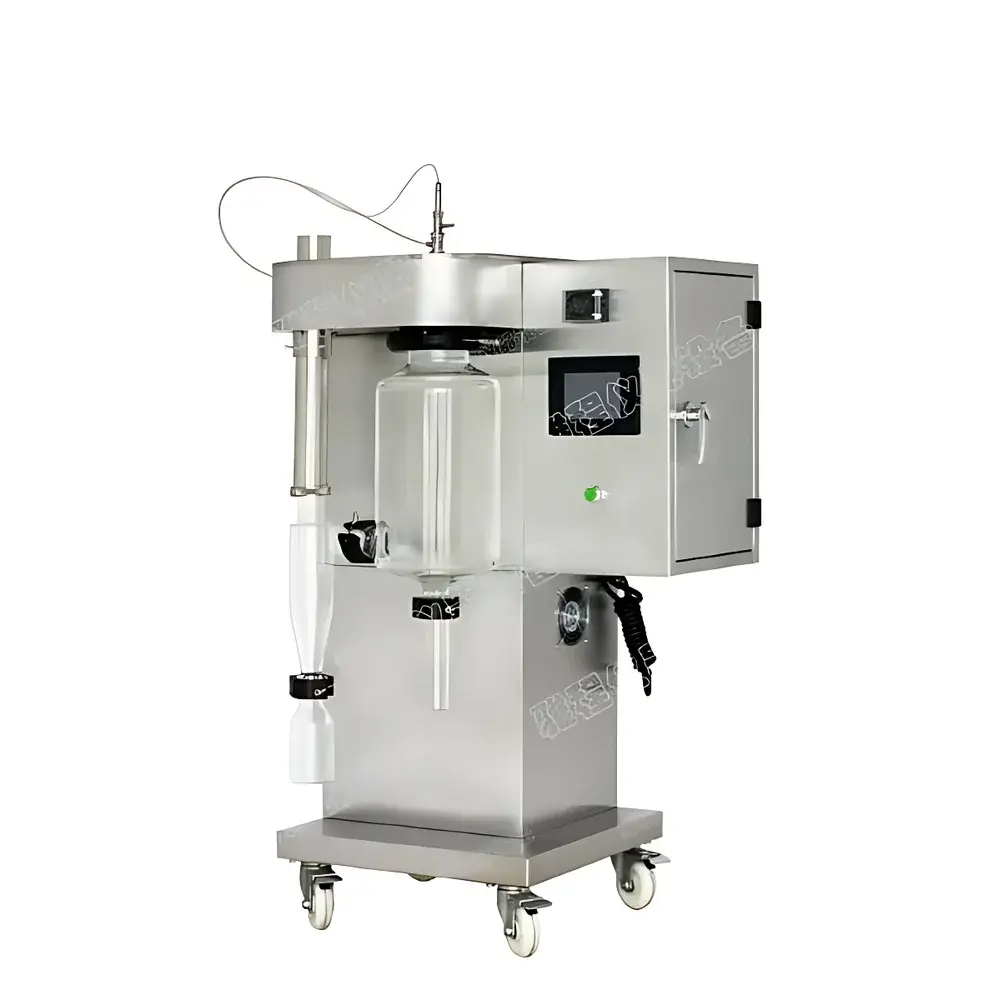
Yacheng YC-015 Benchtop Spray Dryer
| Origin | Shanghai, China |
|---|---|
| Manufacturer Type | Authorized Distributor |
| Country of Origin | China |
| Model | YC-015 |
| Pricing | Available Upon Request |
Overview
The Yacheng YC-015 Benchtop Spray Dryer is a compact, self-contained laboratory-scale spray drying system engineered for precise, reproducible conversion of liquid feedstocks—including aqueous solutions, emulsions, and suspensions—into free-flowing micro-powders. It operates on the principle of flash evaporation via two-fluid nozzle atomization: feed solution is pneumatically dispersed into fine droplets (typically 10–100 µm) within a heated drying chamber; rapid solvent removal occurs in <1.5 seconds, minimizing thermal exposure to thermolabile compounds such as proteins, enzymes, probiotics, and bioactive pharmaceuticals. Designed for stand-alone operation in standard laboratory environments, the unit requires no external air compressors, chillers, or exhaust ducting. Its integrated all-oil-free air compressor, borosilicate glass drying tower, and PID-controlled dual-temperature regulation (inlet: 30–300 °C; outlet: 30–140 °C) ensure consistent particle formation under controlled, contamination-minimized conditions.
Key Features
- Full-color 7-inch LCD touchscreen interface with real-time animated process visualization and dual-mode operation: fully automated startup/shutdown sequences or manual parameter override during experimentation.
- Borosilicate glass drying chamber, cyclone separator, and collection vessel—optically transparent, autoclavable, and chemically inert—enabling direct visual monitoring and rapid cleaning between runs.
- PID-regulated inlet/outlet temperature control with ±1 °C accuracy across the full operating range, ensuring process repeatability essential for method development and regulatory documentation.
- Adjustable two-fluid nozzle assembly with interchangeable orifice diameters (0.5–2.0 mm), supporting optimization of droplet size distribution and final powder morphology.
- Automatic needle-cleaning mechanism (‘clearing pin’) with user-adjustable activation frequency to prevent nozzle clogging during viscous or particulate-laden feed processing.
- Tower wall sweeping system that enhances powder recovery efficiency (>95% typical yield) by minimizing wall deposition and facilitating complete sample retrieval.
- Integrated oil-free air compressor (noise level <60 dB(A)), compliant with ISO 14644-1 Class 8 cleanroom ambient noise requirements for shared laboratory spaces.
- Feed rate control via precision peristaltic pump (50–2000 mL/h), compatible with optional magnetic stirrer for homogeneous suspension feeding.
- Standard filtration at the intake air path to maintain particulate-free drying gas, critical for GMP-aligned pre-formulation studies.
Sample Compatibility & Compliance
The YC-015 accommodates a broad spectrum of feed materials—including heat-sensitive biologics, polymer dispersions, ceramic precursors, food-grade emulsions, and nanosuspensions—without requiring solvent-specific hardware modifications. Its design aligns with core principles of Good Laboratory Practice (GLP) and supports traceability through timestamped parameter logging. While not certified to specific FDA 21 CFR Part 11 standards out-of-the-box, its digital interface enables integration with validated LIMS or ELN platforms for audit-ready data capture. Optional nitrogen recirculation upgrade permits safe drying of organic solvents (e.g., ethanol, acetone, dichloromethane) under inert atmosphere—meeting OSHA PEL and ATEX zone 2 safety prerequisites when configured accordingly. All wetted parts comply with USP Class VI and ISO 10993-5 biocompatibility guidelines.
Software & Data Management
Process parameters—including inlet/outlet temperatures, airflow rate, peristaltic pump speed, and clearing pin frequency—are continuously displayed and logged to internal memory with UTC timestamps. Data export is supported via USB interface in CSV format for downstream statistical analysis (e.g., DOE, ANOVA, Cpk calculation). The system architecture allows firmware updates and configuration backup/restore, facilitating instrument qualification (IQ/OQ) documentation. For regulated environments, optional third-party software packages provide electronic signature capability, role-based access control, and 21 CFR Part 11-compliant audit trails when deployed on networked workstations.
Applications
- Pharmaceutical R&D: Preparation of amorphous solid dispersions, inhalable dry powders, and nanoparticle carriers for controlled release profiling.
- Food Science: Encapsulation of flavors, probiotics, omega-3 oils, and anthocyanins to improve oxidative stability and gastric survivability.
- Materials Engineering: Synthesis of spherical metal oxide nanoparticles (e.g., LiFePO₄, SiO₂), catalyst supports, and battery electrode precursors.
- Agrochemical Development: Formulation of water-dispersible granules (WDGs) and microencapsulated pesticides with reduced environmental leaching potential.
- Academic Research: Teaching platform for mass/heat transfer fundamentals, particle engineering, and process scale-up correlation studies.
FAQ
What is the minimum sample volume required for a single run?
A minimum feed volume of 50 mL is supported, enabling efficient use of precious research-grade materials.
Can the YC-015 handle organic solvents?
Yes—via optional nitrogen recirculation retrofit, which replaces ambient air with inert gas to eliminate explosion risk and enable closed-loop solvent recovery.
Is the system compliant with international electrical safety standards?
It meets IEC 61010-1 for laboratory electrical equipment and carries CE marking for EMC and low-voltage directive compliance.
How is particle size distribution influenced by operational parameters?
Droplet size—governed primarily by nozzle orifice diameter, feed concentration, and atomizing gas pressure—directly determines primary particle size; secondary aggregation may be modulated via outlet temperature and residence time.
What maintenance is required for long-term reliability?
Routine tasks include weekly glassware cleaning, monthly air filter replacement, and annual calibration verification of temperature sensors and flow meters using NIST-traceable references.



