
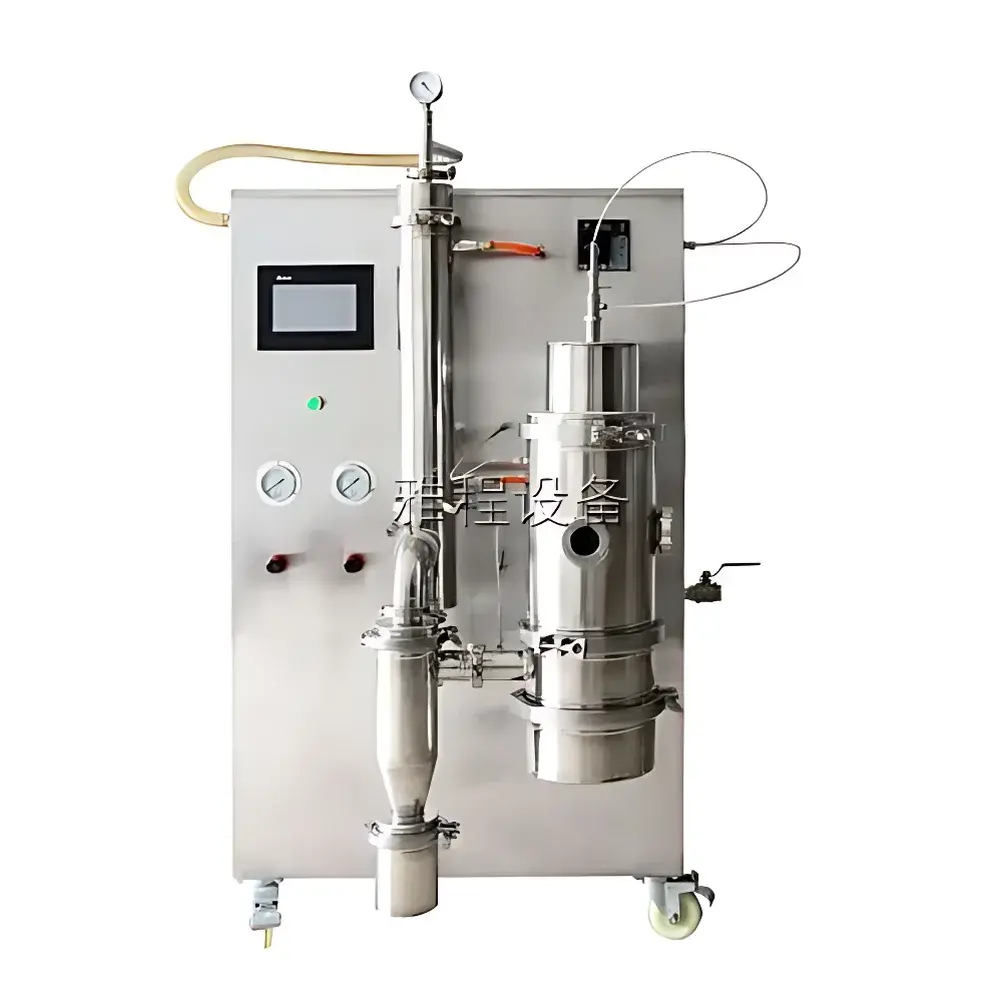
YaCheng YC-2000 Laboratory Vacuum Spray Dryer
| Brand | YaCheng / PILOTECH |
|---|---|
| Origin | Shanghai, China |
| Manufacturer Type | Direct Manufacturer |
| Model | YC-2000 |
| Power Supply | 6 kW / 380 V AC |
| Maximum Feed Rate | 800 mL/h |
| Minimum Sample Volume | 50 mL (varies with solids content) |
| Heating Temperature Range | 60–80 °C |
| Vacuum Range | −0.05 to −0.06 MPa |
| Temperature Control Accuracy | ±1 °C (PID-controlled) |
| Nozzle Orifice Options | 0.5, 0.7, 1.0, 1.5, 2.0 mm (stainless steel, customizable) |
| Integrated Oil-Free Compressor | Yes |
| Atomization System | Dual-Fluid (compressed air + liquid feed) |
| Construction Material | Full 316L stainless steel |
| Touchscreen Interface | Color LCD, Chinese-language UI (no English firmware provided) |
| Cleaning Feature | Automatic needle-type nozzle cleaner (adjustable frequency) |
| Particle Flowability | High (normal size distribution) |
| Noise Level | <60 dB(A) — compliant with ISO 7779 and national laboratory acoustic standards |
Overview
The YaCheng YC-2000 Laboratory Vacuum Spray Dryer is an integrated, bench-scale drying system engineered for the gentle, rapid dehydration of thermolabile substances under reduced pressure. Unlike conventional atmospheric spray dryers that rely on elevated inlet temperatures (often >120 °C), this instrument operates within a controlled vacuum environment (−0.05 to −0.06 MPa), enabling complete solvent evaporation at significantly lower thermal input—typically between 60 °C and 80 °C. This operational regime is grounded in the physical principle that lowering ambient pressure reduces the boiling point of solvents (e.g., water, ethanol, acetone), thereby permitting rapid droplet desolvation without thermal degradation. The system employs dual-fluid nozzle atomization—where compressed air shears the liquid feed into fine, uniform droplets—followed by immediate exposure to a low-temperature, low-pressure drying chamber. This architecture preserves molecular integrity, enzymatic activity, microbial viability, and structural conformation in sensitive biologics, natural product extracts, polymeric nanoparticles, and volatile organic compounds.
Key Features
- Integrated vacuum-compatible design: self-contained unit with built-in oil-free air compressor, eliminating external gas supply dependencies and minimizing contamination risk.
- PID-regulated heating system with ±1 °C temperature stability across the full 60–80 °C operating range—ensuring reproducible thermal profiles critical for method development and regulatory compliance.
- Color LCD touchscreen interface with intuitive Chinese-language navigation; supports both fully automated operation and real-time manual intervention modes for experimental flexibility.
- Dual-fluid stainless steel nozzle assembly (316L), available in five standard orifice diameters (0.5–2.0 mm), allowing precise control over droplet size distribution and final powder morphology.
- Auto-clearing nozzle cleaning mechanism (“needle cleaner”) with programmable activation frequency—reducing downtime and operator dependency during extended runs with viscous or particulate-laden feeds.
- Full 316L stainless steel construction throughout wetted and process zones—meeting material compatibility requirements for GMP-aligned pilot studies and pharmaceutical process characterization.
Sample Compatibility & Compliance
The YC-2000 accommodates aqueous and organic solutions containing heat-sensitive actives—including live probiotics, monoclonal antibody fragments, plant-derived glycosides, polysaccharide-protein conjugates, and low-Tg synthetic polymers. Its vacuum-assisted drying pathway inherently suppresses Maillard reactions, oxidation, and racemization pathways commonly triggered by prolonged thermal exposure. While the device itself does not carry CE, UL, or FDA 510(k) certification, its mechanical design and material traceability align with foundational elements of ISO 22000 (food safety), ISO 13485 (medical device manufacturing support), and ICH Q5C (biopharmaceutical stability). Users performing GLP or GMP-adjacent research are advised to validate drying parameters (e.g., residual moisture, assay recovery, particle size distribution) per internal SOPs referencing USP <1210> and ASTM E29-23.
Software & Data Management
The embedded controller logs time-stamped process data—including chamber temperature, vacuum level, feed rate, and compressor status—to internal memory. Export is limited to USB flash drive transfer in CSV format; no network connectivity, cloud integration, or audit-trail functionality is implemented. For laboratories requiring 21 CFR Part 11 compliance, third-party SCADA or LIMS interfacing must be achieved via analog signal outputs (4–20 mA) or optional RS485 Modbus RTU port (not standard). All parameter changes are recorded with timestamp but lack user authentication or electronic signature capability.
Applications
- Preformulation screening of amorphous solid dispersions using polymer carriers (e.g., HPMCAS, PVP-VA).
- Rapid generation of inhalable microparticles from protein solutions under non-denaturing conditions.
- Stabilization of lactic acid bacteria (LAB) and bifidobacteria for functional food ingredient development.
- Drying of anthocyanin-rich fruit extracts without anthocyanidin degradation or color shift.
- Production of nanostructured lipid carriers (NLCs) and liposomal suspensions for topical delivery.
- Process mapping of critical quality attributes (CQAs) including residual solvent content (<500 ppm), hygroscopicity (by DVS), and redispersion kinetics.
FAQ
What is the minimum sample volume required for a valid run?
50 mL is the recommended minimum, though actual feasibility depends on total solids concentration—samples with <5 wt% solids may require volume adjustment to ensure adequate powder yield.
Can the system handle chlorinated solvents like dichloromethane?
No. The vacuum pump and seals are rated for water, ethanol, methanol, and acetone only; halogenated solvents may compromise elastomer integrity and void warranty.
Is remote monitoring or Ethernet connectivity supported?
Not natively. The unit lacks TCP/IP hardware; integration requires external PLC-based data acquisition with analog signal conditioning.
Does the dryer include inert gas purging capability?
No. The system operates under vacuum only; optional nitrogen blanket integration is possible via custom manifold retrofit but not supplied.
What maintenance intervals are recommended for the built-in air compressor?
Compressor filter replacement every 500 operating hours; full service (bearing inspection, seal replacement) every 3,000 hours—per manufacturer’s technical bulletin YC-2000-MNT-REV4.



