
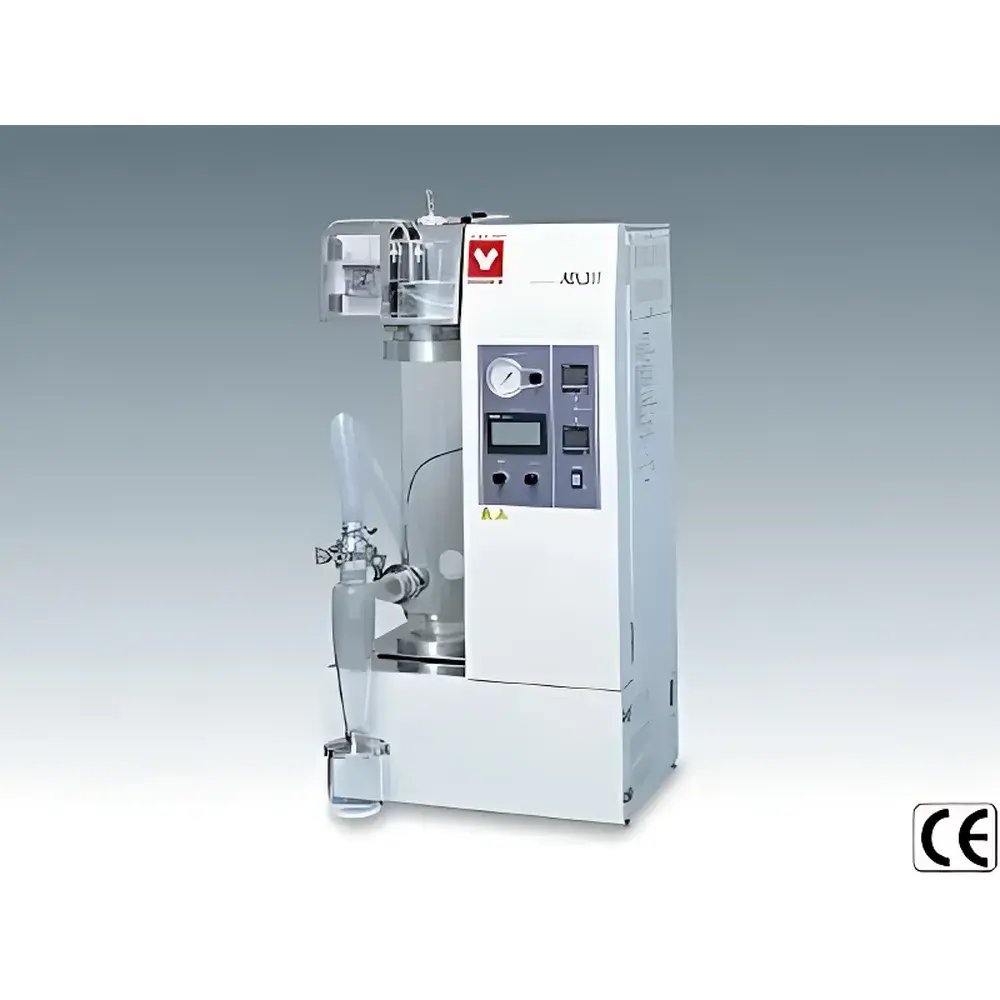
YAMATO ADL311S-A Spray Dryer
| Brand | YAMATO |
|---|---|
| Origin | Japan |
| Model | ADL311S-A |
| Sample Types | Aqueous, Organic, and Mixed Solvent Systems |
| Max. Feed Rate | 3 mL/h |
| Inlet Temperature Range | 40–220 °C |
| Outlet Temperature Range | 0–60 °C |
| Particle Size Output | ~100 µm (typical, dependent on feed properties) |
| Evaporation Capacity | Up to 1300 mL/h |
| Drying Air Flow | 0–0.7 m³/min |
| Atomizing Air Pressure | 0–0.6 MPa |
| Heating Power | 2.0–2.88 kW (voltage-dependent) |
| Dimensions (W×D×H) | 580 × 420 × 1150 mm |
| Weight | 80 kg |
| Compliance | CE-marked |
Overview
The YAMATO ADL311S-A Spray Dryer is a compact, benchtop-scale laboratory spray drying system engineered for precise, reproducible conversion of liquid feeds—including aqueous solutions, organic solvent-based suspensions, and mixed-phase formulations—into free-flowing, low-moisture micro-powders. Operating on the principle of flash evaporation via two-fluid nozzle atomization, the system introduces feed solution into a controlled stream of heated drying air, enabling rapid solvent removal within milliseconds. This short residence time (<2 s) minimizes thermal degradation, making the ADL311S-A particularly suitable for thermolabile compounds such as proteins, peptides, polymers, and active pharmaceutical ingredients (APIs). Unlike conventional oven or freeze-drying methods, spray drying eliminates intermediate steps including filtration, centrifugation, and mechanical milling—reducing cross-contamination risk and preserving particle morphology integrity. When integrated with the optional YAMATO GAS410 solvent recovery unit, the system supports closed-loop operation with flammable organic solvents (e.g., ethanol, acetone, dichloromethane), meeting OSHA and local lab safety requirements for volatile organic compound (VOC) handling.
Key Features
- Two-stage temperature control: Independent PID-regulated inlet (40–220 °C) and outlet (0–60 °C) temperature monitoring with ±1 °C accuracy at inlet
- Integrated pulse-jet nozzle cleaning function—manual activation clears residue without disassembly
- Quick-release drying chamber and cyclonic separator with ergonomic lift-assist mechanism for routine maintenance
- Digital touchscreen interface with real-time display of critical parameters: inlet/outlet temperatures, airflow rate, atomizing pressure, and pump status
- 4–20 mA analog output for external data logging of inlet and outlet temperatures
- Comprehensive safety architecture: Overheat protection (inlet/outlet), liquid pump reverse-rotation detection, earth-leakage circuit breaker, and interlock sensing for GAS410 connection integrity
- Modular design supporting seamless integration of optional accessories—including GF300 atomization kit, ODL21C support stand, COV20C safety enclosure, and third-party temperature recorders
Sample Compatibility & Compliance
The ADL311S-A accommodates a broad range of feedstocks: water-based colloids, polymer emulsions, nanoparticle dispersions, and organic-solvent suspensions (when paired with GAS410). Its stainless-steel wetted path (316L-grade nozzle tip, borosilicate glass drying chamber) ensures chemical resistance and minimal metal leaching. The system conforms to IEC 61000-6-3 (EMC emissions) and IEC 61000-6-2 (immunity), and carries CE marking per Machinery Directive 2006/42/EC and Low Voltage Directive 2014/35/EU. While not inherently 21 CFR Part 11 compliant, audit-ready electronic records can be generated via external validated data acquisition systems interfaced through its analog outputs—supporting GMP/GLP workflows when operated under documented SOPs and periodic calibration (traceable to NIST standards).
Software & Data Management
The ADL311S-A operates without proprietary software; all operational logic resides in its embedded microcontroller. Parameter setpoints, runtime logs, and alarm histories are stored locally on the device’s non-volatile memory (retention ≥10 years). For regulated environments, users may connect external programmable logic controllers (PLCs) or validated SCADA platforms via the 4–20 mA analog outputs. Optional integration with YAMATO’s GF300 spray head enables fine-tuned droplet size modulation through adjustable air-to-liquid ratio control—critical for achieving narrow particle size distributions (PSD) in inhalable dry powder formulations. All firmware updates are delivered via secure USB key, with version history and change logs provided in accompanying technical bulletins.
Applications
- Pharmaceutical R&D: Production of amorphous solid dispersions, inhalable microparticles, and excipient-free API powders
- Materials science: Synthesis of ceramic precursors, catalyst supports, and battery electrode materials (e.g., LiFePO₄, SiO₂ nanoparticles)
- Food & nutraceuticals: Encapsulation of probiotics, vitamins, and omega-3 oils using maltodextrin or gum arabic matrices
- Academic research: Fundamental studies of droplet evaporation kinetics, crust formation dynamics, and glass transition behavior during drying
- Quality control labs: Rapid generation of reference standards from stock solutions for HPLC, DSC, or XRD analysis
FAQ
What solvents can be processed with the ADL311S-A?
Aqueous solutions are supported natively. Organic solvents (e.g., methanol, THF, ethyl acetate) require the GAS410 solvent recovery unit to maintain explosion-proof operation and comply with local fire codes.
Is the particle size distribution controllable?
Yes—via adjustment of inlet temperature, feed rate, atomizing air pressure, and nozzle geometry (e.g., GF300 kit). Typical median diameters range from 50–150 µm depending on feed viscosity and solids content.
Does the system support automated batch documentation?
Not internally—but its analog outputs enable connection to validated third-party data loggers compliant with 21 CFR Part 11 when configured with electronic signature and audit trail modules.
What maintenance is required for routine operation?
Daily: Visual inspection of nozzle tip, cleaning of cyclone walls with lint-free cloth. Weekly: Replacement of intake/exhaust filters. Annually: Calibration of K-type thermocouples and verification of airflow sensor linearity.
Can the ADL311S-A be used for sterile processing?
No—it is not designed for ISO Class 5 environments or equipped with SIP/CIP capabilities. Sterile applications require additional containment (e.g., isolator integration) and validation per ISO 14644-1.



