
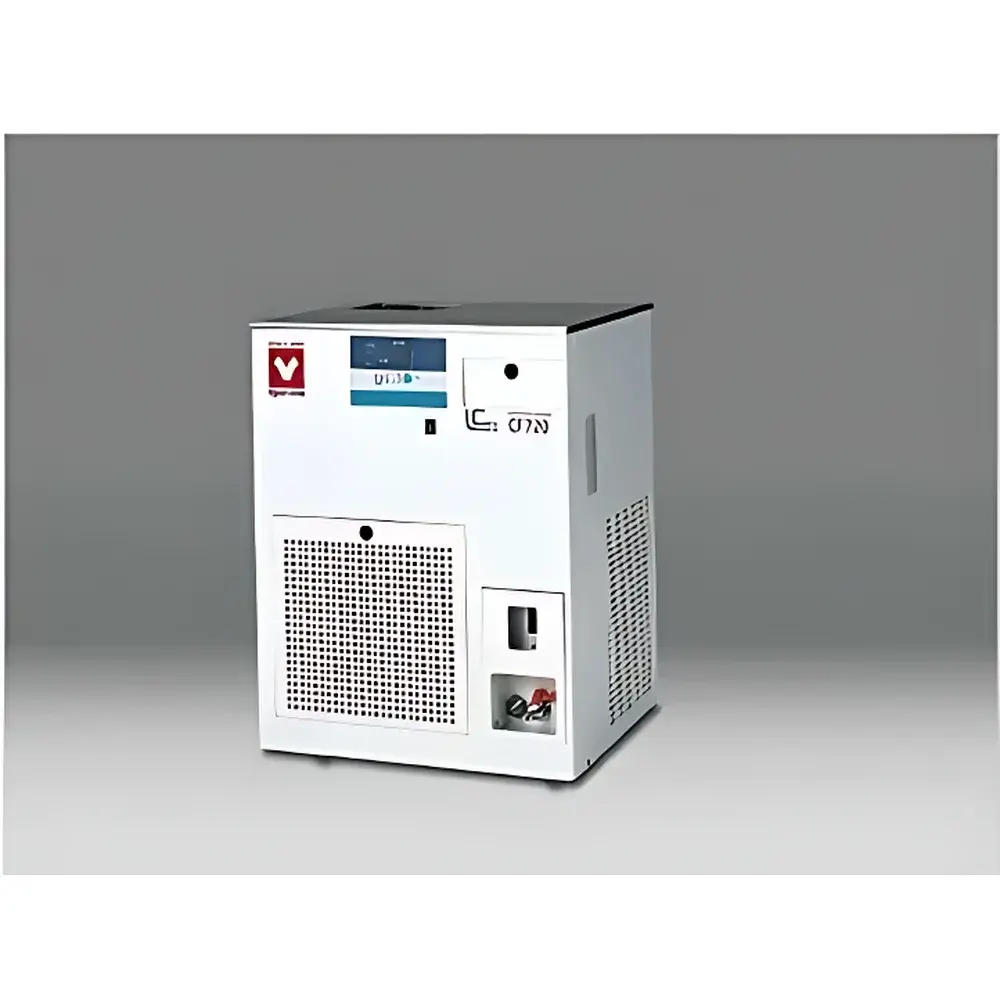
YAMATO CF720 Low-Profile Circulating Chiller
| Brand | YAMATO |
|---|---|
| Origin | Japan |
| Model | CF720 |
| Cooling Capacity | 880 W (at 10°C liquid temp) |
| Temperature Range | –20°C to ambient |
| Reservoir Volume | 14 L |
| Pump Type | Magnetic Drive Circulation Pump |
| Refrigerant | R404A (680 g) |
| Power Supply | AC 100 V, 10 A |
| Dimensions (W×D×H) | 460 × 400 × 600 mm |
| Weight | ~60 kg |
| Safety Features | Overcurrent/leakage protection, compressor overload relay, pump thermal protector, compressor delay timer, H-branch pump protection |
| Control | Digital setpoint & display, timer function, deviation correction, power failure compensation, key lock, analog temperature output |
Overview
The YAMATO CF720 Low-Profile Circulating Chiller is an engineered solution for precise, stable thermal management of analytical instruments, laboratory reactors, spectroscopic systems, and other heat-sensitive equipment requiring external cooling. Designed specifically for integration beneath fume hoods or within compact benchtop configurations, its low-height chassis (600 mm tall) enables seamless alignment with standard laboratory work surfaces and ventilation enclosures—eliminating spatial constraints without compromising performance. The unit operates on the principle of vapor-compression refrigeration, utilizing a hermetically sealed rotary compressor and environmentally compliant R404A refrigerant to deliver consistent cooling across a wide operational range from –20°C to ambient temperature. Its dual-circuit circulation architecture supports simultaneous cooling of two independent external devices via four dedicated fluid ports (two inlet, two outlet), each fitted with stainless-steel quick-connect fittings and integrated shut-off valves—ensuring flexibility in multi-instrument setups while maintaining hydraulic isolation and pressure stability.
Key Features
- Low-profile mechanical design (460 × 400 × 600 mm) optimized for under-hood or flush-mount installation in regulated laboratory environments.
- Dual independent circulation circuits enable concurrent cooling of two external instruments—ideal for HPLC column ovens, ICP-MS torch interfaces, laser sources, or vacuum pumps.
- Digital PID-based temperature control with T-type thermocouple feedback ensures ±2°C stability across the full operating range (–20°C to ambient).
- Magnetic-drive circulation pump (127 W) delivers up to 30 L/min flow at low head, minimizing cavitation risk and eliminating shaft seal leakage—critical for long-term reliability in continuous operation.
- Comprehensive safety architecture includes overcurrent/earth-leakage circuit breaker, compressor overload relay, pump thermal cutout, compressor delay timer (prevents short-cycling), and H-branch pump protection circuitry.
- User interface features digital setpoint entry, real-time liquid temperature display, programmable timer, key lock, deviation offset correction, and analog temperature output (0–5 V or 4–20 mA) for integration into centralized monitoring systems.
- Stainless-steel reservoir (14 L usable volume) with nickel-plated copper cooling coils, condenser filter mesh, overflow port, drain valve, and integrated condensate management system.
Sample Compatibility & Compliance
The CF720 is compatible with water, water-glycol mixtures (up to 30% v/v), and other non-corrosive, low-viscosity heat-transfer fluids commonly used in analytical instrumentation cooling loops. Its stainless-steel reservoir, nickel-plated copper heat exchanger, and SUS316 tubing interfaces resist corrosion from deionized water and mild aqueous solutions. While not certified as a medical device or explosion-proof unit, the chiller meets general electrical safety requirements per JIS C 61010-1 (equivalent to IEC 61010-1) for laboratory equipment. Its R404A refrigerant charge complies with Japanese industrial refrigerant handling regulations and aligns with global phase-down schedules under the Kigali Amendment framework. For GLP/GMP-regulated laboratories, the unit supports audit-ready documentation through its analog temperature output and stable thermal performance—though it does not include built-in 21 CFR Part 11-compliant electronic records functionality.
Software & Data Management
The CF720 operates as a standalone, microprocessor-controlled instrument with no embedded PC or proprietary software dependency. All configuration and monitoring occur via the front-panel keypad and LED display. Analog temperature output (configurable 0–5 V or 4–20 mA) permits direct connection to data loggers, SCADA systems, or building management platforms for trend analysis and alarm integration. No firmware updates, cloud connectivity, or remote diagnostics are provided—consistent with YAMATO’s design philosophy emphasizing deterministic operation, electromagnetic compatibility (EMC), and minimal service intervention in mission-critical lab infrastructure.
Applications
- Cooling of high-power analytical light sources (e.g., X-ray tubes, plasma torches, solid-state lasers) requiring stable thermal setpoints and low vibration transmission.
- Thermal regulation of chromatographic columns, detectors, and autosamplers in HPLC, GC, and LC-MS systems where ambient drift affects retention time reproducibility.
- Heat extraction from vacuum pumps, rotary evaporators, and reaction calorimeters during extended synthesis or process optimization studies.
- Support of electrophoresis apparatus, DNA sequencers, and PCR thermal cyclers requiring auxiliary cooling beyond onboard Peltier capacity.
- Integration into pilot-scale bioreactor or fermentation control systems where precise jacket temperature control is required alongside primary heating/cooling loops.
FAQ
What is the minimum operating temperature of the CF720?
The unit achieves a stable setpoint down to –20°C when using pure water or appropriate water-glycol mixtures; performance is fluid-dependent and must be verified against viscosity and freezing-point depression characteristics.
Can the CF720 be used with organic solvents?
No—only water, aqueous glycol solutions (≤30%), or other non-flammable, non-aggressive heat-transfer fluids compatible with stainless steel and nickel-plated copper are permitted.
Does the unit support remote start/stop or network communication?
No—control is local only via front-panel interface; analog output allows passive temperature monitoring but no bidirectional command capability.
How often should the condenser filter be cleaned?
Under typical laboratory conditions (5–35°C ambient, low-dust environment), inspection and cleaning every 3–6 months is recommended; frequency increases in high-particulate or high-humidity settings.
Is the R404A refrigerant charge serviceable in the field?
Refrigerant charging requires certified HVAC-R technicians and calibrated recovery equipment per Japanese Industrial Standards (JIS B 8601); end users must not attempt recharging or modification.



