
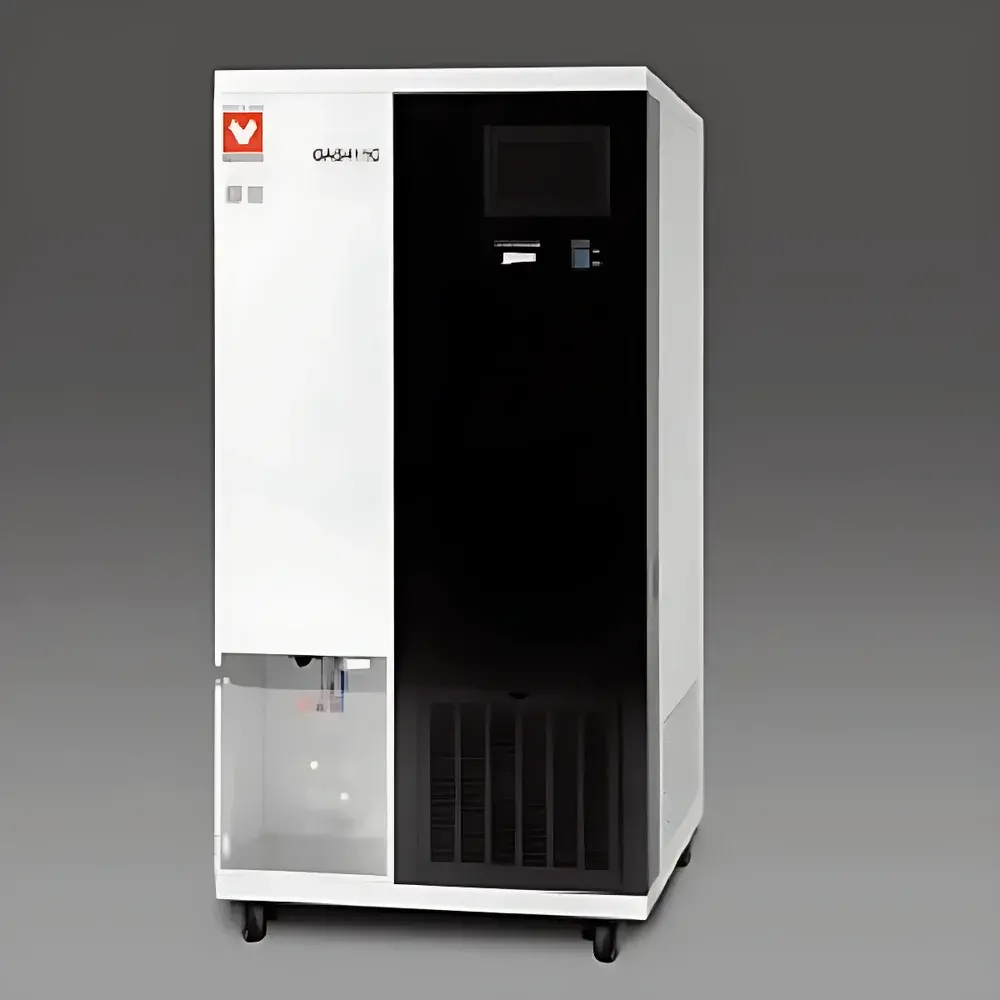
Yamato GAS411C Organic Solvent Recovery System for Spray Dryers
| Brand | Yamato |
|---|---|
| Origin | Japan |
| Model | GAS411C |
| Sample Types | Water-soluble & organic solvents |
| Max. Solvent Recovery Rate | 1500 mL/h |
| Temperature Range | 40–240 °C |
| Condensation Temp. Range | −20 to 30 °C |
| Circulating Airflow | 0.12–0.65 m³/min |
| Oxygen Monitoring Range | 0.01–25% vol |
| Power Supply | AC 200–230 V, 50 Hz, 5–6 A |
| Dimensions (W×D×H) | 710 × 950 × 1450 mm |
| Weight | 130 kg |
| Refrigerant | R404A |
| Compressor Type | Linear reciprocating air compressor |
| Cooling System | Air-cooled, fully sealed refrigeration unit (400 W) |
| Filtration | Class 100 corrosion-resistant HEPA filter |
| Safety Features | O₂ concentration upper-limit alarm, combustible gas alarm, overcurrent protection, automatic N₂ purge activation upon O₂ rise |
Overview
The Yamato GAS411C Organic Solvent Recovery System is an engineered safety-critical auxiliary unit designed exclusively for integration with Yamato spray dryers—including the ADL312SC, GB211C-A, and DL411C models—to enable closed-loop, nitrogen-purged solvent processing under strict regulatory and operational safety constraints. Unlike conventional open-air drying systems, the GAS411C implements a dual-stage recovery architecture: first, inert nitrogen gas establishes and maintains an oxygen-deficient (<1% O₂ typical) atmosphere within the drying chamber and circulation loop; second, vapor-phase organic solvents are condensed via a precisely controlled cryogenic condenser (-20 to +30 °C), cooled by an integrated air-cooled R404A refrigeration system (400 W). This combination ensures quantitative recovery of flammable (e.g., acetone, ethanol, ethyl acetate) and toxic solvents (e.g., chloroform, DMF), while simultaneously protecting oxidation-sensitive active pharmaceutical ingredients (APIs), polymers, and biologics from thermal or oxidative degradation. The system operates across a process temperature range of 40–240 °C—enabling both low-temperature drying of thermolabile compounds and high-temperature dehydration of robust matrices—without venting volatile organic compounds (VOCs) to ambient exhaust.
Key Features
- Integrated nitrogen purge and closed-circuit gas recirculation with real-time oxygen monitoring (0.01–25% vol, diffusion-type and pump-suction O₂ sensors)
- Dual-stage solvent recovery: cryogenic condensation (-20 to +30 °C) coupled with high-efficiency filtration (Class 100 corrosion-resistant HEPA)
- Intelligent safety interlock system: automatic nitrogen injection upon O₂ threshold exceedance, combustible gas alarm, overcurrent cutoff, and emergency shutdown protocols
- 7-inch multi-language touchscreen HMI (English, Japanese, Chinese) with bidirectional communication to compatible Yamato spray dryer controllers
- Modular airflow management: adjustable circulating fan speed (0.12–0.65 m³/min), programmable spray gas source selection (N₂ or compressed air), and visual status indicators for all subsystems
- Robust mechanical design: linear reciprocating air compressor for stable atomization pressure, Rothenberger-type circulation blower, and 2 L solvent collection flask with anti-detachment clamp
Sample Compatibility & Compliance
The GAS411C supports aqueous and organic solvent-based feedstocks, including but not limited to methanol, ethanol, isopropanol, acetone, acetonitrile, dichloromethane, and dimethylformamide. Its closed-loop architecture meets essential requirements for GLP-compliant laboratories and GMP-regulated pharmaceutical manufacturing environments. The system’s oxygen control strategy aligns with ICH Q5C stability guidelines for oxygen-sensitive biologics, while its VOC containment performance satisfies ISO 14001 environmental management standards and local occupational exposure limits (OELs) per ACGIH TLVs®. Optional audit-trail logging (via external data acquisition) supports compliance with FDA 21 CFR Part 11 when paired with validated software platforms.
Software & Data Management
The embedded controller logs time-stamped operational parameters—including condenser temperature, O₂ concentration, airflow rate, nitrogen flow status, and alarm events—with onboard non-volatile memory retention. While the base unit does not include network connectivity, it provides RS-485/Modbus RTU output for integration into centralized laboratory information management systems (LIMS) or SCADA networks. All critical safety thresholds (e.g., O₂ > 8% vol, refrigerant pressure deviation > ±15%) trigger immediate visual/audible alerts and automatic fail-safe responses. Remote operation is supported via optional Ethernet gateway modules compliant with IEEE 802.3 standards.
Applications
- Pharmaceutical R&D: spray drying of heat-labile APIs, peptide formulations, and nanocrystal suspensions using flammable solvents under inert conditions
- Material science: synthesis and recovery of metal-organic frameworks (MOFs), conductive polymer nanoparticles, and lithium-ion battery cathode precursors
- Food & nutraceuticals: encapsulation of omega-3 oils, probiotics, and polyphenols in organic solvent systems without thermal degradation
- Agrochemical development: formulation of microencapsulated pesticides requiring solvent-free final products and zero atmospheric VOC release
- Academic research: method development for continuous solvent recovery in pilot-scale closed-cycle drying studies
FAQ
Can the GAS411C be retrofitted to non-Yamato spray dryers?
Yes, provided the host dryer supports nitrogen purging, closed-loop airflow, and analog/digital signal interfacing (0–10 V or 4–20 mA) for O₂ and temperature feedback.
What maintenance intervals are recommended for the refrigeration unit?
Compressor oil and refrigerant levels should be verified annually; condenser coils require quarterly cleaning; HEPA filters must be replaced every 6 months or after 1,000 operating hours, whichever occurs first.
Is validation documentation available for GMP use?
Yamato provides Factory Acceptance Test (FAT) reports and IQ/OQ templates; PQ protocols must be developed per site-specific process requirements and qualified by the end user’s QA team.
Does the system comply with ATEX or IECEx explosion protection directives?
The GAS411C itself is not certified for Zone 1 hazardous areas; however, when installed with appropriate upstream nitrogen supply pressure regulation and downstream explosion relief venting per EN 14491, it functions safely within classified environments under engineering supervision.
Can solvent recovery efficiency be quantified in real time?
Recovery yield is inferred indirectly via mass balance (feed volume vs. collected condensate) and confirmed post-run by GC-FID analysis; direct inline density or refractive index measurement requires third-party sensor integration.



