
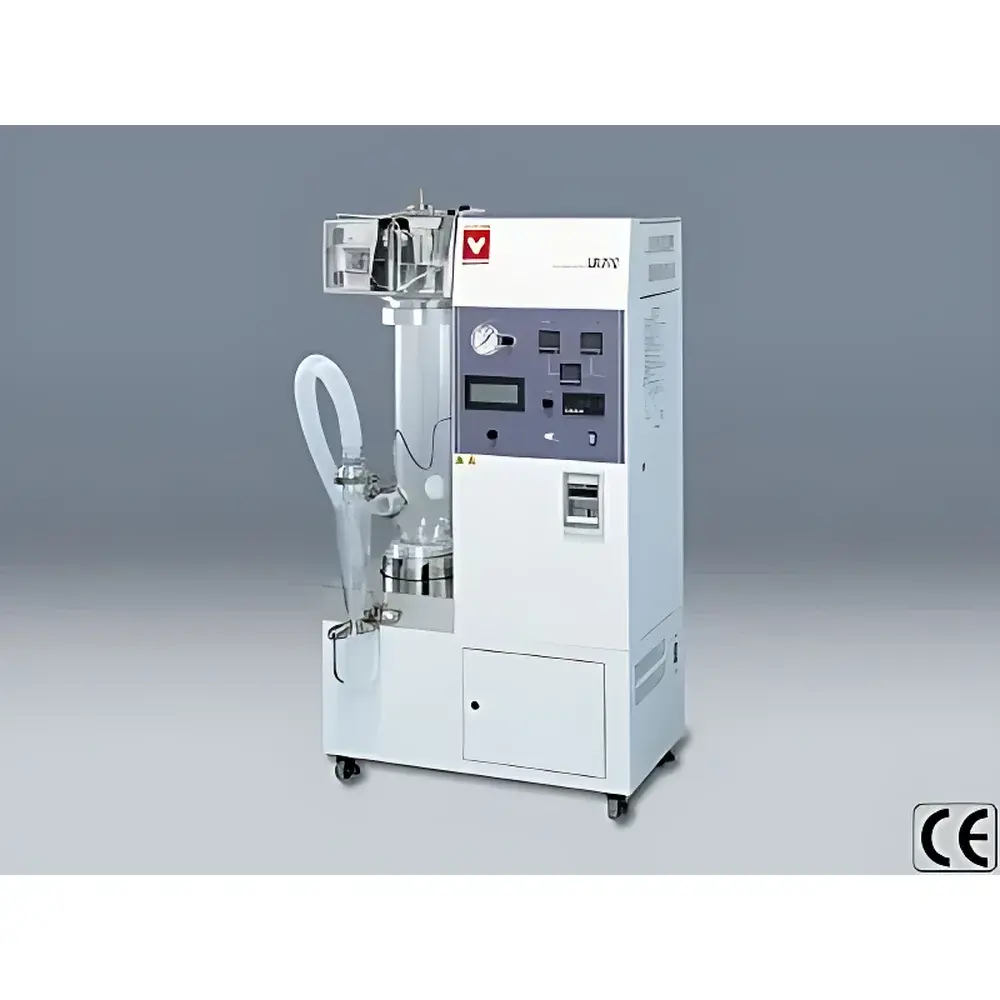
Yamato GB210 Spray Granulation and Drying Instrument
| Brand | Yamato |
|---|---|
| Origin | Japan |
| Model | GB210 |
| Max Feed Rate | 1300 mL/h |
| Temperature Range | 40–220°C (inlet), 0–60°C (outlet) |
| Particle Size Range | ~1 µm (typical median, dependent on feed formulation) |
| Sample Types | Aqueous & organic solvent-based solutions/suspensions |
| Power Supply | AC200–240V, 50/60 Hz |
| Dimensions | 760 × 420 × 1350 mm |
| Weight | 110 kg |
| Compliance | CE-marked, compatible with GLP/GMP environments when configured with audit-trail-capable software and optional accessories |
Overview
The Yamato GB210 Spray Granulation and Drying Instrument is a benchtop-scale, closed-loop spray processing system engineered for precise, reproducible conversion of liquid feedstocks—such as aqueous solutions, colloidal suspensions, and organic solvent-based formulations—into free-flowing, low-moisture micro-powders or engineered granules. Operating on the principle of concurrent-contact spray drying, the GB210 atomizes feed solution via a pneumatic nozzle into fine droplets within a controlled hot-air stream; rapid solvent evaporation yields solid particles in milliseconds, minimizing thermal exposure and preserving thermolabile compounds. Its design integrates granulation capability through optional GF200 module integration, enabling single-step particle formation, densification, and drying—eliminating post-drying milling, sieving, or agglomeration steps. The system supports both inlet-temperature control (primary mode) and outlet-temperature feedback control (conditional mode), ensuring consistent particle morphology and residual moisture content across batches.
Key Features
- Compact, modular architecture with automatic glass component lifting mechanism (electromechanical升降 unit) for safe, repeatable assembly and cleaning.
- High-precision PID digital temperature controller with ±1°C inlet temperature stability and dual K-type thermocouple monitoring (inlet/outlet).
- Dual-mode air handling: adjustable drying airflow (0–0.7 m³/min) and independent atomizing air pressure regulation (0–0.6 MPa), optimized for viscous or volatile feeds.
- Peristaltic feed pump with 0–26 mL/min flow range and pulse-jet nozzle cleaning function to prevent clogging during extended operation.
- Nozzle cooling jacket interface (dual 10.5 mm OD ports) for thermal management of heat-sensitive nozzles during organic solvent processing.
- Integrated safety suite: overheat protection (inlet/outlet), pump rotation fault detection, earth-leakage circuit breaker, and GAS410 connection status monitoring.
- Tri-language touchscreen HMI (English, Japanese, Chinese) with real-time parameter logging and 4–20 mA analog outputs for external SCADA or data acquisition systems.
Sample Compatibility & Compliance
The GB210 accommodates a broad spectrum of feed materials—including pharmaceutical actives, biopolymers, catalyst precursors, functional ceramics, and food-grade emulsions—provided they are soluble or stably suspended in water or common organic solvents (e.g., ethanol, acetone, ethyl acetate). When coupled with the optional GAS410 solvent recovery unit, the system achieves closed-loop operation compliant with OSHA PEL and ACGIH TLV guidelines for airborne solvent exposure. All wetted parts contact-grade borosilicate glass (DIN ISO 3585) and PTFE/FKM seals meet USP Class VI and FDA 21 CFR 177.2600 requirements. The instrument’s electrical design conforms to IEC 61010-1:2010 for laboratory equipment safety, and its documentation framework supports GLP audit readiness when paired with validated data management protocols.
Software & Data Management
While the GB210 operates autonomously via its embedded controller, it provides native 4–20 mA analog outputs for inlet/outlet temperatures and digital I/O signals for pump, heater, and blower status—enabling integration with third-party LIMS or MES platforms. Optional temperature recording modules (e.g., Yamato TR-800 series) support 21 CFR Part 11-compliant electronic records when deployed with user-authenticated access and audit-trail-enabled firmware. Raw process data—including time-stamped temperature profiles, airflow setpoints, and feed rate logs—can be exported via USB for offline analysis in MATLAB, Python (Pandas), or JMP. No proprietary cloud service or mandatory subscription is required.
Applications
- Pharmaceutical development: production of inhalable dry powders, amorphous solid dispersions, and nanoparticle-loaded microparticles under inert or solvent-recycled conditions.
- Materials science: synthesis of spherical Li-ion battery cathode precursors, metal oxide nanoparticles, and porous silica carriers with narrow PSD (Dv50 ≈ 1–10 µm).
- Food & nutraceuticals: gentle drying of probiotics, enzymes, and anthocyanin-rich extracts while retaining >90% bioactivity (validated per AOAC 990.11).
- Academic research: rapid screening of formulation variables (solid content, surfactant type, solvent ratio) in DOE-driven particle engineering studies.
- Quality control labs: standardized powder preparation for XRD, BET surface area, or dissolution testing per USP and ISO 8503-2.
FAQ
Can the GB210 handle heat-sensitive biological samples such as proteins or peptides?
Yes—the millisecond residence time (<1 s) and adjustable inlet temperature (as low as 40°C) enable drying of labile biomolecules; optimal results require co-solvent or bulking agent optimization.
Is the GB210 suitable for GMP manufacturing environments?
It is designed for R&D and pilot-scale use; full GMP compliance requires validation of installation (IQ), operational (OQ), and performance (PQ) protocols, plus integration with 21 CFR Part 11–compliant data systems.
What is required to process flammable organic solvents safely?
Mandatory use of the GAS410 solvent recovery unit, nitrogen inerting option (not standard), explosion-proof exhaust ducting, and Class I, Division 1 electrical certification of the installation site.
Does the GB210 include particle size measurement capability?
No—particle size distribution must be characterized post-drying using external instrumentation (e.g., laser diffraction per ISO 13320 or SEM imaging).
Can the GF200 granulation module be retrofitted to an existing GB210 unit?
Yes—mechanical and pneumatic interfaces are standardized; retrofit requires factory calibration and updated firmware revision v2.4 or later.



