
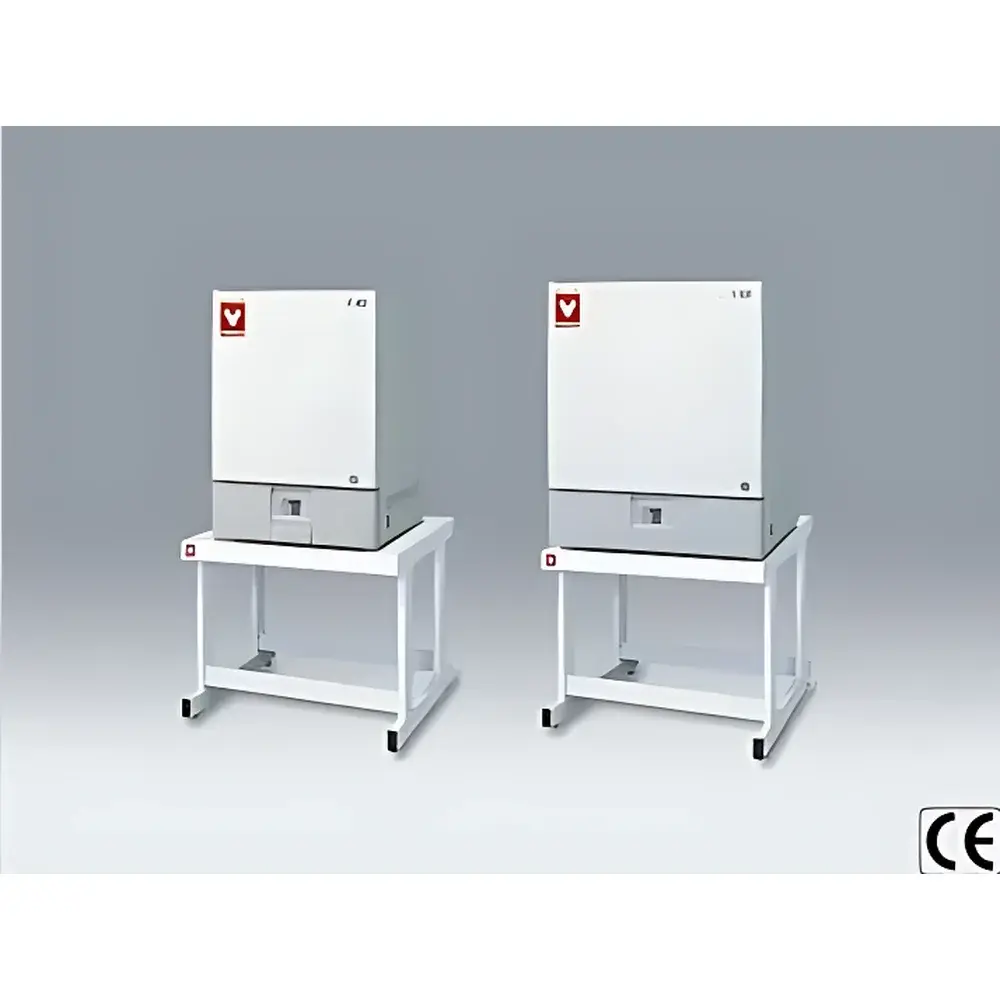
YAMATO IC412C / IC612C / IC812C Temperature-Controlled Incubators (Natural Convection Type)
| Brand | YAMATO |
|---|---|
| Origin | Japan |
| Model | IC412C / IC612C / IC812C |
| Temperature Range | Ambient +5°C to 80°C |
| Temp. Control Accuracy | ±0.5°C at 37°C |
| Temp. Uniformity | ±1.0°C at 37°C |
| Interior Material | Stainless Steel |
| Exterior Material | Cold-Rolled Steel with Chemical-Resistant Coating |
| Insulation | Glass Fiber |
| Heating Element | Ni-Cr Wire (0.3 kW / 0.4 kW / 0.7 kW) |
| Chamber Volume | 97 L / 159 L / 318 L |
| Shelf Capacity | 15 kg per shelf |
| Shelf Spacing | 30 mm |
| Power Supply | AC 220 V, 50/60 Hz |
| Controller | PID-based Digital Temperature Controller with Dual LED Display (Green for Actual, Red for Setpoint) |
| Safety Features | Self-Diagnostic Circuit (Sensor Fault, SSR Short, Heater Open, Over-Temp Prevention), Independent Over-Temperature Cut-Off, Earth Leakage Circuit Breaker, Keypad Lock |
| Optional Interfaces | RS485 Communication, 4–20 mA Analog Output, External Alarm & Timer Output Terminals |
Overview
The YAMATO IC412C, IC612C, and IC812C series are precision-engineered natural convection incubators designed for stable, uniform temperature control in life science laboratories, quality control environments, and regulated bioprocessing workflows. These units operate on a passive air circulation principle—relying on thermal buoyancy rather than forced airflow—to minimize mechanical vibration, avoid sample desiccation, and ensure gentle thermal equilibration across the chamber volume. This architecture is particularly suited for applications requiring low turbulence and minimal disturbance to cell cultures, microbial growth assays, enzyme activity studies, and stability testing of biological reagents. Each model is manufactured in Japan under stringent ISO 9001-certified production protocols and conforms to IEC 61010-1 safety standards for laboratory equipment. The chamber maintains temperature stability within ±0.5°C at 37°C (typical operating setpoint), with spatial uniformity of ±1.0°C across the working volume—validated per ASTM E145-22 Annex A3 for gravity convection ovens.
Key Features
- Natural convection design eliminates fans and associated noise, vibration, and localized drying effects—critical for sensitive cell monolayers and agar-based microbiological media.
- Dual-door construction: outer door with thermal insulation and inner tempered glass door enables real-time visual monitoring without compromising thermal integrity or increasing heat loss.
- PID digital temperature controller with independent Pt100 RTD sensing and K-type thermocouple backup for over-temperature protection ensures repeatable setpoint accuracy and robust drift compensation.
- Multi-function operation modes include constant-temperature (setpoint) operation, auto-start, auto-stop, and rapid shutdown—programmable via intuitive membrane keypad with dedicated function keys and up/down adjustment buttons.
- Comprehensive safety architecture includes self-diagnostic circuitry (detecting sensor failure, SSR short-circuit, heater open-circuit), mechanical over-temperature limiter, earth leakage protection, and configurable keypad lock to prevent unauthorized parameter changes.
- Power-loss recovery function retains programmed settings and resumes operation upon power restoration—essential for unattended overnight or weekend runs compliant with GLP and GMP documentation requirements.
Sample Compatibility & Compliance
These incubators accommodate standard laboratory vessels—including Petri dishes, multi-well plates, flasks, and test tubes—on adjustable stainless-steel wire mesh shelves spaced at precise 30 mm intervals. Shelf load capacity is rated at 15 kg per level, supporting stacked configurations without deformation. The interior chamber is constructed entirely from electropolished stainless steel (SUS304), ensuring corrosion resistance against routine disinfectants (e.g., 70% ethanol, hydrogen peroxide vapor, quaternary ammonium compounds) and compatibility with ISO 14644-1 Class 5 cleanroom maintenance protocols. Units meet CE marking requirements under the EU Machinery Directive 2006/42/EC and Low Voltage Directive 2014/35/EU. Optional RS485 serial interface supports integration into centralized lab monitoring systems compliant with FDA 21 CFR Part 11 when paired with validated data acquisition software.
Software & Data Management
While the IC-series operates via embedded firmware without onboard PC software, it provides multiple hardware-level data interfaces for external logging and system integration. The 4–20 mA analog output enables continuous temperature telemetry to PLCs or SCADA systems. RS485 Modbus RTU protocol allows bidirectional communication for remote setpoint adjustment, status polling, and alarm event reporting. Optional analog chart recorders or third-party validated digital loggers (e.g., Eurotherm, Omega) may be connected via the temperature output terminal for audit-trail-capable data capture. All operational parameters—including setpoint, actual temperature, timer status, and error codes—are retained in non-volatile memory and accessible via front-panel display, satisfying traceability needs under ISO/IEC 17025 and USP analytical instrument qualification guidelines.
Applications
- Bacterial and fungal culture incubation (e.g., E. coli, S. aureus, C. albicans) per CLSI M07-A10 and ISO 8199 standards.
- Cell-based assay incubation for ELISA, proliferation, and cytotoxicity studies where forced-air convection may induce edge effects or evaporation artifacts.
- Stability testing of vaccines, monoclonal antibodies, and diagnostic reagents per ICH Q1A(R2) and USP .
- Enzyme kinetics and protein denaturation studies requiring stable thermal conditions without airflow-induced convection currents.
- Quality assurance incubation for raw material testing in pharmaceutical manufacturing environments governed by Annex 1 and EU GMP Chapter 5.
FAQ
What is the difference between natural convection and forced-air incubation?
Natural convection relies on thermal gradients to drive gentle, laminar air movement—ideal for minimizing evaporation and mechanical stress on delicate biological samples. Forced-air systems use blowers that increase uniformity but risk desiccation and vibration; the IC-series prioritizes sample integrity over ultra-rapid equilibration.
Can these incubators be used for humidity-controlled applications?
No—the IC412C/612C/812C models are strictly temperature-controlled. For combined temp/humidity regulation, refer to YAMATO’s HI series or PL series humidified incubators.
Is calibration documentation provided with shipment?
Each unit ships with a factory calibration certificate traceable to JCSS (Japan Calibration Service System). On-site IQ/OQ validation support packages—including protocol templates and witness checklists—are available upon request.
Are spare parts and service support available internationally?
Yes—YAMATO maintains authorized service centers across North America, EMEA, and APAC regions. Critical spares (controllers, sensors, heaters) are stocked globally with lead times under 10 business days.
Does the unit comply with FDA 21 CFR Part 11 for electronic records?
The base unit does not include electronic signature or audit trail functionality. However, when integrated with validated third-party data loggers or LIMS platforms via RS485 or analog outputs, full Part 11 compliance can be achieved through documented system qualification.






