
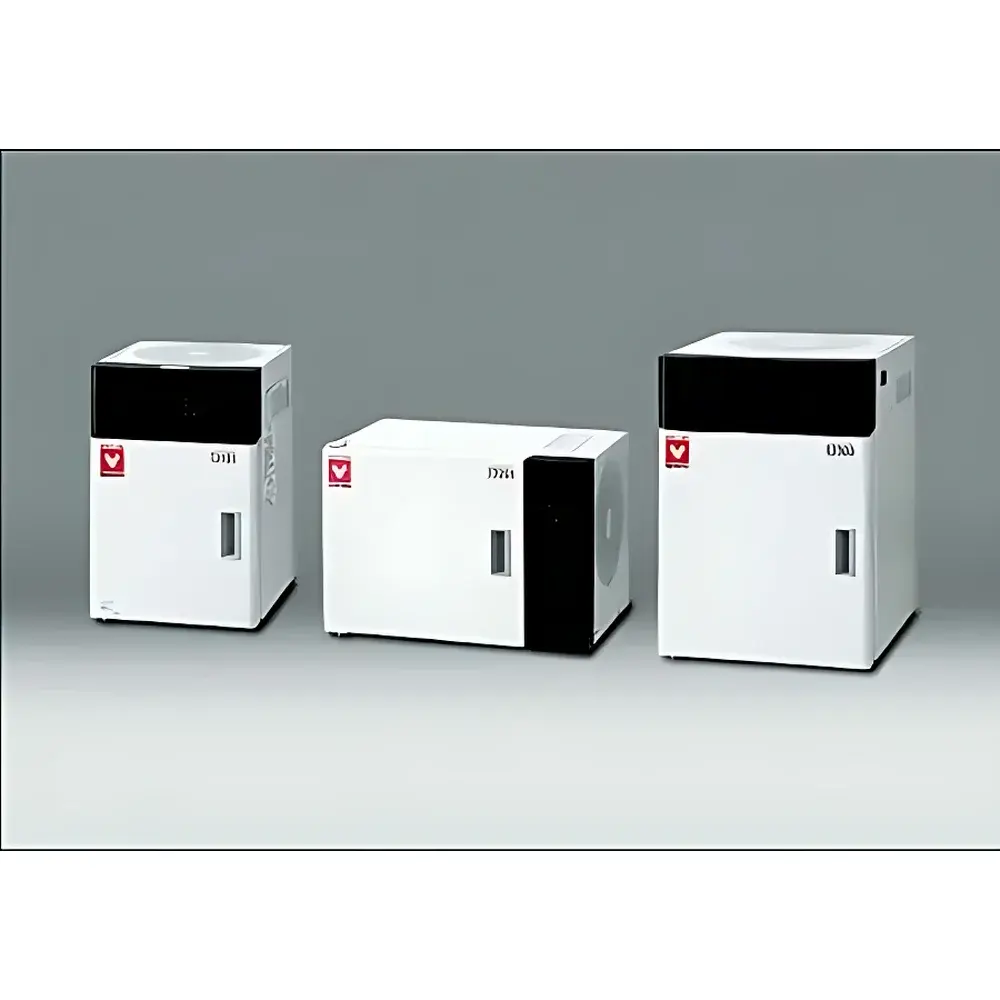
YAMATO IJ101W Low-Vibration, Peltier-Cooled Low-Temperature Incubator
| Brand | YAMATO |
|---|---|
| Origin | Japan |
| Model | IJ101W |
| Temperature Range | 5–60 °C |
| Temperature Uniformity | ±0.3 °C |
| Chamber Capacity | 15.6 L |
| Humidity Control | Not equipped |
| Cooling Method | Solid-State Peltier Element |
| Power Supply | Standard AC Input (Compliant with JIS C 61000-3-2/3) |
| Safety Features | Self-Diagnostic System, Dual Over-Temperature Protection (Electronic + Mechanical), Earth Leakage Circuit Breaker, Overcurrent Protection |
Overview
The YAMATO IJ101W is a compact, low-vibration, Peltier-cooled low-temperature incubator engineered for precision thermal stability in life science laboratories where mechanical disturbance and refrigerant environmental impact must be minimized. Unlike compressor-based systems, the IJ101W employs solid-state thermoelectric (Peltier) cooling technology—eliminating chlorofluorocarbon (CFC) and hydrofluorocarbon (HFC) refrigerants entirely while delivering silent, vibration-free operation critical for sensitive cell cultures, enzyme assays, and long-term sample storage. Its temperature control architecture is optimized for reproducibility across the full operating range of 5 °C to 60 °C, with spatial uniformity maintained within ±0.3 °C at setpoint—validated per ISO 15279:2021 guidelines for laboratory incubators. The unit’s 15.6 L internal chamber features a rigid, insulated stainless-steel interior and double-layer semi-tempered glass observation window, which reduces radiative and conductive heat transfer without compromising optical clarity or structural integrity.
Key Features
- Peltier-based thermoelectric cooling: Zero global warming potential (GWP) refrigerant usage; no oil-lubricated compressors or associated maintenance.
- Low-vibration design: Vibration amplitude <0.5 µm RMS (measured per ISO 20816-1 at 1–100 Hz), suitable for suspension cultures and microplate-based kinetic assays.
- Digital programmable temperature controller: 12-segment ramp-soak profile capability; adjustable PID parameters for load-dependent thermal response tuning.
- Enhanced thermal insulation: High-density polyurethane foam walls (45 mm thickness) combined with vacuum-gap window construction minimize ambient thermal intrusion.
- Integrated safety architecture: Dual independent over-temperature safeguards (electronic sensor + mechanical backup thermostat), automatic fault logging, earth leakage circuit interrupter (ELCI), and self-diagnostic startup sequence compliant with IEC 61010-1:2010.
- Modular expandability: Optional gas jacket interface (for CO2– or N2-enriched atmospheres) and stackable dual-unit configuration support scalable workflow integration.
Sample Compatibility & Compliance
The IJ101W accommodates standard 125 mL Erlenmeyer flasks, 96-well microplates, Petri dishes (up to 150 mm diameter), and cryovial racks without obstruction. Its non-humidified chamber design ensures compatibility with desiccant-sensitive reagents, lyophilized standards, and moisture-labile reference materials. The unit conforms to key regulatory and quality frameworks including JIS Z 8801-2 (temperature measurement uncertainty for laboratory equipment), ISO/IEC 17025:2017 (for calibration traceability of internal sensors), and meets essential requirements of the EU Machinery Directive 2006/42/EC. While not designed for humidified cell culture, its stable thermal environment supports GLP-compliant stability testing per ICH Q1A(R2) when used for accelerated degradation studies of pharmaceutical intermediates.
Software & Data Management
The built-in controller supports RS-485 Modbus RTU communication for integration into centralized lab monitoring systems (e.g., LabVantage, Thermo Fisher SampleManager). Optional YAMATO Data Logger Software (v3.2+) enables time-stamped temperature logging with audit-trail functionality compliant with FDA 21 CFR Part 11 Annex 11 requirements—including electronic signatures, user access levels, and immutable record retention. All alarm events (e.g., door open duration >30 s, temperature deviation >1.0 °C for >60 s) trigger automatic CSV export and optional SNMP trap notification.
Applications
- Low-temperature enzymatic reaction profiling (e.g., restriction digests, ligase incubations at 16 °C).
- Short- to medium-term storage of plasmid DNA, PCR master mixes, and antibody conjugates.
- Environmental simulation for material stability testing under controlled cold-chain conditions.
- Pre-incubation conditioning of biosensors and electrochemical transducers requiring thermal equilibration prior to measurement.
- Supporting QC/QA workflows in contract research organizations (CROs) performing ICH-aligned stability protocols.
FAQ
Does the IJ101W support humidity control?
No. This model is explicitly configured as a dry-air incubator. Humidity regulation is not implemented, making it unsuitable for mammalian cell culture but ideal for applications requiring strict moisture exclusion.
Can the unit operate continuously at 5 °C in ambient environments above 30 °C?
Yes—its Peltier module and forced-air convection system are rated for uninterrupted operation at minimum setpoint under ambient temperatures up to 35 °C, provided adequate ventilation clearance (≥100 mm on all sides) is maintained.
Is validation documentation available for IQ/OQ/PQ protocols?
YAMATO provides a Factory Acceptance Test (FAT) report with NIST-traceable calibration certificates for temperature sensors. Full GxP validation kits—including protocol templates, URS checklists, and performance qualification test scripts—are available upon request through authorized distributors.
What is the expected service life of the Peltier module?
Under normal laboratory use (≤16 h/day, 5–40 °C ambient), the thermoelectric module is rated for ≥50,000 hours MTBF, with no scheduled replacement interval required per YAMATO’s maintenance schedule.




