
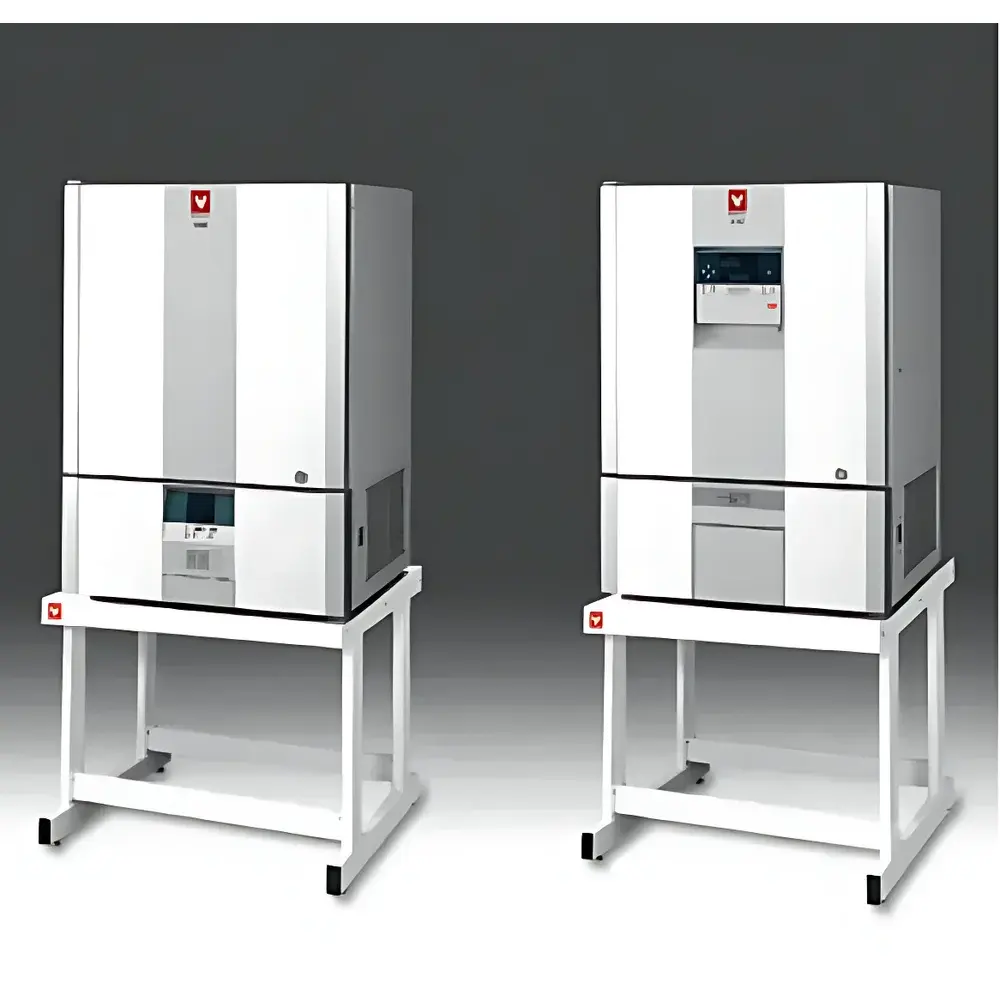
YAMATO IL612C Low-Temperature Biochemical Incubator
| Brand | YAMATO |
|---|---|
| Origin | Japan |
| Model | IL612C |
| Temperature Range | 0–50 °C |
| Cooling Medium | R134a (eco-friendly refrigerant) |
| Heating/Cooling Method | Air-jacketed |
| Control System | PID-based microprocessor controller with independent over-temperature prevention circuit |
| Communication Interface | RS485 |
| Analog Output | 4–20 mA temperature signal output |
| Alarm Outputs | Dry-contact relay outputs |
| Safety Features | Self-diagnostic function, compressor thermal overload protection, compressor delay-start protection, dual-stage over-temperature safeguard, earth-leakage circuit breaker, keypad lock |
Overview
The YAMATO IL612C Low-Temperature Biochemical Incubator is an air-jacketed, precision-controlled environmental chamber engineered for stable, uniform thermal conditions across a wide operational range of 0 °C to 50 °C. Designed specifically for biochemical and microbiological applications requiring reliable low-temperature incubation—such as psychrophilic organism cultivation, enzyme activity assays, cold-adapted protein expression studies, and long-term sample storage—the IL612C employs a dual-mode thermoregulation system combining resistive heating and vapor-compression cooling using R134a, an ozone-safe, low-global-warming-potential refrigerant compliant with international environmental directives including the Montreal Protocol and EU F-Gas Regulation. Its air-jacketed architecture ensures rapid thermal response and exceptional spatial uniformity (< ±0.5 °C at 25 °C, typical), minimizing vertical and horizontal gradients across the 120 L working chamber. The unit operates under closed-loop feedback control via a high-resolution PID algorithm, continuously adjusting power delivery to both heating elements and the refrigeration cycle to maintain setpoint stability within ±0.3 °C (typical) under steady-state conditions.
Key Features
- Air-jacketed thermal design for improved temperature homogeneity and reduced door-opening recovery time
- Dual-stage independent over-temperature protection: primary microprocessor-controlled limit + secondary hardware-based safety cutoff (UL/EN 61010-1 compliant)
- Integrated self-diagnostic system monitoring compressor status, sensor integrity, fan operation, and power supply anomalies
- Compressor-specific safeguards: thermal overload protection, programmable delay-start (≥3 min) to prevent liquid slugging and mechanical stress
- Electrical safety: built-in earth-leakage circuit breaker (ELCB) and tamper-resistant keypad lock for GLP/GMP environments
- Analog process output: isolated 4–20 mA current loop for integration with building management systems (BMS) or SCADA platforms
- RS485 serial interface (Modbus RTU protocol) supporting remote parameter setting, real-time data logging, and alarm event polling
Sample Compatibility & Compliance
The IL612C accommodates standard laboratory vessels—including Petri dishes, multiwell plates, Erlenmeyer flasks (up to 2 L), and serum bottles—within its stainless-steel interior chamber and adjustable wire shelving (3 shelves included). Interior dimensions (W×D×H): 490 × 490 × 500 mm. All materials in contact with the chamber environment meet ISO 8573-1 Class 4 purity requirements for non-contaminating surfaces. The incubator conforms to IEC 61010-1:2010 for electrical safety and EN 61326-1:2013 for electromagnetic compatibility (EMC). It supports audit-ready operation under GLP and GMP frameworks through configurable logging intervals, user-access-level controls, and non-volatile event history storage (power failures, alarms, setpoint changes). While not FDA 21 CFR Part 11–certified out-of-the-box, its RS485 interface and analog outputs enable integration with validated third-party data acquisition systems meeting Part 11 requirements.
Software & Data Management
The IL612C does not include embedded touchscreen software but provides full interoperability with external supervisory systems via its RS485 port. Modbus RTU register mapping enables read/write access to setpoint, actual temperature, alarm status, run mode (constant vs. program), and diagnostic flags. When paired with YAMATO’s optional communication cable and compatible PC software (e.g., YAMATO LabControl Suite v3.x), users can configure up to 99-step temperature programs, schedule automatic start/stop cycles, export timestamped CSV logs, and generate calibration trace reports aligned with ISO/IEC 17025 documentation standards. All analog outputs (4–20 mA) are factory-calibrated and NIST-traceable; calibration certificates are available upon request.
Applications
- Cultivation of cold-tolerant bacteria (e.g., Pseudomonas fluorescens, Colwellia psychrerythraea) and fungi in environmental or food safety testing
- Low-temperature enzymatic reaction profiling for industrial biocatalysis development
- Stabilization and pre-incubation of cryopreserved cell lines prior to thawing
- Controlled degradation studies of pharmaceutical excipients under accelerated stability protocols (ICH Q1A)
- Long-term storage of RNA samples and temperature-sensitive reagents at 4 °C or 8 °C
- Quality control testing of diagnostic kits requiring precise thermal conditioning
FAQ
What is the temperature uniformity specification across the chamber volume?
Typical uniformity is ≤ ±0.5 °C at 25 °C (measured per ISO 1533:2022 Annex B at 9 locations), with worst-case deviation ≤ ±0.8 °C at extremes of the range (0 °C and 50 °C).
Is the IL612C suitable for CO₂ or humidity-controlled applications?
No—this is a dry-air, temperature-only incubator. For CO₂ or humidified environments, consider YAMATO’s MIR series or specialized CO₂ incubators.
Can the RS485 interface support connection to a PLC network?
Yes—Modbus RTU implementation allows direct integration into Allen-Bradley, Siemens, or Mitsubishi PLC architectures using standard industrial gateways.
Does the unit include a validation support package?
Factory-installed sensors are calibrated prior to shipment; IQ/OQ documentation templates and calibration checklists are provided in the user manual (English edition Rev. 2023).
What maintenance intervals are recommended for optimal performance?
Compressor oil and refrigerant levels require verification every 24 months; air filter cleaning is advised quarterly; annual verification of temperature sensor accuracy against a NIST-traceable reference thermometer is recommended.





