
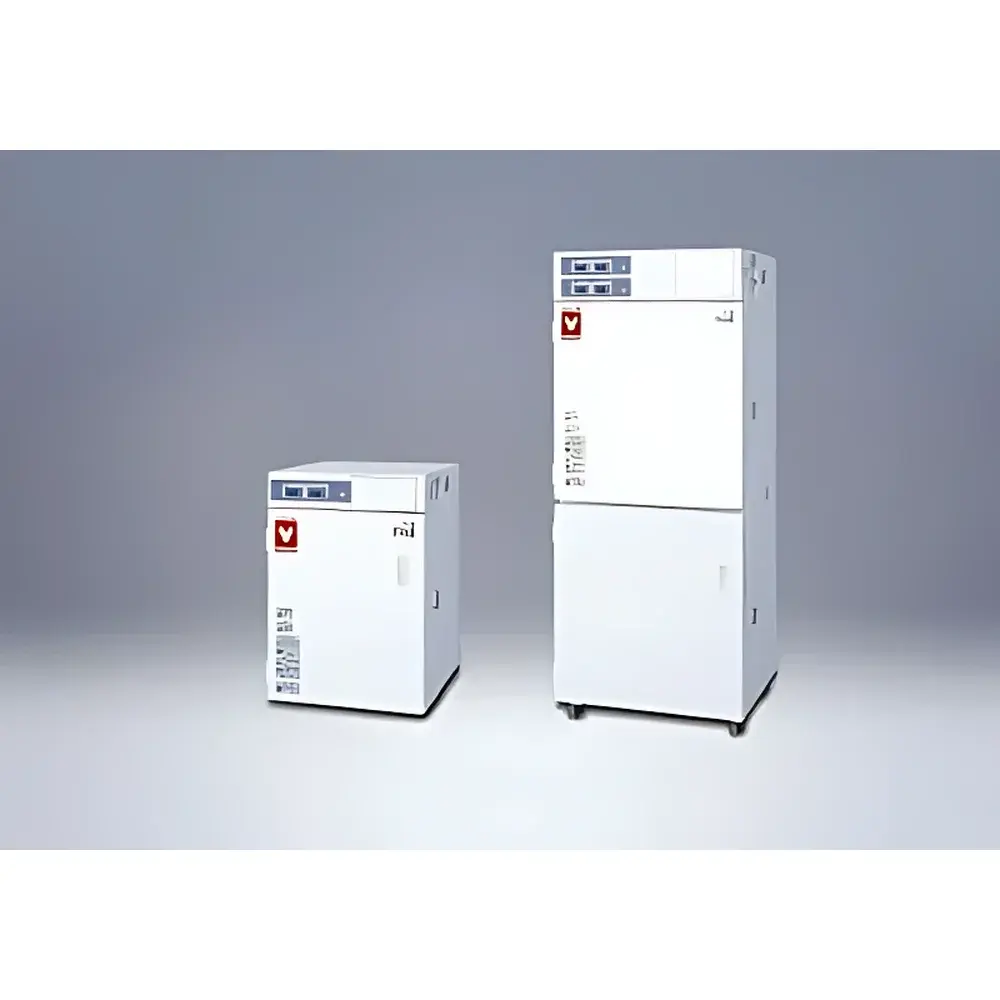
YAMATO IT400/IT600/IT820 CO₂ Incubator
| Brand | YAMATO |
|---|---|
| Origin | Japan |
| Model | IT400 / IT600 / IT820 |
| Temperature Control Range | Ambient +5°C to 50°C |
| Temperature Uniformity | ±0.2°C at 37°C |
| Humidity Control | ≥95% RH (natural evaporation via water pan) |
| Capacity | 72 L / 133 L / 266 L (dual-chamber) |
| CO₂ Control Range | 0.1–20.0% |
| CO₂ Accuracy | ±0.1% at 5% CO₂ |
| Temperature Accuracy | ±0.1°C at 37°C |
| Heating Method | Water-jacketed |
| CO₂ Sensor | Infrared absorption |
| Temperature Sensor | Pt100 RTD |
| Independent Over-Temperature Protection | K-type thermocouple |
| Power Supply | AC 100 V, 50/60 Hz |
Overview
The YAMATO IT400, IT600, and IT820 CO₂ incubators are precision-engineered, water-jacketed environmental control systems designed for long-term, stable maintenance of mammalian cell cultures under physiologically relevant conditions. These instruments operate on the principle of dual-regulated gas–thermal equilibrium: infrared-absorption-based CO₂ sensing ensures accurate, drift-resistant carbon dioxide concentration control, while a fully insulated water jacket provides exceptional thermal inertia and spatial uniformity—critical for minimizing thermal stress during extended incubation cycles. Unlike forced-air designs, the IT-series employs low-velocity micro-circulation fans to homogenize the internal atmosphere without inducing vibration or desiccation, preserving delicate monolayers and suspension cultures. The seamless, R-cornered stainless-steel chamber eliminates microbial harborage points and supports rigorous cleaning protocols required in GLP-compliant laboratories and biopharmaceutical QC environments.
Key Features
- Water-jacketed thermal architecture with high thermal mass (280 W / 340 W ×2 heating capacity), ensuring minimal temperature fluctuation (<±0.1°C at setpoint) and rapid recovery after door opening.
- Infrared CO₂ sensor with automatic zero calibration and ±0.1% accuracy at 5% CO₂—certified for stability over 12-month intervals without field recalibration.
- Micro-fan-assisted gas mixing system activates only during CO₂ injection, preventing laminar stratification while eliminating mechanical vibration that compromises sensitive assays (e.g., stem cell differentiation or neuronal co-cultures).
- Independent dual-safety architecture: dedicated K-type thermocouple for over-temperature cutoff, plus electronic PID/P control loops for temperature and CO₂—each capable of autonomous shutdown upon sensor fault detection.
- Tool-free service design: removable fan assembly, slide-out humidity pan, and modular probe mounts (Pt100 temperature, IR CO₂) enable rapid maintenance without disassembly or third-party technician support.
- No condensate drainage required—humidity is maintained exclusively via natural evaporation from a stainless-steel water reservoir, reducing contamination risk and simplifying facility integration.
Sample Compatibility & Compliance
The IT-series accommodates standard tissue culture formats—including T-flasks (up to T225), multi-well plates (6–96-well), Petri dishes, and roller bottles—with optimized shelf spacing (12–14 adjustable levels, 5 kg load capacity per shelf). Chamber dimensions (e.g., IT820: 609 × 426 × 514 mm ×2) allow vertical stacking of stacked plate racks while maintaining unobstructed airflow. All models comply with IEC 61010-1 (Safety Requirements for Electrical Equipment for Measurement, Control, and Laboratory Use) and meet electromagnetic compatibility standards per CISPR 11. The microprocessor-based control system logs operational parameters (temperature, CO₂, door status, alarm events) with timestamping, supporting audit-ready documentation for ISO 13485, FDA 21 CFR Part 11 (when paired with validated LIMS integration), and internal GLP/GMP quality records.
Software & Data Management
While the IT-series operates via an embedded microcontroller interface (no external PC dependency), it provides full digital parameter logging to non-volatile memory with 30-day rolling storage (temperature, CO₂, humidity status, error codes). Optional RS-232/RS-485 communication ports enable integration with building management systems (BMS) or centralized lab monitoring platforms. Real-time analog outputs (0–10 V) for temperature and CO₂ allow connection to chart recorders or PLCs for continuous environmental validation. All setpoints, alarms, and calibration offsets are password-protected and subject to operator-level access control—facilitating compliance with controlled-access laboratory policies.
Applications
These incubators are routinely deployed in academic research labs for primary cell isolation and immortalized line expansion; in clinical diagnostics for microbiological culture (e.g., Mycobacterium tuberculosis growth under 10% CO₂); in biomanufacturing for upstream process development (seed train expansion, transfection optimization); and in regenerative medicine for 3D organoid maturation requiring strict pH stability (achieved via buffered bicarbonate media + precise CO₂ control). Their water-jacketed stability makes them particularly suitable for overnight and multi-day assays where thermal drift would otherwise compromise reproducibility—such as time-lapse microscopy, metabolic flux analysis, or CRISPR-Cas9 editing efficiency studies.
FAQ
What is the difference between water-jacketed and air-jacketed CO₂ incubators?
Water-jacketed models provide superior thermal stability and recovery due to high heat capacity; they are preferred for applications requiring uninterrupted temperature integrity across power interruptions or frequent door openings.
Does the IT-series support humidification without external plumbing?
Yes—humidity is generated passively via evaporation from a removable stainless-steel water pan; no external humidifier or drain line is required.
Can CO₂ concentration be calibrated in-house?
Yes—the infrared sensor includes a manual zero-calibration function using ambient air (0% CO₂ reference), and span adjustment is accessible via service mode with NIST-traceable 5% CO₂ gas standard.
Is the IT820 truly two independent chambers?
No—it is a single cabinet housing two vertically stacked, thermally coupled chambers sharing one CO₂ supply manifold and control system; each chamber has independent temperature setpoints but not independent gas regulation.
What safety certifications do these units carry?
All models are CE-marked and conform to IEC 61010-1 Edition 3 for laboratory equipment safety, including protection against electric shock, fire hazard, and mechanical instability.





