
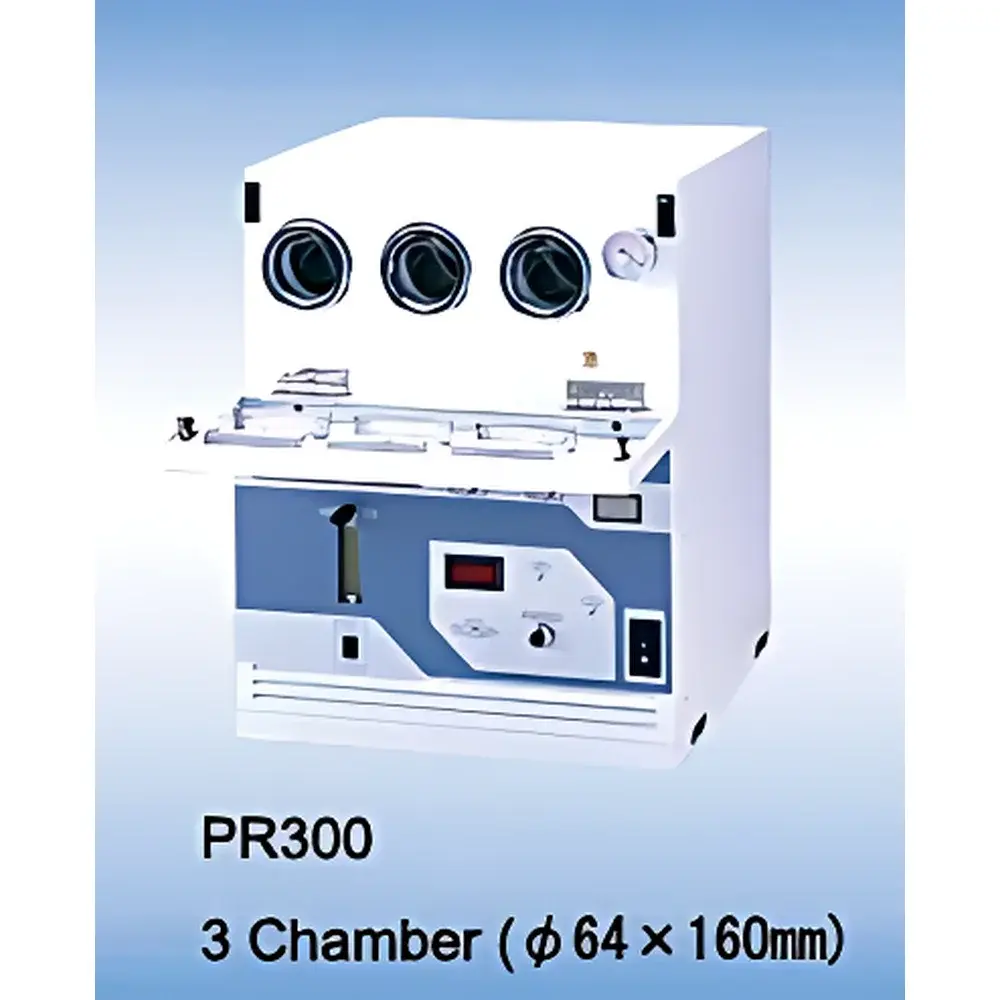
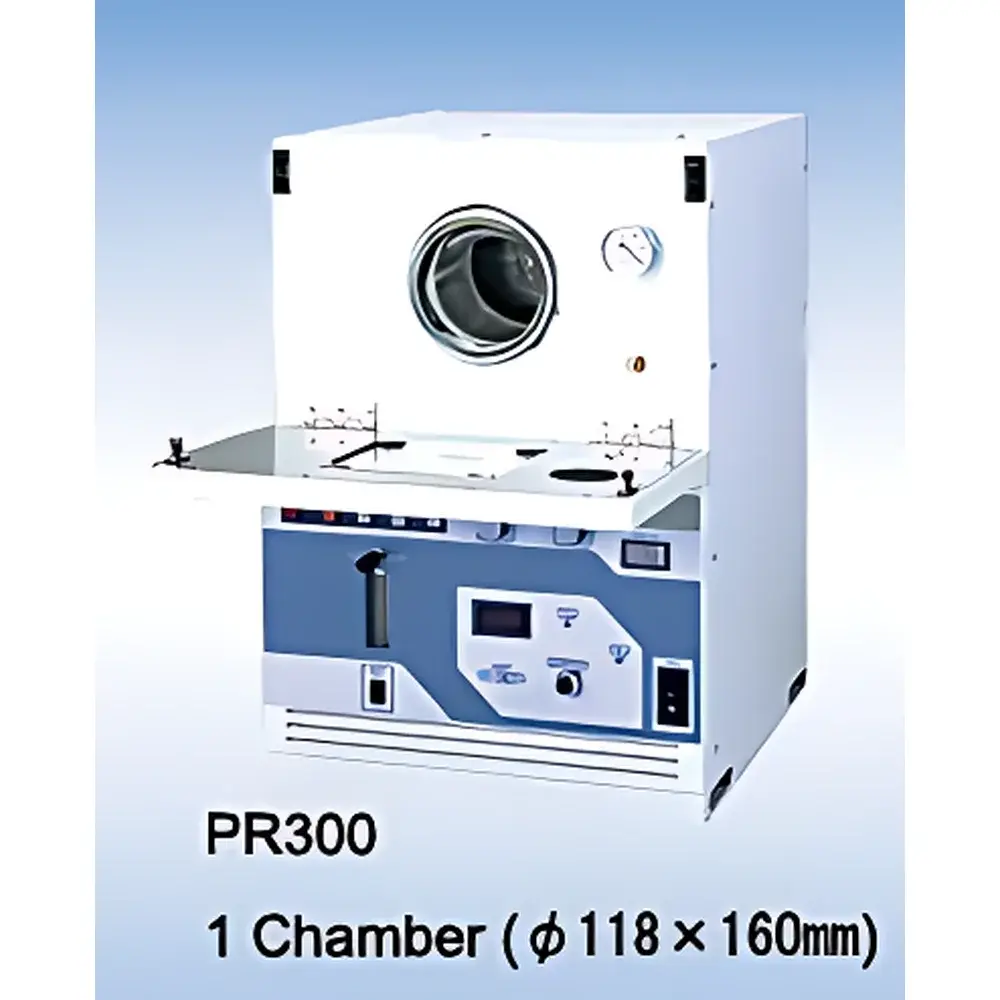
YAMATO PR300/PR301 Low-Temperature Plasma Asher
| Brand | YAMATO |
|---|---|
| Origin | Japan |
| Model | PR300/PR301 |
| RF Frequency | 13.56 MHz |
| RF Power | 300 W |
| Chamber Volume | 3 L |
| Chamber Material | Quartz Glass |
| Chamber Dimensions | 64 mm × 160 mm (D × H) |
| Gas Inlets | 2 independent mass flow-controlled lines |
| Control Interface | Manual operation via front-panel tactile switches (no touchscreen — PR510 reference is model-specific and not applicable to PR300/PR301) |
| Vacuum System | External pump required (not included) |
| Compliance | Designed for ISO/IEC 17025-compliant laboratories |
Overview
The YAMATO PR300/PR301 is a benchtop low-temperature plasma asher engineered for precise, non-thermal oxidative decomposition of organic matrices in analytical sample preparation. Unlike conventional muffle furnace ashing or wet digestion, this instrument utilizes radiofrequency (13.56 MHz)–generated oxygen plasma to produce highly reactive atomic oxygen species (•O) under controlled vacuum conditions. These radicals selectively oxidize carbon-based contaminants at the molecular surface without bulk heating—maintaining specimen temperature below 200 °C throughout the process. This mechanism preserves thermally labile inorganic constituents—including volatile elements (e.g., As, Se, Hg, I), isotopic integrity, and crystalline lattice structures—making it indispensable for nuclear forensics, geochemical reference material certification, and regulatory trace-element analysis per USP , EPA SW-846, and ISO 17294-2 protocols.
Key Features
- Quartz glass reaction chamber (3 L volume, 64 mm diameter × 160 mm height) ensuring high UV transparency, chemical inertness, and thermal stability during extended plasma exposure
- Stable 300 W RF power delivery at industrial-standard 13.56 MHz frequency, optimized for uniform plasma ignition and sustained radical generation
- Dual independent gas inlet ports supporting sequential or simultaneous introduction of O2, air, or Ar/O2 mixtures for process tuning across diverse sample classes
- Compact monolithic chassis (W × D × H ≈ 320 × 420 × 510 mm) designed for integration into fume-hood–constrained analytical labs or cleanroom gloveboxes
- Manual control architecture with calibrated analog knobs and LED status indicators—eliminating software dependencies and enhancing operational repeatability in GLP environments
- No internal vacuum pump; interfaces directly with externally mounted dry scroll or diaphragm pumps meeting ISO 8573-1 Class 0 oil-free air requirements
Sample Compatibility & Compliance
The PR300/PR301 accommodates heterogeneous solid samples up to 80 mm in diameter and 50 mm in height—including coal briquettes, asbestos-containing building materials (ACBM), plant tissues, filter membranes, biological cryosections, and polymer-coated substrates. Its closed-chamber design prevents atmospheric contamination and eliminates reagent-derived blanks common in acid digestion. The system supports method validation per ASTM D3174 (ash content in coal), ISO 1171 (determination of ash in solid mineral fuels), and EPA Method 3050B (acid digestion of sediments and soils)—serving as a documented alternative for laboratories seeking reduced procedural uncertainty in certified reference material (CRM) preparation. All hardware components comply with RoHS Directive 2011/65/EU and meet CE marking requirements for electromagnetic compatibility (EN 61326-1) and electrical safety (EN 61010-1).
Software & Data Management
The PR300/PR301 operates without embedded firmware or proprietary software—deliberately omitting digital controllers to ensure audit-trail simplicity and long-term serviceability. Process parameters (gas flow rates, RF duration, pressure setpoints) are recorded manually in laboratory notebooks or integrated into LIMS via external pressure transducers and timer relays (optional). For FDA 21 CFR Part 11–regulated environments, users may deploy third-party validated data acquisition systems (e.g., LabVIEW-based DAQ with electronic signature modules) interfaced through standard 0–10 V analog outputs. No cloud connectivity or remote access capabilities are provided—aligning with cybersecurity best practices for regulated analytical infrastructure.
Applications
- Preparation of coal and coke samples for ultimate analysis (C/H/N/S/O) and ash fusion temperature determination
- Decontamination of asbestos filter samples prior to TEM/SEM-EDS quantification per NIOSH Method 7400
- Residue removal from silicon wafers and MEMS devices without altering dopant profiles
- Organic matrix elimination from environmental particulate matter (PM2.5/PM10) filters prior to ICP-MS multi-element screening
- Decellularization support for tissue engineering scaffolds requiring retention of collagen microstructure
- Removal of photoresist residues from X-ray optics calibration standards
FAQ
Is a vacuum pump included with the PR300/PR301?
No. A compatible external vacuum pump (minimum ultimate pressure ≤5 × 10⁻² mbar, oil-free operation recommended) must be procured separately.
Can the system operate with gases other than oxygen?
Yes. The dual-gas manifold supports O2, synthetic air, argon, or custom mixtures—though optimal ashing performance is achieved using pure oxygen at 5–20 sccm flow rates.
What is the maximum sample weight capacity?
While chamber volume permits up to ~120 g of low-density organic material (e.g., plant tissue), practical loading is governed by surface-area–to–volume ratio; typical batches range from 0.5–5 g for reproducible ash residue morphology.
Does the quartz chamber require periodic replacement?
Quartz exhibits excellent plasma erosion resistance; under normal use (≤2 h/session, ≤5 sessions/week), chamber service life exceeds 5 years. Visual inspection for frosting or microcracking is recommended quarterly.
How is process endpoint determined?
Endpoint is monitored visually (disappearance of organic browning/charring) or via real-time residual gas analysis (RGA) when integrated with optional quadrupole mass spectrometer—no built-in endpoint sensor is provided.



