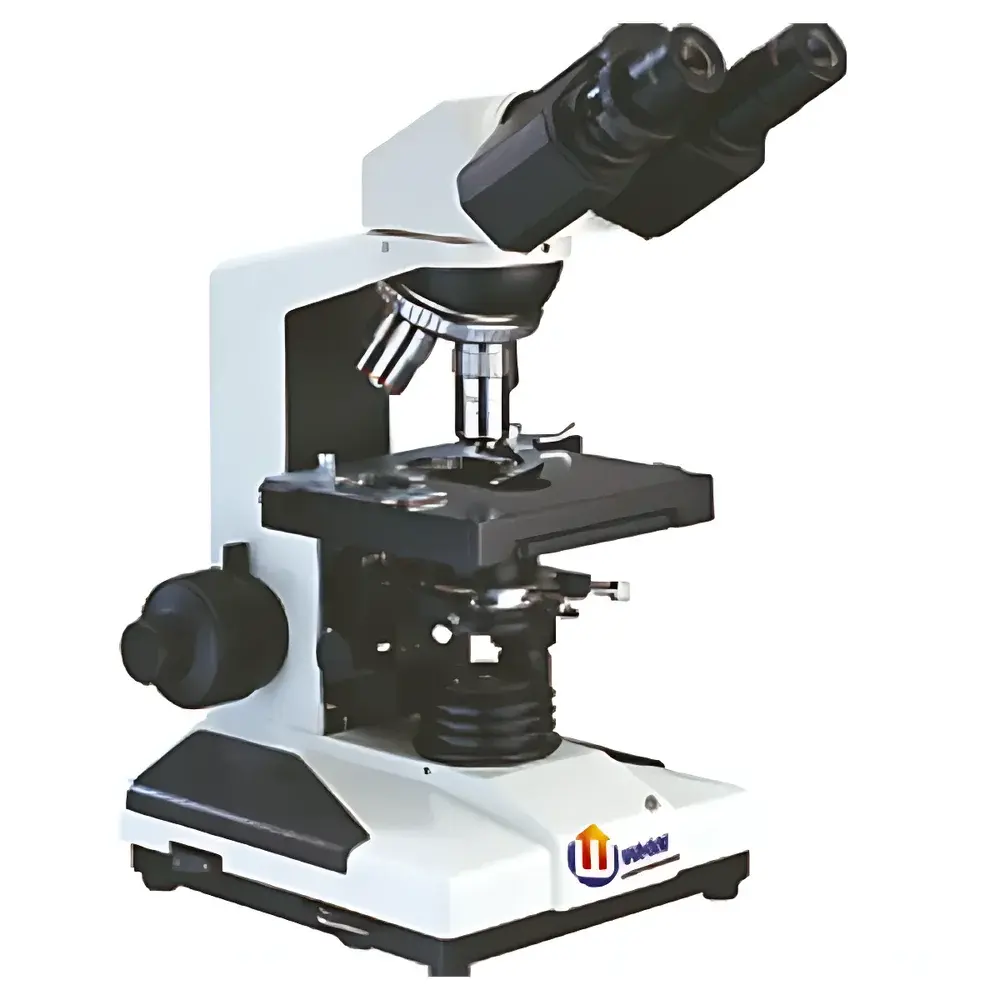
YANRUN BI-18 Biological Inverted Microscope
| Brand | YANRUN |
|---|---|
| Origin | Shanghai, China |
| Manufacturer Type | Direct Manufacturer |
| Product Category | Domestic (PRC-Made) |
| Model | BI-18 Biological Microscope |
| Instrument Type | Inverted Microscope |
| Eyepiece Configuration | Binocular |
| Magnification Range | 40×–1000× |
| Eyepieces | Wide-Field WF10× (f = 25 mm, FOV Φ18 mm) |
| Interpupillary Distance | 53–75 mm |
| Objective Lenses | Achromatic: 4×/0.10 (WD 37.4 mm), 10×/0.25 (WD 6.6 mm), 40×/0.65 (spring-loaded, WD 0.64 mm), 100×/1.25 (spring-loaded, oil immersion, WD 0.19 mm) |
| Head | 30° inclined binocular tube |
| Focusing Mechanism | Coaxial coarse/fine focus with adjustable coarse tension, locking mechanism, and limit stop |
| fine focus graduation | 2 µm |
| Nosepiece | Four-position inward-rolling ball bearing turret |
| Stage | Dual-layer mechanical stage (135 mm × 125 mm) |
| travel range | 75 mm × 35 mm |
| Condenser | Abbe condenser, N.A. 1.25, vertically adjustable |
| Filters | Blue filter, ground glass |
| Illuminator | 6 V / 20 W halogen lamp (220 V or 110 V AC), intensity continuously variable |
| Optional Accessories | Phase contrast kits (PH-I/PH-II turrets, PHP objectives), LED illumination modules (9 V / 500 mA adapters), polarizing components, infinity-corrected optical components, USB/VIDEO trinocular photo-tubes, darkfield condensers (dry/wet), extended objective sets (SP and infinity-corrected), reticle eyepieces, teaching twin-head tubes |
Overview
The YANRUN BI-18 Biological Inverted Microscope is an engineered platform for routine and advanced life science observation of adherent cells, tissue cultures, and live specimens in Petri dishes, flasks, and multi-well plates. Its inverted optical configuration places the objective lenses beneath the specimen stage and the condenser above—enabling unobstructed access to culture vessels while maintaining stable focus during long-term time-lapse imaging or micromanipulation procedures. The system employs a finite-conjugate achromatic optical design optimized for high-fidelity contrast and resolution across the full 40×–1000× magnification range. Critical optical components—including wide-field WF10× eyepieces (Φ18 mm field number), precision-ground achromatic objectives (4×–100×), and an N.A. 1.25 Abbe condenser—are aligned to minimize chromatic aberration and maximize flatness of field. The microscope conforms to ISO 8578:2017 (Microscopes — Requirements for biological microscopes) and supports compliance-ready workflows under GLP and basic GMP environments when paired with documented calibration and maintenance records.
Key Features
- Coaxial coarse/fine focusing mechanism with calibrated fine-focus graduation (2 µm per division), integrated tension adjustment, mechanical lock, and upper/lower travel limit stops—ensuring repeatable Z-axis positioning and operator safety during extended use.
- 30° inclined binocular head with interpupillary adjustment (53–75 mm) and diopter compensation for sustained ergonomic viewing; optional configurations include monocular, 45° push-pull binocular, and dual-student teaching heads.
- Dual-layer mechanical stage (135 mm × 125 mm) with 75 mm × 35 mm travel range, enabling precise navigation across large culture surfaces without repositioning vessels.
- Four-position inward-rolling ball-bearing nosepiece ensures accurate, low-backlash objective alignment and long-term rotational stability.
- Halogen-based Köhler illumination system (6 V / 20 W) with continuous brightness control and interchangeable blue/ground-glass filters—optimized for both brightfield visualization and preliminary phase contrast setup.
- Modular upgrade path supporting phase contrast (PH-I/PH-II turret, PHP objectives), darkfield (dry/wet condensers), polarization (360° rotatable polarizer + slide-in analyzer), and digital imaging (USB/VIDEO trinocular port).
Sample Compatibility & Compliance
The BI-18 accommodates standard cell culture formats including 35 mm, 60 mm, and 100 mm Petri dishes; T-25, T-75, and T-175 flasks; and 6-, 12-, 24-, 48-, and 96-well plates—without requiring coverslip mounting. Its low-profile stage clearance and vertical objective arrangement eliminate interference from vessel rims or caps. All optical components meet RoHS Directive 2011/65/EU material restrictions. While not certified to IEC 61010-1 for medical device use, the instrument satisfies general laboratory equipment safety requirements per EN 61326-1:2013 (EMC) and EN 61010-1:2010 (electrical safety). Documentation packages—including factory calibration certificates, optical alignment reports, and traceable component specifications—support internal audit readiness for ISO/IEC 17025-accredited labs.
Software & Data Management
The BI-18 itself is hardware-only and does not include embedded firmware or proprietary software. However, its USB/VIDEO output interface is compatible with industry-standard acquisition platforms such as Ocular Imaging Suite (v5.2+), StreamPix 6, and open-source tools including Micro-Manager 2.0 and Fiji/ImageJ via UVC-compliant capture devices. When used with validated camera modules, image metadata (timestamp, magnification, objective ID, exposure settings) can be embedded into TIFF or ND2 files. For regulated environments, laboratories may implement electronic lab notebooks (ELNs) with audit-trail functionality (e.g., LabArchives, Benchling) to record observational notes, calibration logs, and maintenance events—aligning with ALCOA+ data integrity principles.
Applications
- Routine monitoring of mammalian, insect, and stem cell cultures—including confluence assessment, morphology scoring, and contamination detection.
- Phase contrast observation of unstained live cells (e.g., fibroblasts, neurons, organoids) using optional PH-I/PH-II turrets and PHP objectives.
- Time-lapse documentation of mitosis, migration, wound healing, and drug-response assays over hours to days.
- Support for manual micropipetting, microinjection, and patch-clamp preparation due to unobstructed top-access design.
- Teaching applications in undergraduate biology and biotechnology programs—enhanced by twin-head demonstration configurations and standardized optics for consistent student outcomes.
- Pre-screening for fluorescence work (when paired with appropriate excitation filters and high-sensitivity cameras), though native fluorescence capability requires external light sources and filter cubes.
FAQ
Is the BI-18 suitable for fluorescence microscopy?
No—the BI-18 is a brightfield/inverted phase contrast platform. Fluorescence imaging requires epi-illumination, dichroic mirrors, and bandpass filters, which are not integrated. External LED or mercury arc sources with third-party filter cubes may be adapted, but performance is not guaranteed or validated by YANRUN.
Can the BI-18 be upgraded to infinity-corrected optics?
Yes—optional infinity-corrected eyepieces, objectives (including 4×–100× achromats and PHP variants), and matching tube lenses are available as retrofit kits, enabling improved parfocality and compatibility with modern digital cameras.
What is the warranty coverage and service support structure?
YANRUN provides a 24-month limited warranty covering parts and labor for manufacturing defects. Technical documentation, alignment guides, and spare parts catalogs are supplied digitally. Field service is available in mainland China; international users typically coordinate through authorized regional distributors for repair logistics and calibration verification.
Does the halogen illuminator comply with energy efficiency regulations in the EU or US?
The 6 V / 20 W halogen lamp meets Class E energy labeling requirements under EU Regulation (EU) No 1194/2012 for general-purpose lamps. For labs targeting sustainability benchmarks (e.g., LEED EBOM), optional high-efficiency white LED illumination modules (9 V / 500 mA) are available as drop-in replacements with comparable color temperature (5500 K) and CRI > 85.
How is optical alignment verified and maintained?
Each unit undergoes factory collimation using autocollimation telescopes and NIST-traceable reference slides. Users may perform routine centering checks using the included centering telescope (for phase contrast) and alignment reticles. Annual verification against ISO 8578 test targets (e.g., resolution pattern R2, depth-of-field gauge) is recommended for quality-critical applications.
Related Products