
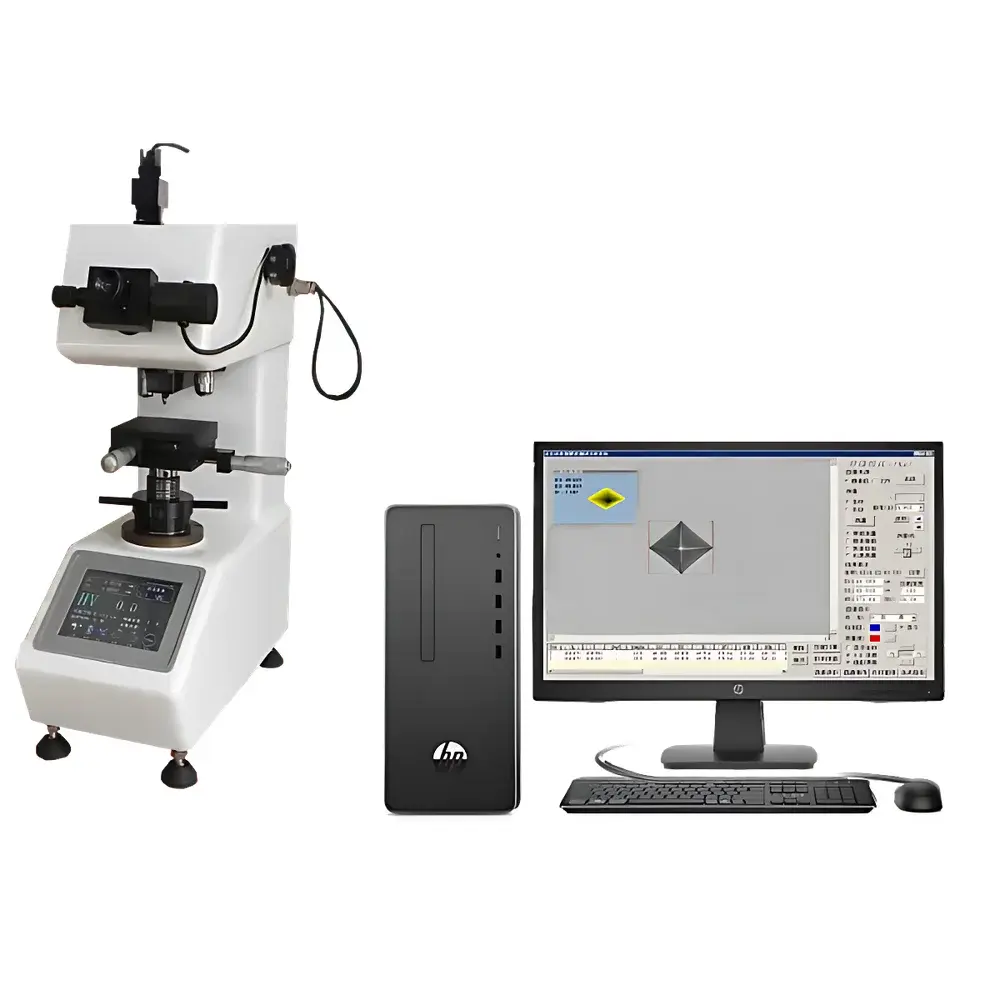
YANRUN HMAS-D1000SMZ Automated Microhardness Testing System with 3D Indentation Modeling and ASTM/GB-Compliant Software Suite
| Brand | YANRUN |
|---|---|
| Origin | Shanghai, China |
| Manufacturer Type | OEM Manufacturer |
| Instrument Type | Automatic Microindentation Hardness Tester |
| Measurement Range | 0.001–6000 HV |
| Test Forces | 10, 25, 50, 100, 200, 300, 500, 1000 gf (0.098–9.807 N) |
| Standards Compliance | GB/T 4340, ASTM E384, ISO 6507-1 |
| Automation | Motorized Turret, Auto-Loading/Unloading, Encoder-Based XY Stage (25 × 25 mm), Digital Focus Simulation & 3D Indent Reconstruction |
Overview
The YANRUN HMAS-D1000SMZ is an automated microhardness testing system engineered for high-precision Vickers hardness evaluation of metallic, ceramic, thin-film, and case-hardened materials. It operates on the principle of microindentation metrology: a diamond pyramidal indenter (136° apex angle) is applied under controlled static load to produce a geometrically reproducible impression on the specimen surface; hardness is calculated from the diagonal lengths measured optically using calibrated image analysis. Designed for laboratory-grade repeatability and traceable metrology, the system integrates a rigid aluminum alloy frame, precision-ground mechanical components, and a dual-path optical train—supporting simultaneous eyepiece observation and high-resolution CCD imaging. Its architecture conforms to fundamental requirements for GLP-compliant hardness testing, including force calibration traceability, environmental stability, and documented measurement uncertainty pathways.
Key Features
- Fully automated indentation cycle: motorized turret selection, closed-loop force application (0.05 mm/s loading rate), dwell time programmable from 1–60 s in 1-s increments, and synchronized unloading—all compliant with GB/T 4340.1 and ASTM E384 protocols.
- Dual magnification path: 10× and 40× objective lenses yield nominal optical magnifications of 100× and 400×; optional 20×/50×/100× objectives extend total magnification up to 1000× (optical) and 1600× (digital).
- High-resolution imaging subsystem: 5-megapixel progressive-scan CCD sensor coupled with real-time image enhancement algorithms—including proprietary digital focus simulation that dynamically sharpens indented region contrast without physical refocusing.
- Sub-micron measurement resolution: minimum detectable diagonal increment of 0.013 µm via encoder-based stage positioning and pixel-calibrated image analysis.
- 3D indentation reconstruction engine: generates topographic surface models from multi-plane focal stacks, enabling quantitative depth profiling, aspect ratio calculation, and volumetric indentation analysis—critical for evaluating plastic deformation behavior in thin coatings and diffusion zones.
- Motorized XY stage with 25 × 25 mm travel range and 0.01 mm mechanical vernier readout, compatible with optional automated mapping modules for hardness gradient profiling (e.g., carburized case depth, nitrided layer transition).
Sample Compatibility & Compliance
The HMAS-D1000SMZ accommodates specimens up to 65 mm in height and 110 mm from indenter center to chamber wall—suitable for forged parts, castings, heat-treated components, and metallurgical cross-sections. Its 12-background-color UI interface optimizes contrast for diverse material surfaces: polished steel, anodized aluminum, copper alloys, sintered carbides, and oxide ceramics. All hardness calculations adhere to ISO 6507-1:2023 definitions and reporting conventions. Force calibration is validated against certified reference standards traceable to NIM (National Institute of Metrology, China) and cross-referenced to NIST SRM 2840/2841 equivalents. Data integrity meets audit requirements for ISO/IEC 17025-accredited laboratories; software supports electronic signatures, user access levels, and full audit trail logging per FDA 21 CFR Part 11 guidelines when deployed in regulated environments.
Software & Data Management
The HMAS Analysis Suite is a Windows-based application developed in-house for deterministic, repeatable microhardness evaluation. It features real-time video overlay, auto-indent detection via edge-enhanced threshold segmentation, and sub-pixel diagonal fitting with uncertainty estimation. Core capabilities include:
- SPC-ready statistical reporting: Cpk/Ppk indices, control charts, histogram distribution, outlier identification via Grubbs’ test.
- Multi-format export: PDF (print-ready with embedded metadata), Excel (.xlsx with raw pixel data and calculated HV values), Word (.docx with customizable templates).
- Hardness gradient mapping: linear or radial profiles with automatic inflection point detection for case depth quantification (e.g., effective case depth per ISO 2639).
- Brittle fracture rating module aligned with DIN 50190-2 for nitrided layers—comparing observed corner chipping patterns against standardized severity scales.
- Calibration management: scheduled reminders, certificate import/export, and drift compensation logs for long-term instrument stability monitoring.
Applications
This system serves critical roles across R&D, quality assurance, and failure analysis workflows. Typical use cases include:
- Depth-resolved hardness profiling of case-hardened gears, bearing races, and aerospace turbine blades.
- Thin-film adhesion assessment via indentation cracking morphology analysis (e.g., PVD/CVD coatings on tool steels).
- Heat-affected zone (HAZ) characterization in welded joints, especially dissimilar metal welds where microstructural gradients govern service life.
- Material homogeneity verification in powder metallurgy compacts and additive-manufactured (AM) builds.
- Reference standard certification in metrology labs supporting national hardness scale dissemination.
FAQ
Does the HMAS-D1000SMZ support ASTM E384-compliant testing procedures?
Yes—the system implements all mandatory parameters defined in ASTM E384-23, including force application rate, dwell time tolerance (±1 s), minimum indentation spacing (≥2.5× diagonal length), and calibration verification intervals.
Can the software generate GMP-compliant audit trails?
When configured with role-based authentication and timestamped event logging enabled, the HMAS Suite satisfies ALCOA+ principles (Attributable, Legible, Contemporaneous, Original, Accurate) and supports 21 CFR Part 11 compliance through optional digital signature integration.
Is the 3D indentation model based on confocal scanning or focus-stacking?
It uses multi-plane focus-stacking with Z-axis motorized stage control and sub-micron step resolution, reconstructing surface topography from 15–30 focal planes per indent—no laser scanning hardware required.
What is the uncertainty budget for HV measurements at 100 gf load?
Typical expanded uncertainty (k=2) is ±1.8% for homogeneous reference blocks (HV 200–800 range), derived from contributions of force calibration (±0.8%), optical magnification (±0.5%), diagonal measurement (±0.7%), and environmental drift (±0.3%).
Are third-party calibration services available for international users?
YANRUN partners with ISO/IEC 17025-accredited calibration providers in EU, North America, and APAC regions; certificates include traceability statements to national metrology institutes (e.g., PTB, NIST, NMIJ).



