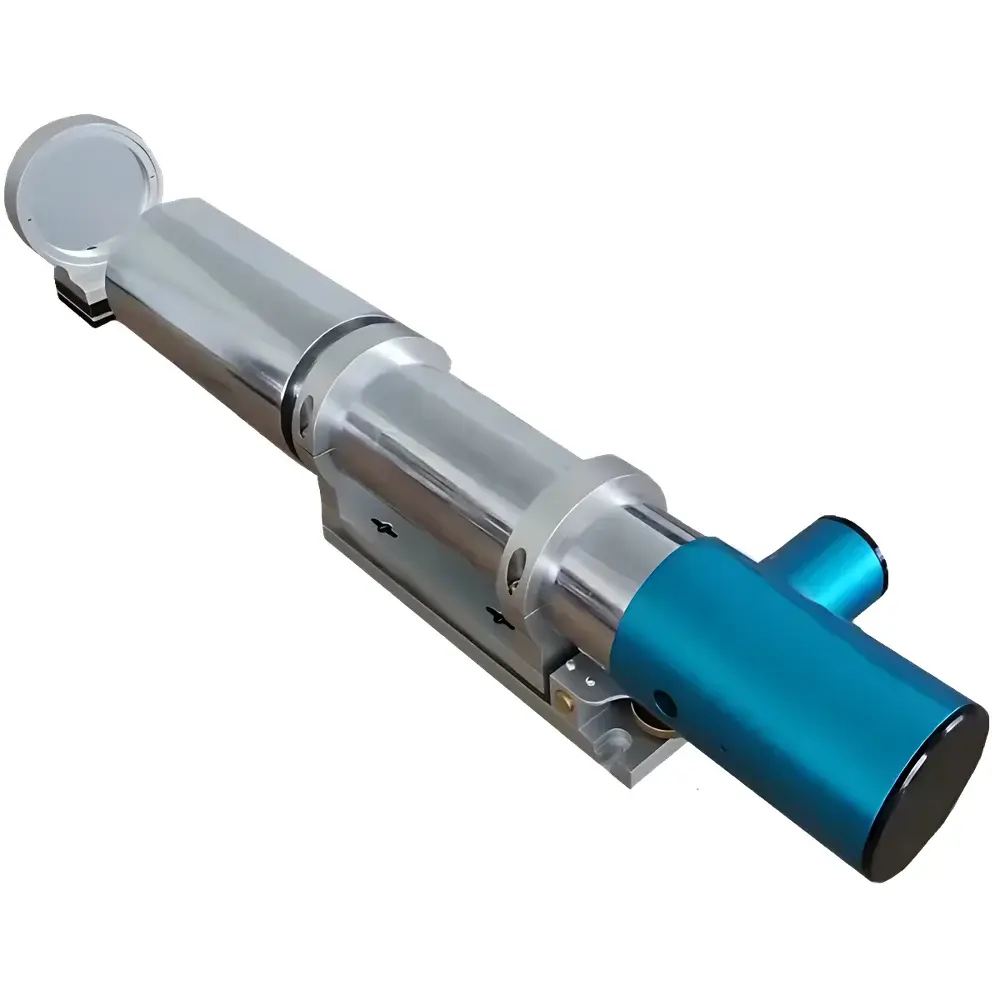
YANRUN MC030-YRMCT500/80/0.3 Dual-Axis Photoelectric Autocollimator
| Brand | YANRUN |
|---|---|
| Origin | Shanghai, China |
| Manufacturer Type | Manufacturer |
| Product Origin | Domestic (China) |
| Model | MC030-YRMCT500/80/0.3 |
| Pricing | Upon Request |
| Focal Length | 500 mm |
| Aperture | 80 mm |
| Light Source | Imported Semiconductor LED |
| Measurement Range | 0–80 m |
| Detector | High-Precision Photodetector |
| Display Resolution | Adjustable from 1″ to 0.0001″ (arc sec) |
| Field of View (X/Y) | 1450″ × 1200″ (arc sec) |
| Accuracy (Center) | ±0.3″ (0–±100″), ±0.5″ (0–±600″) |
| Frequency Response | ≤30 Hz |
| Interface | USB 2.0 |
| OS Requirement | Windows 7 or later, 64-bit |
| Minimum CPU | 4th-Gen Intel Core i3, ≥2.3 GHz |
Overview
The YANRUN MC030-YRMCT500/80/0.3 Dual-Axis Photoelectric Autocollimator is an advanced angular metrology instrument engineered for high-precision, non-contact measurement of minute angular deviations in two orthogonal axes (X and Y). It operates on the fundamental optical principle of autocollimation: a collimated beam—generated by projecting a reticle located at the focal plane of a high-aperture objective lens—is reflected back by a planar mirror and reimaged onto a co-located, high-resolution photodetector array. Angular displacement α of the mirror induces a linear image shift ΔS = 2f·α (where f = 500 mm is the effective focal length), enabling sub-arcsecond resolution through precise centroid detection algorithms. Unlike traditional visual autocollimators reliant on human eye alignment and micrometer readouts, this system replaces the ocular with a digital imaging sensor and real-time signal processing firmware, eliminating parallax and observer-induced bias. Its compact, integrated architecture—comprising an objective tube (80 mm clear aperture), electronic eyepiece module, dual-axis adjustable base, reference mirror set, and embedded LED illumination—supports traceable angular metrology in dynamic and static environments across manufacturing, calibration labs, and R&D facilities.
Key Features
- Dual-axis simultaneous acquisition: Real-time synchronous measurement of pitch and yaw angles with independent resolution settings per axis.
- High-stability semiconductor LED light source: Rated for >20,000 hours lifetime; spectrally stable, low-noise output optimized for photodetector SNR.
- Adjustable display resolution: Configurable from 1 arc second down to 0.0001 arc second (0.005 µrad), supporting both routine verification and ultra-fine alignment tasks.
- Real-time centroid tracking algorithm: Compensates for thermal drift and mechanical vibration via frame averaging and outlier rejection over user-defined integration windows.
- USB 2.0 interface with deterministic latency: Ensures synchronized data streaming at up to 30 Hz sampling rate under Windows 7+ 64-bit OS with compliant host controller drivers.
- Modular software architecture: Supports optional add-on modules for straightness, flatness, perpendicularity, and parallelism analysis per ISO 230-1, ISO 10360, and ASME B89.3.7 standards.
- Multi-language UI: Native support for English, Chinese, Russian, and Korean interfaces—fully localized for technical terminology and report generation.
- Compliance-ready data handling: Software enforces audit trails, user authentication, and electronic signature workflows aligned with GLP/GMP documentation requirements.
Sample Compatibility & Compliance
The MC030-YRMCT500/80/0.3 is compatible with standard optical flats (λ/20 or better), kinematic mirror mounts, and precision rotary stages equipped with retroreflective surfaces. It meets mechanical and optical design criteria referenced in ISO 10110-7 (laser beam quality), ISO 10012 (measurement management systems), and JJG 623–2007 (Chinese national verification regulation for autocollimators). While not FDA-certified as a medical device, its measurement traceability path—calibrated against NIM (National Institute of Metrology, China)-certified angle standards—enables use in ISO/IEC 17025-accredited laboratories. The system supports periodic verification per ASTM E2912 (Standard Practice for Verification of Autocollimators) and accommodates environmental compensation inputs (temperature, air pressure) when used with external sensors for uncertainty budgeting per GUM (JCGM 100:2008).
Software & Data Management
The bundled Windows-based control software provides full instrument configuration, live image visualization, real-time coordinate extraction, and automated error mapping. All raw pixel coordinates, timestamped measurement sequences, and user-defined calibration coefficients are stored in structured binary format with XML metadata headers. Export options include CSV and native Excel (.xlsx) files conforming to ISO 80000-3 for angular units (arc seconds, milliradians). Data integrity is preserved via SHA-256 hashing of each measurement session; revision-controlled software updates are digitally signed using X.509 certificates. For regulated environments, optional 21 CFR Part 11 compliance packages provide role-based access control, electronic signatures, and immutable audit logs—including operator ID, parameter changes, and report generation events—with retention configurable to organizational SOPs.
Applications
- Precision machine tool alignment: Verifying squareness between X-Y-Z axes, spindle tilt, and guideway straightness per ISO 230-1 Annex C.
- Optical assembly and testing: Collimation verification of laser cavities, alignment of multi-element lens systems, and interferometer cavity tuning.
- Aerospace component inspection: Angular stability assessment of gimbal platforms, inertial sensor mounts, and satellite payload interfaces.
- Calibration laboratory services: Serving as a transfer standard for angular artifact calibration (e.g., polygon mirrors, angle blocks) within accredited scopes.
- Research-grade physics experiments: Measuring thermal expansion-induced angular drift in cryogenic optical benches or gravitational wave detector suspension systems.
- Quality assurance in semiconductor lithography: Monitoring stage-level orientation stability during mask alignment and wafer stepping.
FAQ
What is the minimum recommended warm-up time before high-accuracy measurements?
A minimum 15-minute power-on stabilization period is required to achieve thermal equilibrium of the optical bench and detector electronics. For metrological-grade verification (e.g., ISO 10012 compliance), the instrument must be conditioned at constant ambient temperature (±0.5 °C) for ≥24 hours prior to calibration.
Can the system operate beyond 80 meters?
Yes—maximum working distance depends on reflector quality and ambient conditions. With λ/10 surface flatness and controlled lighting, reliable operation up to 120 m has been validated under laboratory conditions; however, accuracy degrades quadratically with distance due to atmospheric turbulence and beam divergence.
Is third-party calibration support available?
YANRUN maintains partnerships with CNAS-accredited calibration providers in China and EU-based DAkkS labs. Traceable calibration certificates (including uncertainty budgets per GUM) can be issued upon request, referencing NIM or PTB primary standards.
Does the software support scripting or API integration?
A documented COM/ActiveX interface is provided for integration into custom test automation frameworks (e.g., LabVIEW, Python pywin32, MATLAB COM client). Full command syntax, error codes, and callback registration methods are included in the SDK documentation.
How is angular accuracy verified across the full field of view?
Accuracy is characterized using a motorized precision goniometer (±0.005″ repeatability) and calibrated step-index mirror. Measurements are taken at ≥25 grid points spanning the 1450″ × 1200″ FOV; residual errors are mapped and optionally applied as spatial correction matrices in software.