
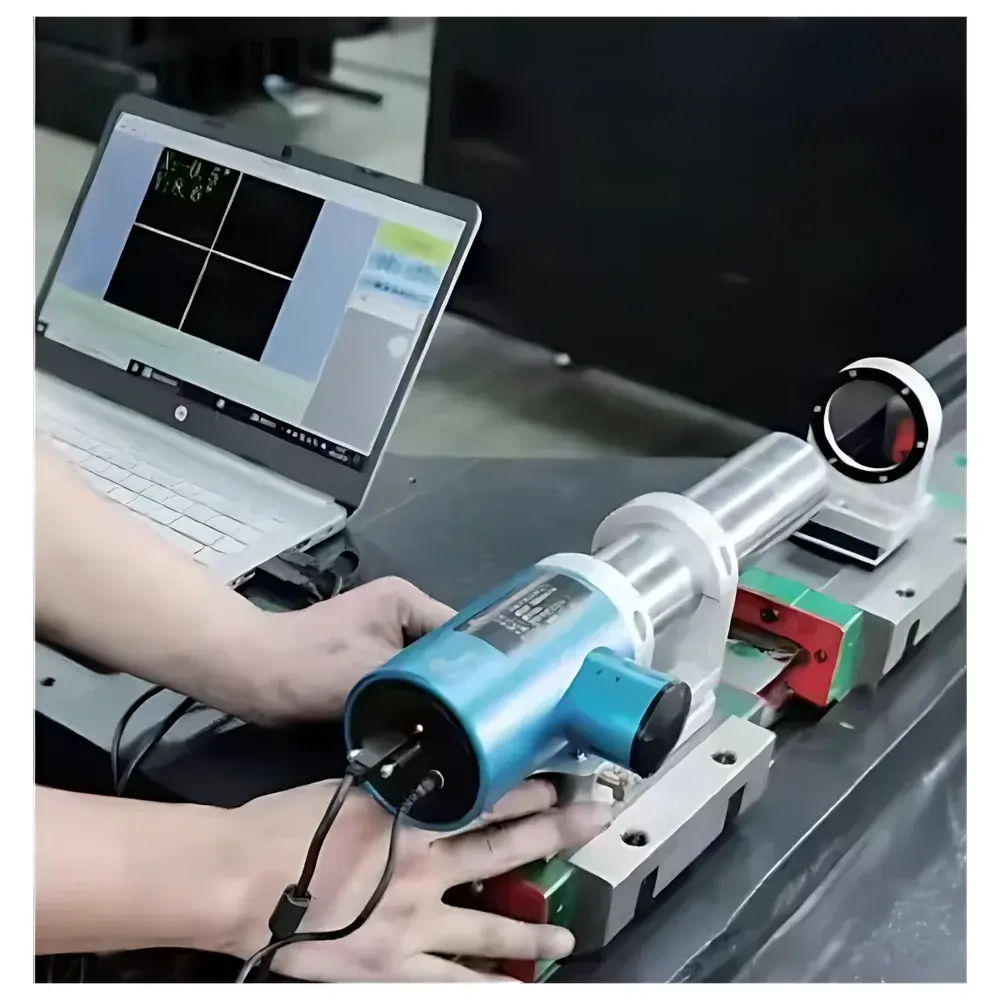
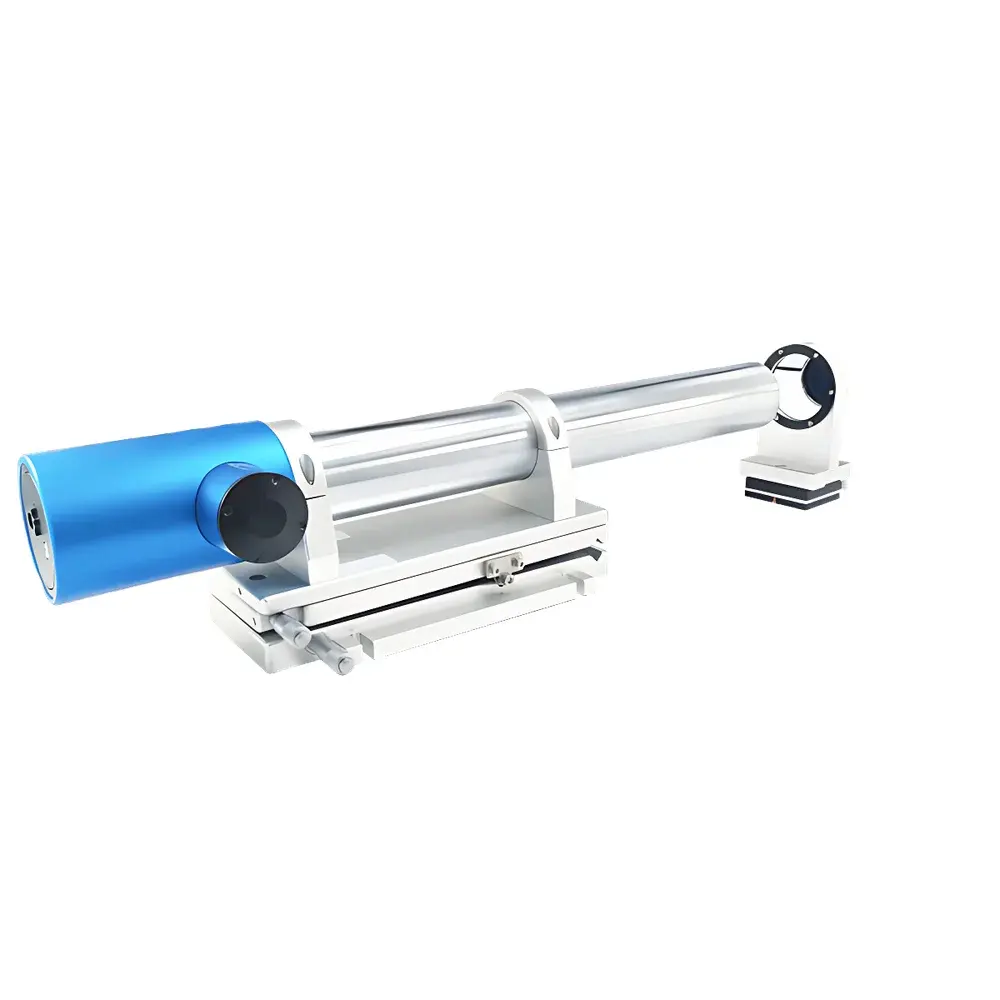
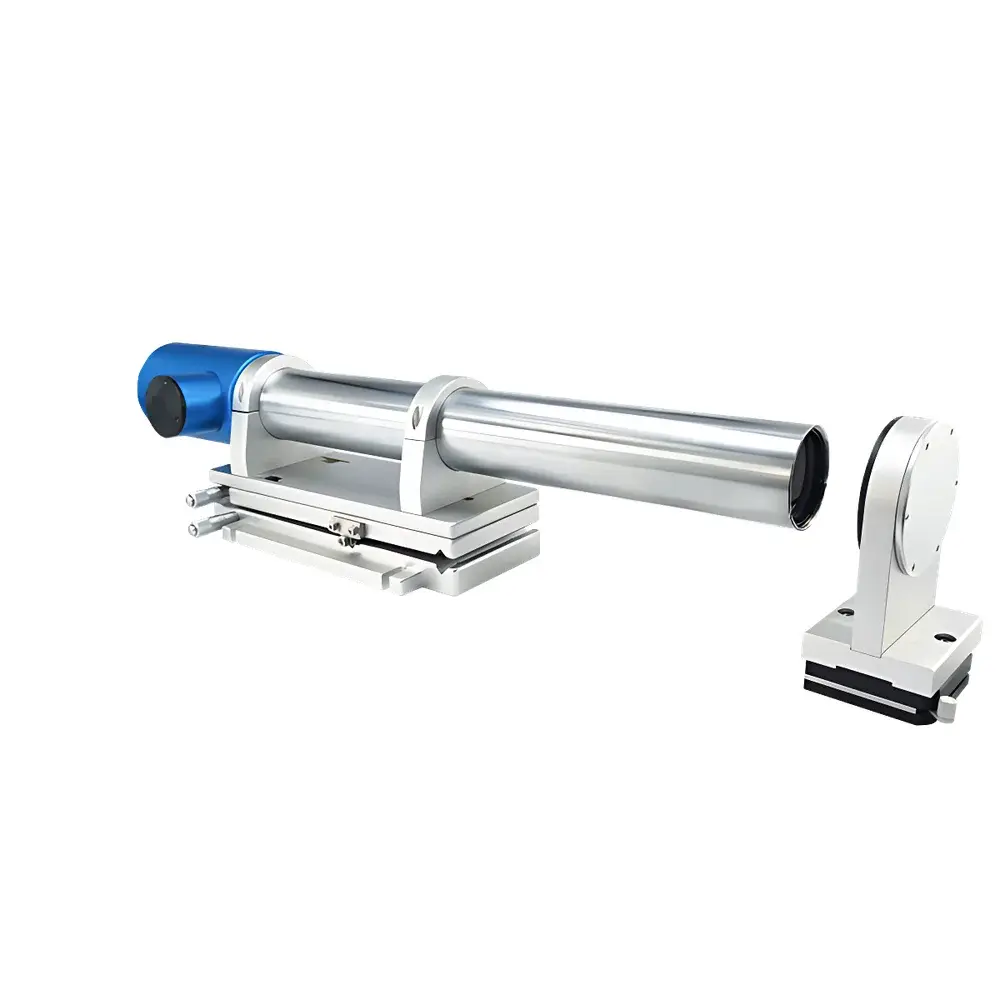
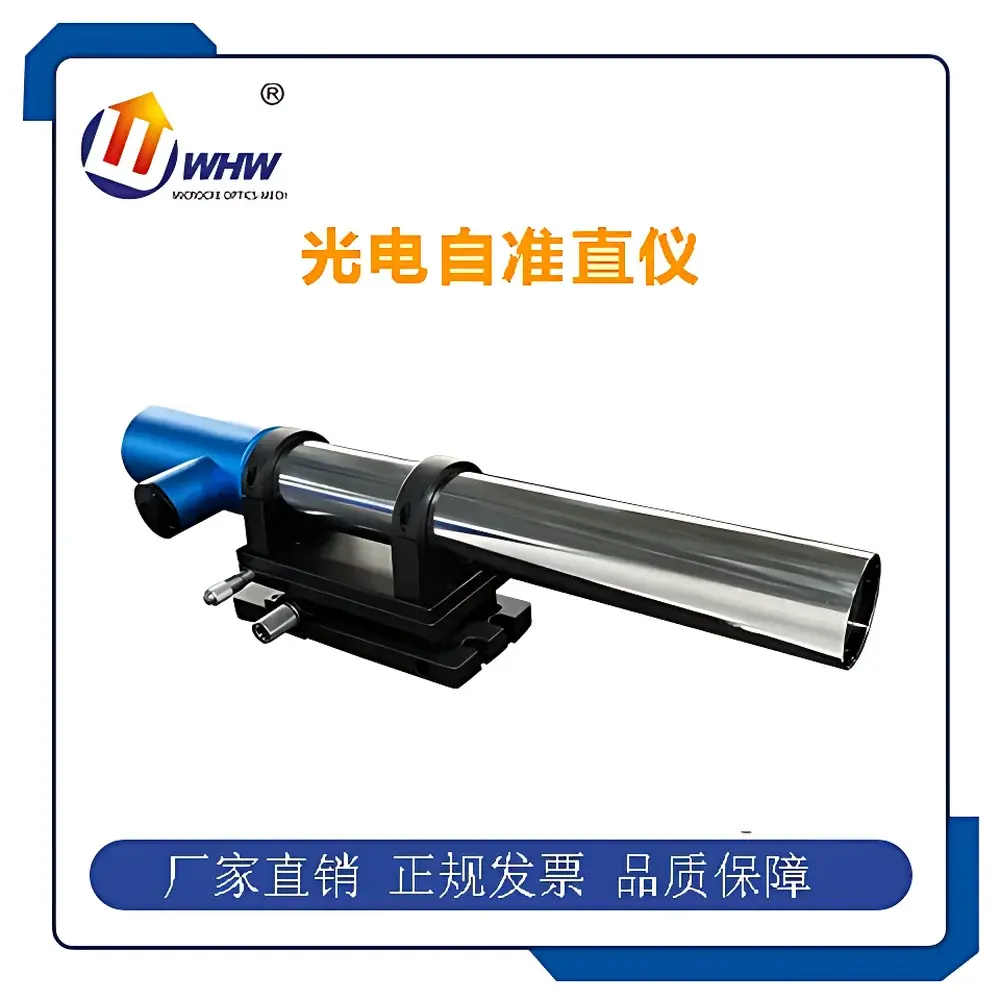
YANRUN MC030-YRUH5000/0.1 Dual-Axis Photoelectric Autocollimator
| Brand | YANRUN |
|---|---|
| Origin | Shanghai, China |
| Manufacturer Type | Manufacturer |
| Model | MC030-YRUH5000/0.1 |
| Focal Length | 500 mm |
| Aperture | 50 mm |
| Light Source | High-Stability Semiconductor LED |
| Measurement Range | 0–50 m |
| Angular Resolution | Adjustable down to 0.0001″ (arc second) |
| Field of View (X/Y) | 1100″ × 850″ (arc sec) |
| Accuracy (Center) | ±0.1″ (0–±100″), ±0.3″ (0–±400″) |
| Sampling Frequency | ≤9 Hz |
| Interface | USB 2.0 |
| Dimensions | 388 × 135 × 125 mm |
| Weight | 5.0 kg |
| Operating System | Windows 7 or later (64-bit), Intel Core i5-9xxx or equivalent |
Overview
The YANRUN MC030-YRUH5000/0.1 Dual-Axis Photoelectric Autocollimator is a precision optical metrology instrument engineered for high-accuracy angular displacement measurement based on the fundamental principle of optical autocollimation. It employs a collimated beam generated by a high-quality f = 500 mm objective lens with 50 mm aperture, directed onto a planar mirror placed in the measurement path. The reflected beam re-enters the same objective and is focused onto a high-resolution two-dimensional photoelectric sensor located at the shared focal plane — forming a co-focal, telecentric optical architecture. When the target mirror rotates by an angle α, the returned image shifts by ΔS ≈ 2α·f on the sensor plane; precise sub-pixel centroid detection enables arc-second-level angular resolution down to 0.0001″. Unlike traditional visual autocollimators requiring manual eyepiece alignment, this system digitizes the entire autocollimation process — eliminating observer parallax, fatigue-induced drift, and subjective interpretation. Its compact monolithic design (388 × 135 × 125 mm, 5.0 kg), integrated long-life LED illumination (rated >20,000 h), and USB 2.0 interface ensure portability without compromising metrological integrity. The instrument is calibrated per ISO 10110-5 and traceable to national angular standards, supporting both laboratory-grade metrology and in-situ industrial verification.
Key Features
- Dual-axis simultaneous measurement (X and Y) with real-time coordinate tracking of reflected reticle image, enabling vectorial angular analysis without mechanical reorientation.
- High-stability semiconductor LED light source operating at constant current, delivering uniform illumination intensity over extended operational cycles — critical for long-term repeatability in GLP/GMP environments.
- Adjustable angular resolution modes: 1″, 0.1″, 0.01″, 0.001″, and 0.0001″ (arc second), selectable via software to match application-specific uncertainty budgets.
- Real-time electronic eyepiece visualization with auto-centering algorithm, reducing operator dependency and minimizing systematic error from manual targeting.
- Modular hardware architecture: compatible with optional accessories including precision kinematic mounts, retroreflector arrays, linear translation stages, and rotary tables for extended geometric metrology workflows.
- Multi-language UI support (English, Chinese, Russian, Korean) with full Unicode compliance — optimized for international calibration labs and multinational manufacturing sites.
- Onboard data logging with timestamped metadata (temperature, humidity, acquisition time), compliant with audit-trail requirements under FDA 21 CFR Part 11 when paired with validated software configuration.
Sample Compatibility & Compliance
The MC030-YRUH5000/0.1 is designed for use with standard optical flat mirrors (λ/20 surface accuracy or better), kinematic mirror mounts, and reflective targets meeting ISO 10110-7 specifications. It supports measurement distances from 0 to 50 meters, accommodating both short-range benchtop alignment and large-scale machine tool verification. The instrument complies with electromagnetic compatibility (EMC) standards IEC 61326-1 and safety standard IEC 61010-1. Its angular accuracy specification (±0.1″ within ±100″ range) is verified under controlled metrological conditions per JJG 815–2018 (Chinese National Verification Regulation for Autocollimators) and aligns with the uncertainty framework of ISO/IEC 17025 for accredited calibration laboratories. For regulatory submissions, measurement reports include full uncertainty budgets incorporating Type A (statistical) and Type B (calibration certificate, environmental influence) components.
Software & Data Management
The included Windows-based control software (64-bit, Windows 7 or newer, Intel Core i5-9xxx minimum) provides full instrument control, real-time image capture, and automated geometric error evaluation. It implements ISO 230-1 and ISO 230-6-compliant algorithms for straightness, flatness, perpendicularity, and parallelism assessment using multi-point autocollimation scans. All raw sensor data (X/Y pixel coordinates, intensity profiles, timestamps) are stored in HDF5 format for traceability and post-processing interoperability. Export options include standardized Excel (.xlsx) reports with configurable templates adhering to ISO/IEC 17025 documentation requirements. Software features built-in statistical process control (SPC) tools, trend analysis, and comparative overlay of historical datasets — facilitating continuous improvement in production line quality assurance. Audit logs record all user actions, parameter changes, and calibration events, satisfying GLP/GMP electronic record retention mandates.
Applications
- Precision alignment of CNC machine tool guideways, spindle axes, and multi-axis motion platforms per ISO 230-1.
- Verification of angular stability and repeatability in aerospace-grade rotary stages and inertial reference units.
- Optical assembly metrology: collimation adjustment of laser cavities, interferometer beam paths, and telescope secondary mirror alignment.
- Flatness and straightness mapping of granite surface plates, optical benches, and vacuum chamber frames using grid-based autocollimation scanning.
- Dynamic angular monitoring during thermal soak tests or vibration qualification, leveraging its 9 Hz sampling capability for low-frequency drift characterization.
- Primary calibration of angle encoders, inclinometers, and tilt sensors in national metrology institutes and third-party calibration labs.
FAQ
What is the minimum required PC configuration for high-precision operation?
A 64-bit Windows system (Windows 7 or newer), Intel Core i5-9th generation or higher (≥2.3 GHz base clock), ≥8 GB RAM, and SSD storage are mandatory for stable real-time image processing at 0.0001″ resolution mode.
Is preheating required before calibration-grade measurements?
Yes. For measurements demanding ≤±0.1″ uncertainty, a minimum 15-minute warm-up is required; for formal metrological verification (e.g., ISO/IEC 17025), the instrument must be thermally stabilized in a temperature-controlled environment (±0.5°C) for ≥24 hours prior to calibration.
Can the system perform dynamic angular measurements?
Yes — with a maximum sampling frequency of 9 Hz, it supports low-bandwidth angular motion profiling such as thermal drift monitoring or slow-speed stage wobble analysis.
Does the software support automated report generation compliant with ISO/IEC 17025?
Yes. Reports include instrument identification, environmental conditions, uncertainty budget breakdown, traceability statement, and digital signature fields — fully configurable to meet accredited lab documentation protocols.
Are custom measurement modules available for specialized geometries?
Yes. YANRUN offers OEM integration support for bespoke optical layouts, non-standard target configurations, and API-based automation via DLL or TCP/IP interface for factory-floor MES/SCADA integration.



