
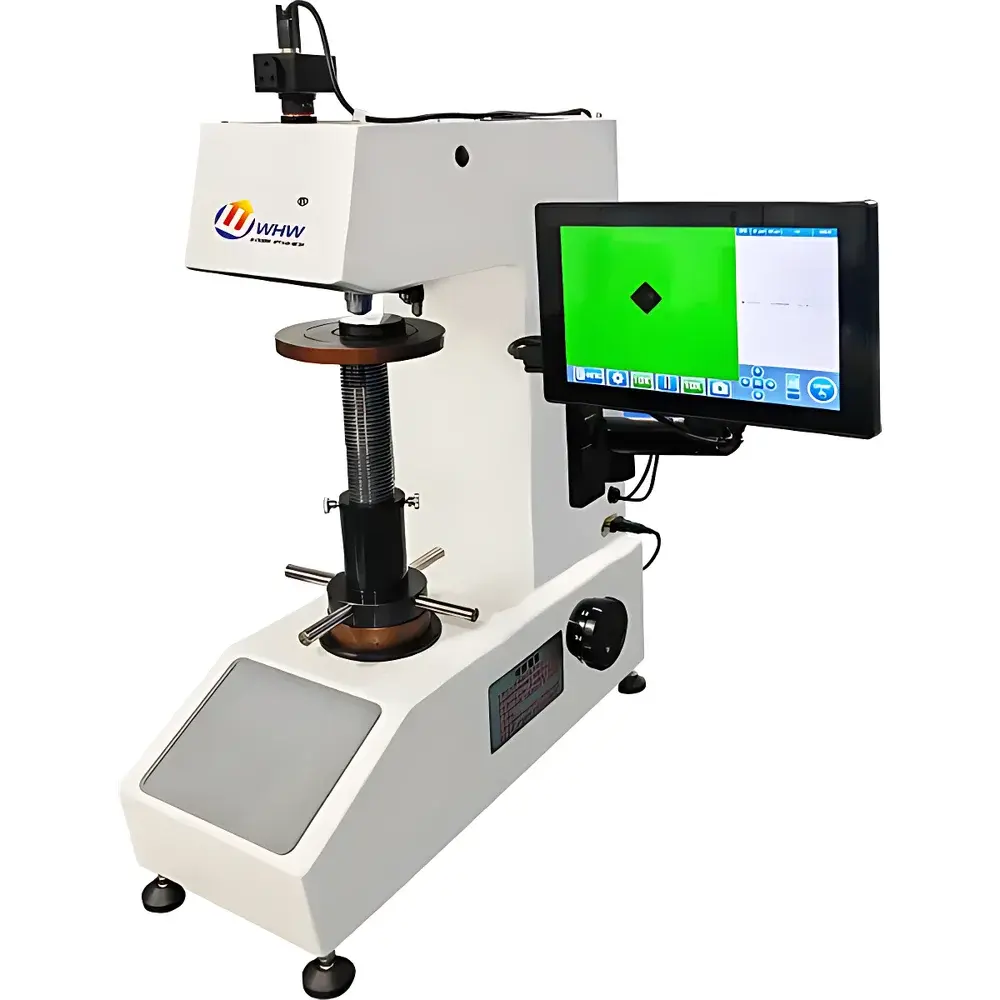
YANRUN MVS-50T Vision-Based Vickers Hardness Tester
| Brand | YANRUN |
|---|---|
| Origin | Shanghai, China |
| Manufacturer Type | Original Equipment Manufacturer (OEM) |
| Product Category | Domestic |
| Model | MVS-50T |
| Instrument Type | Vickers Hardness Tester |
| Hardness Measurement Range | 8–3000 HV |
| Maximum Test Force | 50 kgf |
| Vertical Testing Space (Height) | 240 mm |
| Depth of Throat | 130 mm |
| Total Magnification for Measurement & Observation | 100× |
| Objective Lens Magnification | 100× |
| Measurement Resolution | ≈0.14 µm (with 10× objective) |
| Dwell Time Range | 0–99 s (1 s increments) |
| Illumination Control | 20-step adjustable brightness (step = 1) |
| Power Supply | AC 220 V / 50 Hz |
| Net Weight | ~60 kg |
| Dimensions (W × D × H) | 570 × 220 × 680 mm |
| Frame Material | Cast aluminum housing (8–10 mm wall thickness) |
| Loading/Unloading Speed | ≈0.05 mm/s |
| Compliant Standards | GB/T 4340.2, ISO 6507-2, ASTM E384 |
Overview
The YANRUN MVS-50T Vision-Based Vickers Hardness Tester is an optomechanical metrology instrument engineered for precision micro- and macro-hardness evaluation of solid materials using the Vickers indentation method. It operates on the principle of applying a precisely controlled diamond pyramid indenter (136° included angle) under static load to produce a geometrically defined impression on the specimen surface; hardness is calculated from the two orthogonal diagonal lengths measured optically via high-magnification imaging. Integrated with an Android-based embedded platform, the MVS-50T unifies real-time image acquisition, automated indentation analysis, and standardized hardness computation—eliminating manual scale reading and human parallax error. Designed for laboratory-grade reproducibility and industrial robustness, it supports both routine quality control and advanced metallurgical research, particularly in evaluating case depth profiles of heat-treated steels, thin-film coatings, brittle ceramics, and semiconductor substrates.
Key Features
- Android-powered 10.1-inch capacitive touchscreen interface with intuitive navigation, offline operation capability, and firmware-upgradable architecture
- Motor-assisted turret system enabling automatic switching between optical objectives (100× standard) and Vickers indenters with positional repeatability ≤2 µm
- Electromechanical force application mechanism delivering six selectable test loads (1.0, 5.0, 10, 20, 30, and 50 kgf) via external rotary selector with automatic load recognition
- High-stability cast aluminum frame (8–10 mm wall thickness) minimizing thermal drift and mechanical vibration during dwell and measurement phases
- Trapezoidal lead screw-driven Z-axis with fine pitch and low backlash, ensuring smooth, repeatable vertical positioning up to 240 mm height and 130 mm throat depth
- Programmable dwell time (0–99 s, 1 s resolution) and fully automated loading–holding–unloading sequence at constant displacement rate (~0.05 mm/s)
- 20-level LED illumination control optimized for contrast enhancement across reflective, matte, or coated surfaces
Sample Compatibility & Compliance
The MVS-50T accommodates flat, polished, or ground specimens up to 240 mm in height and 130 mm in throat depth—suitable for bulk metal components, cross-sectioned welds, sintered ceramics, and wafer-scale semiconductor samples. Surface preparation follows ASTM E384 and ISO 6507-1 requirements: mirror finish (Ra ≤ 0.05 µm), absence of scratches or oxidation within the indentation zone. All hardness calculations adhere strictly to GB/T 4340.2–2012, ISO 6507-2:2018, and ASTM E384–22 calibration protocols. The system supports traceable hardness reporting with embedded audit trail metadata (operator ID, timestamp, load, dwell time, diagonal measurements), facilitating GLP/GMP-aligned documentation workflows.
Software & Data Management
The embedded Android OS hosts a proprietary hardness analysis suite featuring real-time image capture, auto-edge detection of Vickers impressions, sub-pixel diagonal measurement (resolution ≈0.14 µm with 10× objective), and automatic HV value derivation per ISO 6507-1 Annex A. Cross-standard conversions (HV ↔ HB, HRB, HRC, HK) are implemented per GB/T 231.1, ISO 18265, and ASTM E140–22. Data export options include CSV, PDF reports (with embedded images and metadata), and USB mass storage transfer. No cloud dependency: all processing occurs locally; no external PC required for operation or data retrieval.
Applications
- Depth profiling of carburized, nitrided, or induction-hardened case layers in aerospace and automotive alloys
- Quality assurance of sintered tungsten carbide tools and structural ceramics (Al₂O₃, SiC, ZrO₂)
- Mechanical property mapping of thin-film coatings (TiN, DLC, CrN) on metallic substrates
- Educational demonstration of hardness–microstructure correlation in metallurgy laboratories
- In-process verification of heat treatment parameters in foundry and forging production lines
- Failure analysis of brittle fracture origins in electronic packaging substrates
FAQ
Does the MVS-50T support ASTM E92 for Knoop hardness testing?
No—the instrument is configured exclusively for Vickers hardness (HV) per ISO 6507 and ASTM E384. Knoop testing requires a different indenter geometry and dedicated calibration routines not implemented in this model.
Is the system compliant with FDA 21 CFR Part 11 for electronic records?
While the MVS-50T generates auditable digital records (timestamp, operator, load, dwell, raw image), it does not include electronic signature enforcement or role-based access control required for full 21 CFR Part 11 compliance. Validation packages for GxP environments can be provided upon request.
Can third-party calibration blocks be used with this tester?
Yes—certified reference blocks traceable to NIM (China), NIST (USA), or PTB (Germany) are fully compatible, provided they meet ISO 6507-3 dimensional and surface finish specifications.
What maintenance intervals are recommended for long-term accuracy?
Annual verification of force sensor linearity, indenter geometry (via SEM inspection), and optical magnification calibration is advised. Daily cleaning of the objective lens and indenter tip with lint-free optical tissue is required.
Is remote software update supported over network?
Firmware updates are delivered via USB flash drive only; no Wi-Fi or Ethernet connectivity is integrated into the base configuration.



