
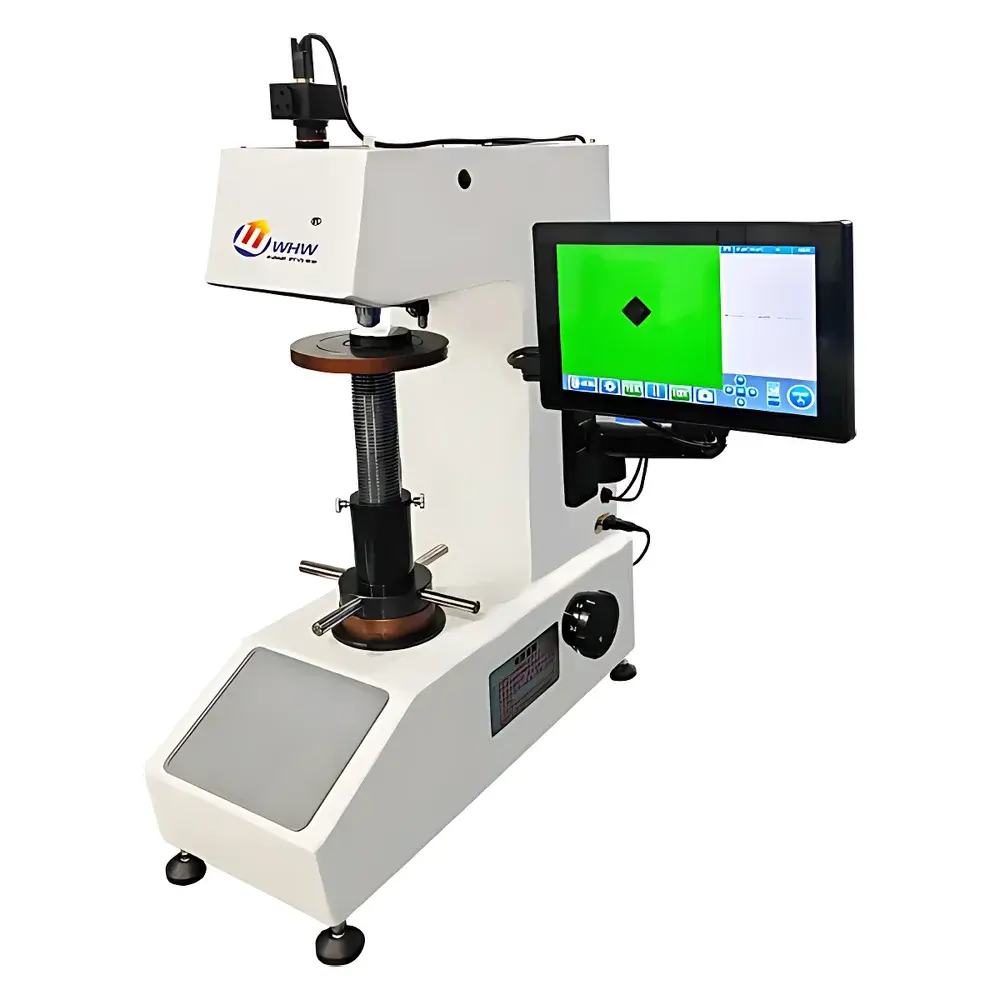
YANRUN MVSZ-5T Advanced Vision-Based Vickers Hardness Tester
| Brand | YANRUN |
|---|---|
| Origin | Shanghai, China |
| Manufacturer Type | Direct Manufacturer |
| Instrument Type | Vickers Hardness Tester |
| Model | MVSZ-5T |
| Measuring Range | 8–3000 HV |
| Maximum Test Force | 5 kgf (49.03 N) |
| Maximum Specimen Height | 240 mm |
| Total Magnification | 100× (observation), 200× (measurement) |
| Objective Lenses | 10× (observation), 20× (measurement) |
| Measurement Resolution | ≈0.14 µm (at 10× objective) |
| Dwell Time | 0–99 s (1 s increment) |
| Illumination Control | 20-step adjustable brightness |
| Load Application Speed | ≈0.05 mm/s |
| Standards Compliance | GB/T 4340.2, ISO 6507-2, ASTM E384 |
| Body Material | Cast aluminum (8–10 mm wall thickness) |
| Dimensions (W×D×H) | 570 × 220 × 680 mm |
| Weight | ~60 kg |
| Power Supply | AC 220 V / 50 Hz |
Overview
The YANRUN MVSZ-5T is a fifth-generation vision-based Vickers hardness tester engineered for high-precision microhardness evaluation in research laboratories, quality control departments, and industrial manufacturing environments. It operates on the fundamental principle of Vickers indentation hardness testing—applying a precisely controlled diamond pyramid indenter (136° apex angle) under standardized loads to produce a geometrically defined impression on the specimen surface. The diagonal lengths of the resulting impression are measured optically using calibrated digital imaging, and hardness values (HV) are calculated automatically via the standard formula: HV = 0.1891·F/d², where F is the applied load in kgf and d is the arithmetic mean of the two diagonals in millimeters. Unlike conventional manual or semi-automatic testers, the MVSZ-5T integrates an Android-based embedded computing platform with real-time image acquisition, sub-pixel edge detection algorithms, and automated indentation analysis—eliminating operator subjectivity and significantly improving measurement repeatability (typically <1.5% RSD at 500 HV, per ISO 6507-2 verification protocols).
Key Features
- Full automation of test cycle: auto-loading, dwell time control (0–99 s in 1 s steps), unloading, turret rotation, objective/indenter switching, and image capture—all synchronized under closed-loop feedback.
- Motorized auto-turret with ≤2 µm positional repeatability between indenter and objective lenses, ensuring consistent optical alignment across all test forces (0.2–5.0 kgf).
- High-resolution 10.1-inch capacitive touchscreen interface running a dedicated Android OS application—supporting multi-language UI, touch-gesture navigation, and local data storage (microSD/USB).
- Dual-magnification optical path: 10× objective for wide-field specimen overview and orientation; 20× objective optimized for precise diagonal measurement at 200× total magnification.
- Optimized mechanical architecture: rigid cast-aluminum frame (8–10 mm wall thickness), trapezoidal lead screw Z-axis lift mechanism, and spur-gear-driven load application system for stable force delivery and minimal vibration-induced error.
- Comprehensive illumination control: 20-level LED brightness adjustment (stepwise, 1 level per increment) with uniform Köhler illumination geometry for optimal contrast and edge definition.
Sample Compatibility & Compliance
The MVSZ-5T accommodates specimens up to 240 mm in height and 130 mm in maximum depth—suitable for large components such as gear blanks, turbine blades, and heat-treated shafts. Its modular stage design supports flat, curved, or irregular surfaces when used with optional V-blocks or custom fixtures. All hardness measurements adhere strictly to internationally recognized metrological standards: GB/T 4340.2 (China), ISO 6507-2 (International Organization for Standardization), and ASTM E384 (American Society for Testing and Materials). The instrument’s calibration traceability follows national metrology institute guidelines, and its measurement uncertainty budget accounts for factors including indenter geometry deviation, load cell linearity, pixel-to-length conversion accuracy, and environmental temperature drift (±2 °C operational range specified). Routine verification uses certified reference blocks (e.g., NIST SRM 2820 series or equivalent ISO 6507-3 compliant materials).
Software & Data Management
The embedded Android application provides full test workflow management—from parameter setup and live image preview to result validation and report generation. Each test record stores raw images, indentation coordinates, calculated diagonals, hardness values, load/dwell settings, and timestamped metadata. Export formats include CSV (for statistical process control integration), PDF (with customizable lab header and compliance footers), and XML (compatible with LIMS systems supporting ASTM E1382 or ISO/IEC 17025 data exchange schemas). Audit trail functionality logs all user actions—including parameter changes, calibration events, and report exports—with timestamps and operator IDs. While not natively 21 CFR Part 11 compliant, the system supports external electronic signature integration via API for regulated environments requiring GLP/GMP documentation integrity.
Applications
The MVSZ-5T is routinely deployed for case depth profiling of carburized or nitrided steel components, hardness gradient mapping across weld zones (HAZ, fusion line, base metal), thin-film characterization (e.g., TiN, DLC coatings ≥1 µm thick), and ceramic sintering quality assessment. Its 0.2 kgf minimum load enables reliable microhardness evaluation of brittle phases (e.g., martensite, intermetallics) without cracking artifacts. In academic settings, it supports metallurgical phase identification through hardness correlation with microstructure (e.g., distinguishing ferrite vs. pearlite in dual-phase steels), while in semiconductor packaging labs, it verifies die-attach material consistency post-reflow. The instrument also serves as a primary reference tool for inter-laboratory round-robin studies conducted under ISO/IEC 17043 proficiency testing frameworks.
FAQ
What standards does the MVSZ-5T comply with for hardness calibration and verification?
It conforms to GB/T 4340.2, ISO 6507-2, and ASTM E384 for testing procedures, and supports verification using certified reference blocks traceable to national metrology institutes.
Can the system measure non-metallic materials such as ceramics or composites?
Yes—the 0.2–5.0 kgf load range and high-resolution imaging enable reliable HV measurement on ceramics, sintered carbides, polymer matrix composites, and thin hard coatings, provided surface preparation meets ISO 6507-1 finish requirements.
Is remote software update supported?
Firmware and application updates are delivered via USB flash drive or microSD card; over-the-air (OTA) updates are not implemented due to industrial cybersecurity requirements.
What is the typical measurement repeatability for routine QC use?
Under controlled environmental conditions (23 ±2 °C, <60% RH) and using standardized test blocks, the instrument achieves ≤1.5% relative standard deviation (RSD) at 500 HV, verified per ISO 6507-2 Annex B.
Does the system support custom reporting templates for ISO/IEC 17025 accreditation?
Yes—users may define report layouts with institutional logos, QA signatures, uncertainty statements, and compliance disclaimers; exported PDFs retain embedded metadata required for audit readiness.



