
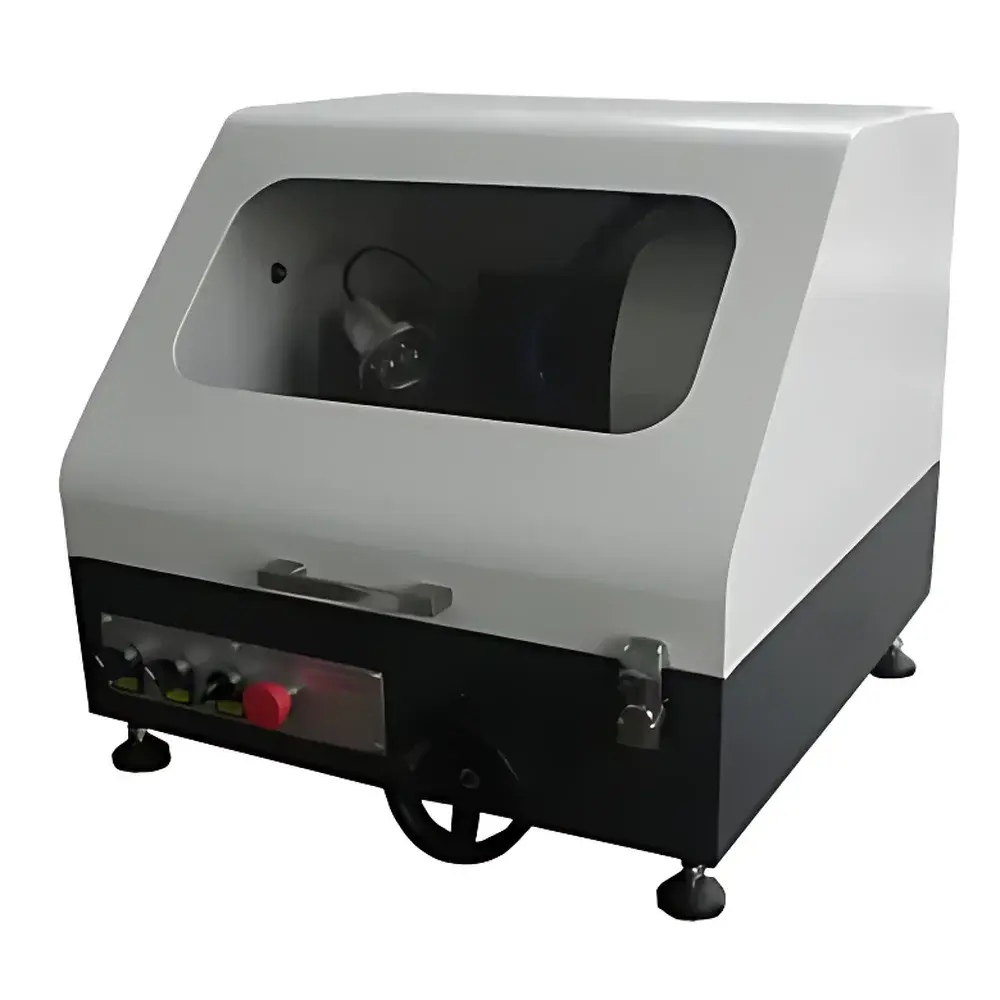
YANRUN QG-65 Precision Metallographic Sample Cutting Machine
| Brand | YANRUN |
|---|---|
| Origin | Shanghai, China |
| Manufacturer Type | Direct Manufacturer |
| Country of Origin | China |
| Model | QG-65 |
| Instrument Type | Precision Cutting Machine |
| Cutting Method | Manual |
| Spindle Speed | 2840 rpm |
| Max. Cutting Diameter | 65 mm |
| Blade Dimensions | (200–300) × (1–2.0) × 32 mm |
| Cooling System | Automatic Circulating Water Cooling |
| Water Tank Capacity | 60 L |
| Motor Power | 1.5 kW |
| Configuration | Benchtop |
| Voltage | 380 V AC |
| Weight | 120 kg |
Overview
The YANRUN QG-65 Precision Metallographic Sample Cutting Machine is an integrated benchtop system engineered for rapid, controlled sectioning of metallurgical and geological specimens prior to mounting, grinding, and polishing. Designed in accordance with standard metallographic preparation workflows defined by ASTM E3, ISO 14487, and GB/T 13298, the QG-65 employs a manually actuated feed mechanism coupled with a high-rigidity spindle assembly rotating at a fixed speed of 2840 rpm. Its core function is to deliver dimensionally stable, thermally undisturbed cross-sections—critical for subsequent microstructural analysis via optical microscopy or SEM. The machine’s structural architecture minimizes vibration transmission during cutting, while its rigid cast-iron base ensures long-term alignment stability under repetitive loading. Unlike abrasive cutoff saws intended for bulk material removal, the QG-65 prioritizes surface integrity: its optimized blade engagement geometry, combined with continuous coolant delivery, suppresses localized heating and prevents oxidation, microcracking, or phase transformation at the cut interface.
Key Features
- Benchtop configuration with reinforced cast-iron frame for mechanical stability and noise attenuation (operating sound pressure level <72 dB(A) at 1 m)
- Dual-platform specimen clamping system enabling rapid positioning and repeatable axial alignment of irregular or multi-part samples
- Automated recirculating water cooling circuit with 60 L reservoir, adjustable flow rate, and temperature monitoring to maintain consistent thermal management across extended operation cycles
- Manual feed control with calibrated depth scale and fine-adjustment knob for precise cut-depth incrementation (0.1 mm resolution)
- Interlocked safety guard with transparent polycarbonate viewport and automatic motor cutoff upon door opening per EN 60204-1 requirements
- Modular blade mounting system compatible with standard ISO 4024-compliant abrasive wheels (200–300 mm diameter, 1–2 mm thickness, 32 mm arbor hole)
Sample Compatibility & Compliance
The QG-65 accommodates a broad spectrum of conductive and non-conductive materials used in metallography and petrography laboratories, including ferrous and non-ferrous alloys, sintered carbides, ceramic composites, geological thin sections, and cementitious specimens. Its 65 mm maximum cutting diameter supports common specimen formats such as Ø25 mm, Ø30 mm, and Ø40 mm mounts, as well as rectangular billets up to 60 × 40 mm cross-section. All operational parameters—including spindle speed, feed force, and coolant flow—are selected to comply with preparatory protocols referenced in ASTM E3 (Standard Guide for Preparation of Metallographic Specimens), ISO 14487 (Metallographic examination — Preparation of specimens), and CNAS-CL01:2018 (accreditation criteria for testing laboratories). The unit is CE-marked for machinery safety and conforms to electromagnetic compatibility (EMC) directive 2014/30/EU.
Software & Data Management
As a manually operated precision cutting instrument, the QG-65 does not incorporate embedded digital controls or proprietary software. However, it is fully compatible with laboratory-wide documentation systems supporting GLP/GMP compliance. Users may log cutting parameters—including date/time, operator ID, sample ID, material type, blade serial number, coolant temperature, and visual inspection notes—into electronic lab notebooks (ELNs) compliant with 21 CFR Part 11. Optional integration with barcode-scanned sample tracking platforms enables full audit trail generation for quality assurance records. Calibration verification (e.g., spindle speed validation using handheld tachometer, coolant flow rate measurement via calibrated flow meter) is recommended quarterly and documented per internal SOPs aligned with ISO/IEC 17025.
Applications
- Routine sectioning of heat-treated steel coupons for grain size evaluation per ASTM E112
- Preparation of weld joint specimens for fusion zone and HAZ microstructure characterization
- Cutting of additively manufactured (AM) metal parts to expose build layers for porosity and defect analysis
- Sectioning of geological core samples for thin-section fabrication in petrographic studies
- Isolation of representative volumes from composite laminates for interfacial adhesion assessment
- Controlled decapsulation of encapsulated electronic components for failure analysis (FA) workflows
FAQ
Is the QG-65 suitable for automated or programmable cutting sequences?
No. The QG-65 is a manually controlled instrument designed for operator-guided, real-time adjustment of feed rate and stopping position. It does not feature CNC capability, motion programming, or digital axis control.
What blade types are recommended for hard ceramics or tungsten carbide?
Diamond-impregnated resin-bonded blades (e.g., 250 mm × 1.2 mm × 32 mm) with medium grit (120–180 mesh) are recommended. Coolant flow must be maintained above 3.5 L/min to prevent blade glazing.
Does the unit include validation documentation for ISO/IEC 17025 traceability?
The QG-65 ships with a factory calibration certificate for spindle speed and coolant flow baseline verification. Full metrological traceability requires user-performed periodic verification using NIST-traceable instruments and documented in accordance with Clause 6.5 of ISO/IEC 17025.
Can the water cooling system be connected to a centralized lab chiller?
Yes. The inlet/outlet ports accept standard 1/2″ BSP threaded connections. Integration with external chillers (5–25°C setpoint) is supported, provided flow rate remains within 2–6 L/min and backpressure does not exceed 0.3 MPa.
What maintenance intervals are specified for long-term reliability?
Lubrication of spindle bearings every 500 operating hours; inspection and replacement of coolant filter cartridge every 200 hours; annual torque verification of clamping mechanism fasteners per manufacturer’s technical bulletin TB-QG65-REV3.



