
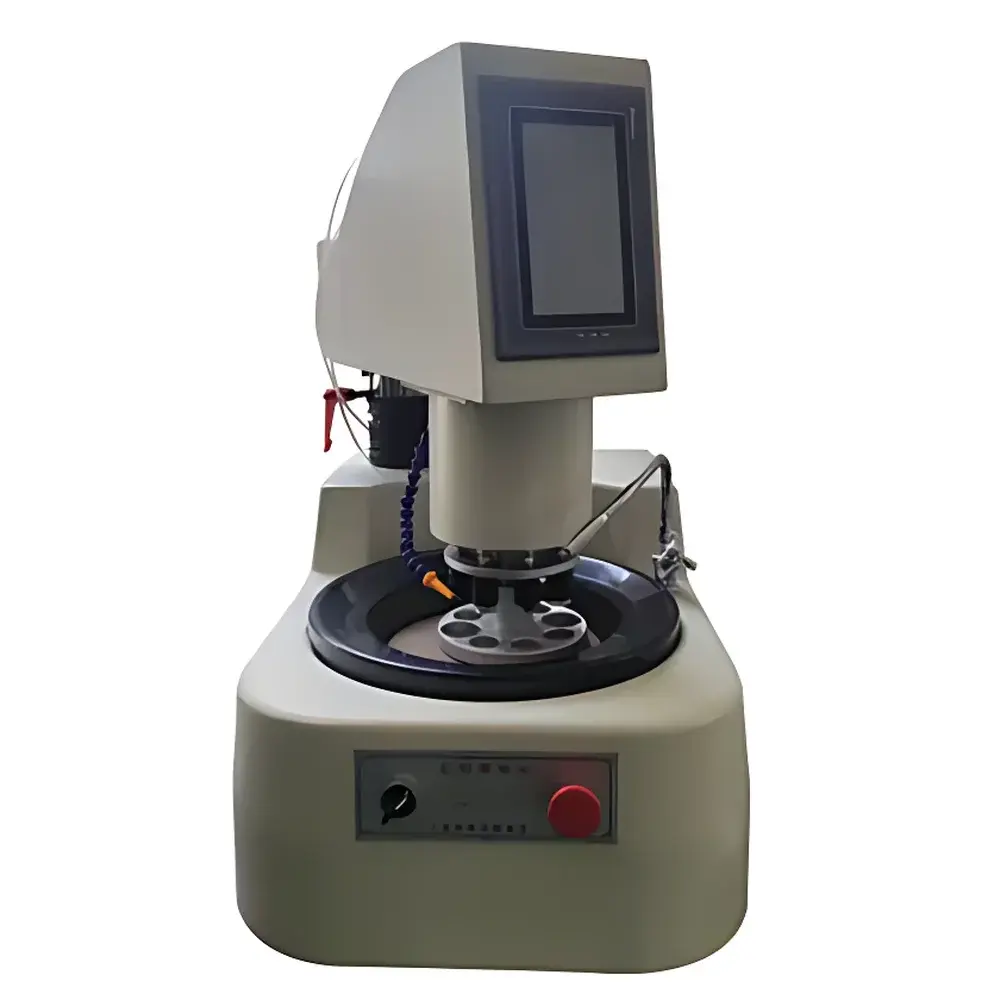
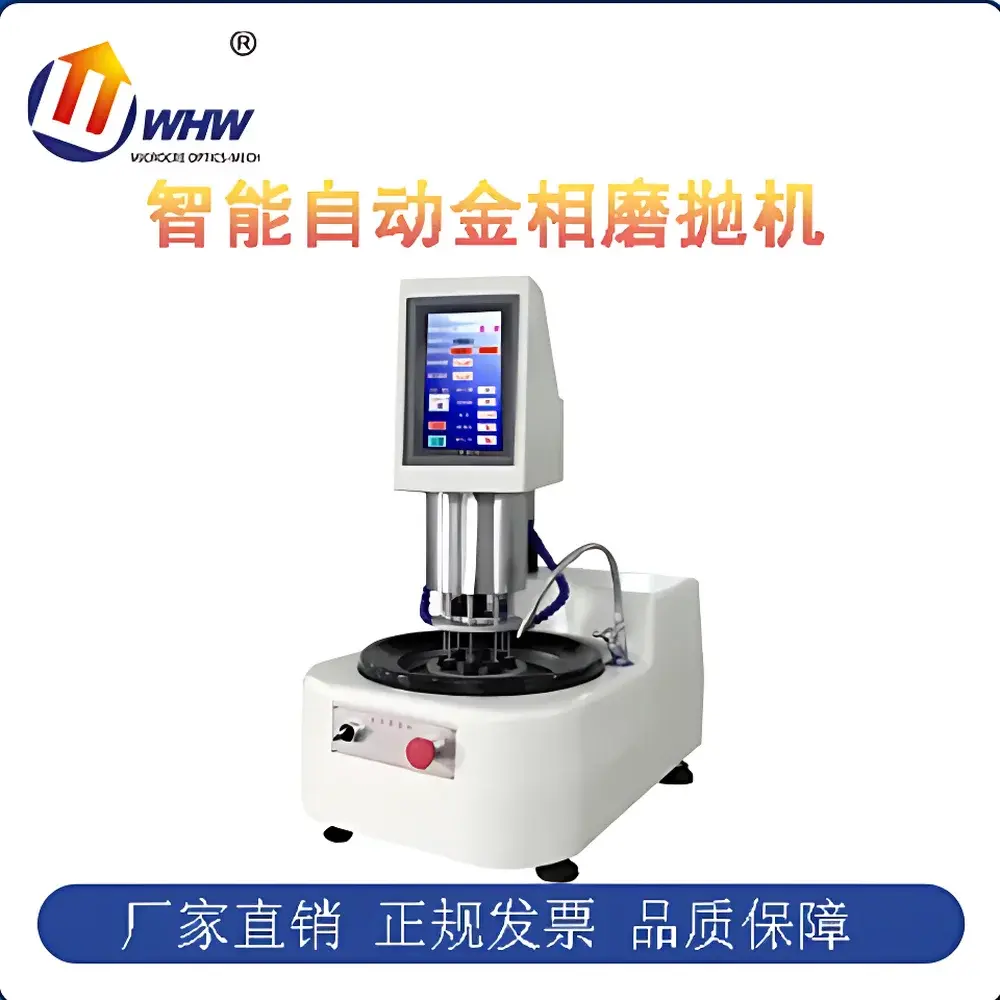
YANRUN ZMP-1000 Intelligent Automated Metallographic Grinding and Polishing System
| Brand | YANRUN |
|---|---|
| Origin | Shanghai, China |
| Manufacturer Type | Direct Manufacturer |
| Product Category | Domestic (PRC-Made) |
| Model | ZMP-1000 |
| Price | USD 5,900 (FOB Shanghai) |
| Speed Range | 50–1500 rpm (intelligent auto-adjustable) |
| Platen Diameter | 230 mm (optional: 200 / 250 / 300 mm) |
| Number of Platens | 1 |
| Sample Capacity | 8 specimens (standard fixture) |
| Pressure Control | Pneumatic (0.5 MPa supply), center-load (300 N) or individual-load (1–40 N × 8) |
| Motor Power | 550 W (AC variable-frequency drive) |
| Control Interface | 8-inch color touchscreen + PLC |
| Grinding/Polishing Programs | Up to 100 user-storable protocols |
| Abrasive Delivery | Dual-channel automated spray system (minimum interval: 0.1 s |
| minimum duration | 0.1 s) |
| Timing Range | 0–9999 s per stage |
| Sample Holder Configuration | 6 × 30 mm + 2 × 40 mm mounting holes |
| Input Power | 220 V AC, 50 Hz |
Overview
The YANRUN ZMP-1000 Intelligent Automated Metallographic Grinding and Polishing System is a precision-engineered, pneumatically actuated sample preparation platform designed for reproducible, high-throughput metallographic specimen preparation in research laboratories, quality control facilities, and materials testing centers. Built upon Couette-flow polishing mechanics and controlled normal-force grinding principles, the ZMP-1000 ensures uniform material removal and surface finish across diverse material classes—including ferrous and non-ferrous alloys, ceramics, geological specimens, optical glasses, semiconductor wafers, and advanced composites. Its architecture integrates closed-loop pneumatic pressure regulation, programmable rotational kinematics, and synchronized abrasive delivery to eliminate operator-dependent variability—critical for ASTM E3, ISO 14577, and ISO 643-compliant microstructural analysis.
Key Features
- Intelligent dual-channel abrasive dispensing system with adjustable spray frequency (0.1 s resolution) and duration (0.1 s resolution), enabling precise, repeatable slurry application across grinding and polishing stages.
- PLC-based control architecture with an 8-inch industrial-grade color touchscreen interface, supporting menu-driven operation, real-time parameter monitoring, and intuitive program navigation.
- Configurable pressure application: selectable center-loading (300 N total) or independent single-specimen loading (1–40 N per station × 8 positions), ensuring optimal force distribution for brittle, ductile, or laminated samples.
- Automated protocol storage for up to 100 distinct grinding-polishing sequences—each including speed profiles, dwell times, pressure settings, and abrasive delivery parameters—facilitating rapid method recall and cross-laboratory standardization.
- Variable-speed platen drive (50–1500 rpm) and independently controllable head rotation (20–160 rpm) support multi-stage preparation workflows from coarse grinding to final colloidal silica polishing.
- Modular sample holder design accommodating eight standard specimens (6 × 30 mm + 2 × 40 mm), with optional custom fixtures for irregular geometries, thin foils, or miniaturized electronic components.
Sample Compatibility & Compliance
The ZMP-1000 supports preparation of specimens ranging from soft aluminum alloys and copper matrices to ultra-hard tungsten carbide, silicon nitride, sapphire substrates, and fused quartz. Its pressure-controlled, low-vibration platform minimizes subsurface deformation and edge rounding—key requirements for quantitative image analysis (QIA) and electron backscatter diffraction (EBSD). The system complies with fundamental safety standards IEC 61000-6-2 (EMC immunity) and IEC 61000-6-4 (EMC emission), and its operational repeatability aligns with GLP documentation practices for regulated environments. While not certified to FDA 21 CFR Part 11 out-of-the-box, audit trails—including timestamped program execution logs, parameter change history, and operator ID tagging—can be exported in CSV format for internal QA/QC traceability.
Software & Data Management
The embedded PLC firmware provides full local control without external PC dependency. All programs are stored internally with non-volatile memory retention. Each protocol includes metadata fields for operator name, date, material type, and QC reference code. Export functionality supports USB-based transfer of log files containing start/stop timestamps, actual vs. setpoint rpm, applied pressure traces, and cumulative abrasive volume per channel. For integration into LIMS or ELN ecosystems, optional RS-232 or Modbus RTU interfaces enable bidirectional communication with laboratory information management systems—supporting automated job initiation and result archiving.
Applications
- Routine metallography in metallurgical labs performing ASTM E3-compliant grain size analysis and inclusion rating.
- Failure analysis of turbine blades, weld joints, and additive-manufactured parts requiring artifact-free cross-sections.
- Geological thin-section preparation for petrographic microscopy and micro-XRF mapping.
- Preparation of ceramic matrix composites (CMCs) and refractory oxides for SEM-EDS phase identification.
- Quality assurance of coated optical components and MEMS devices where surface integrity directly impacts functional performance.
- Academic research involving novel battery electrode materials, where controlled delamination-free sectioning is essential for interfacial characterization.
FAQ
Does the ZMP-1000 support fully unattended operation?
Yes—once a protocol is selected and specimens are loaded, the system executes grinding, rinsing, polishing, and drying (if integrated) without manual intervention.
Can the ZMP-1000 be used for electrolytic polishing or etching?
No—it is a mechanical grinding/polishing platform only; electrochemical modules are not supported.
What maintenance intervals are recommended for the pneumatic system?
Air filter elements should be inspected monthly and replaced quarterly under continuous use; regulator lubrication is required annually.
Is remote diagnostics or firmware update capability available?
Firmware updates require local USB stick upload; remote access is not implemented for cybersecurity compliance.
Are calibration certificates provided with the instrument?
Factory calibration verification reports (speed, pressure, timing) are included; NIST-traceable third-party calibration is available as an optional service.



