
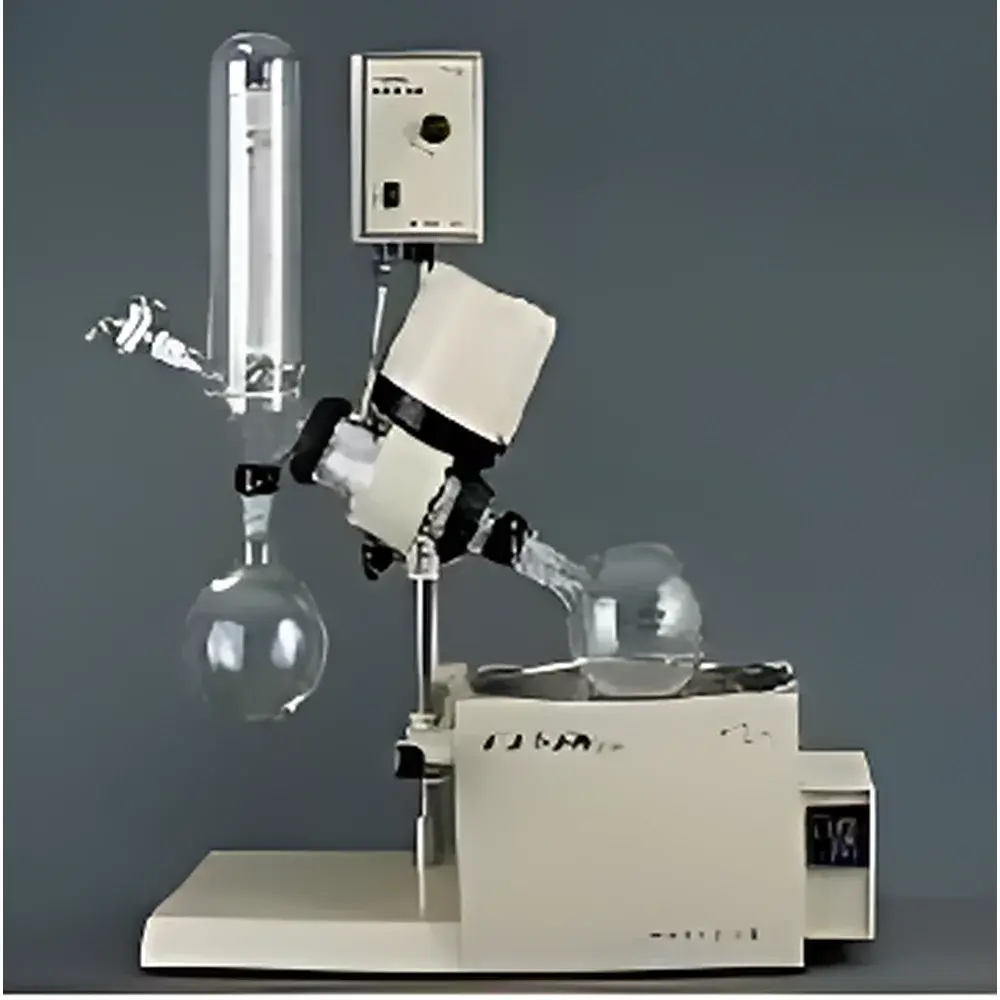
Yarong RE-52CS-1 Manual-Lift 2L Rotary Evaporator
| Brand | Yarong |
|---|---|
| Origin | Shanghai, China |
| Model | RE-52CS, RE-52CS-1, RE-52CS-2 |
| Capacity | 2 L |
| Ultimate Vacuum | 399.9 Pa |
| Rotation Speed | 0–120 rpm |
| Bath Temperature Range | Ambient to 100 °C |
| Heating Control Accuracy | ±1 °C (typical for analog thermostatic control) |
| Cooling Surface Area | 0.11 m² |
| Condenser Type | Vertical |
| Lift Mechanism | Manual lever-type with 150 mm travel |
| Water Bath Dimensions | 260 × 150 mm stainless steel |
| Power | 1.0 kW |
| Voltage/Frequency | 220 V / 50 Hz |
Overview
The Yarong RE-52CS-1 is a manually operated, benchtop rotary evaporator engineered for reliable solvent removal, concentration, and recovery under reduced pressure in academic, pharmaceutical, and industrial R&D laboratories. It operates on the principle of thin-film evaporation: a rotating flask increases surface area while simultaneous heating (via a thermostatically controlled water bath) and vacuum application lower the boiling point of solvents—enabling gentle, efficient separation without thermal degradation of heat-sensitive compounds. Designed for routine purification workflows, the RE-52CS-1 integrates a vertical condenser, manual lever-based lift mechanism, and analog temperature regulation—providing deterministic control for reproducible batch processing of up to 2 L volumes.
Key Features
- 2 L evaporation capacity with standard 24/29 or 29/32 ground-glass joints—compatible with common round-bottom flasks and receiving flasks.
- Manual lever-type lifting system with 150 mm vertical travel—ensures precise positioning of the evaporation flask relative to the water bath and condenser, minimizing risk of bumping or overflow during startup or shutdown.
- Vertical double-surface condenser (0.11 m² effective cooling area) constructed from high-conductivity borosilicate glass—optimized for condensing low-boiling solvents (e.g., diethyl ether, acetone, ethyl acetate) at moderate vacuum levels (down to 399.9 Pa).
- DC motor-driven rotation with electronic stepless speed control (0–120 rpm), delivering stable torque across the full range—critical for maintaining uniform thin-film formation on flask walls.
- Stainless steel water bath (260 × 150 mm footprint) with analog thermostatic control—capable of maintaining setpoints from ambient temperature up to 100 °C with typical stability of ±1 °C under steady-state conditions.
- Integrated valve-type feed tube for controlled addition of sample or solvent during operation—supporting sequential or continuous feed protocols without breaking vacuum.
- Robust aluminum alloy mainframe and corrosion-resistant hardware—designed for long-term mechanical stability and ease of cleaning in multi-user laboratory environments.
Sample Compatibility & Compliance
The RE-52CS-1 accommodates a broad spectrum of organic and aqueous solutions, including but not limited to extraction mixtures, reaction crude products, natural product isolates, and polymer solutions. Its operating vacuum range (399.9 Pa) aligns with common ASTM E202 and ISO 6610 standards for solvent removal in analytical sample preparation. While the unit itself does not include digital audit trail or electronic signature capabilities, its analog controls and mechanical design support GLP-compliant documentation when paired with external logbooks and calibrated thermometers/manometers. The stainless steel bath and borosilicate glass train meet USP material compatibility requirements for pharmaceutical applications involving non-sterile intermediate processing.
Software & Data Management
As an analog-controlled instrument, the RE-52CS-1 does not incorporate embedded firmware, touchscreen interfaces, or data logging functionality. All operational parameters—including rotation speed, bath temperature, and vacuum level—are monitored and adjusted manually using front-panel dials and external gauges. This architecture eliminates software validation requirements and simplifies qualification (IQ/OQ) for regulated environments where deterministic, non-programmable operation is preferred. Users may integrate third-party vacuum controllers or temperature recorders via standard 1/4″ NPT or hose barb ports for enhanced process traceability.
Applications
- Concentration of natural product extracts (e.g., plant alkaloids, essential oils) prior to HPLC or GC analysis.
- Removal of reaction solvents (THF, dichloromethane, methanol) following synthetic chemistry procedures.
- Recovery and recycling of high-purity solvents in small-scale pilot processes.
- Drying of heat-labile samples—such as peptides or enzyme preparations—under mild vacuum and controlled bath temperatures.
- Preparative-scale fractional distillation when coupled with optional fractional distillation heads and chilled recirculating chillers.
- Teaching laboratory demonstrations of phase equilibria, vapor pressure depression, and mass transfer principles in chemical engineering curricula.
FAQ
Is the RE-52CS-1 compatible with vacuum pumps requiring oil-free operation?
Yes—the system uses standard 10 mm or 12 mm vacuum tubing and can be connected to diaphragm, scroll, or hybrid vacuum pumps rated for ≤400 Pa ultimate vacuum.
What is the maximum recommended flask size for stable rotation at 120 rpm?
A 2 L round-bottom flask (with balanced load) is rated for full-speed operation; however, loads exceeding 1.5 L are advised to rotate at ≤90 rpm to ensure mechanical stability and minimize vibration.
Does the vertical condenser require external coolant circulation?
No—the condenser relies on ambient air convection and optional cold finger insertion; for optimal efficiency with low-boiling solvents, connection to a recirculating chiller (5–10 °C output) is recommended.
Can the water bath temperature be validated per ISO/IEC 17025 requirements?
Yes—using a calibrated PT100 probe inserted into the bath fluid, users may perform periodic temperature uniformity and accuracy verification per ILAC-G8 guidelines.
Is the RE-52CS-1 suitable for use with corrosive solvents such as concentrated HCl or bromine solutions?
Not without modification—the standard glass train and stainless steel bath are incompatible with strong oxidizers or halogenated acids; quartz condensers and PTFE-coated baths are required for such applications.



